THE city of Manila is situated on the east side of Manila Bay, on the western coast of the island of Luzon, about half way down the coast. It is spread out on a flat piece of ground, the main portion of the city being only a few inches above the sea level; it gradually slopes back from the river to higher ground.
This old city is the largest in the archipelago. It, with its many little suburbs, has a population of about three hundred thousand. Legaspi, the conqueror, entered the bay and established a form of government under Spanish sovereignty in 1571.
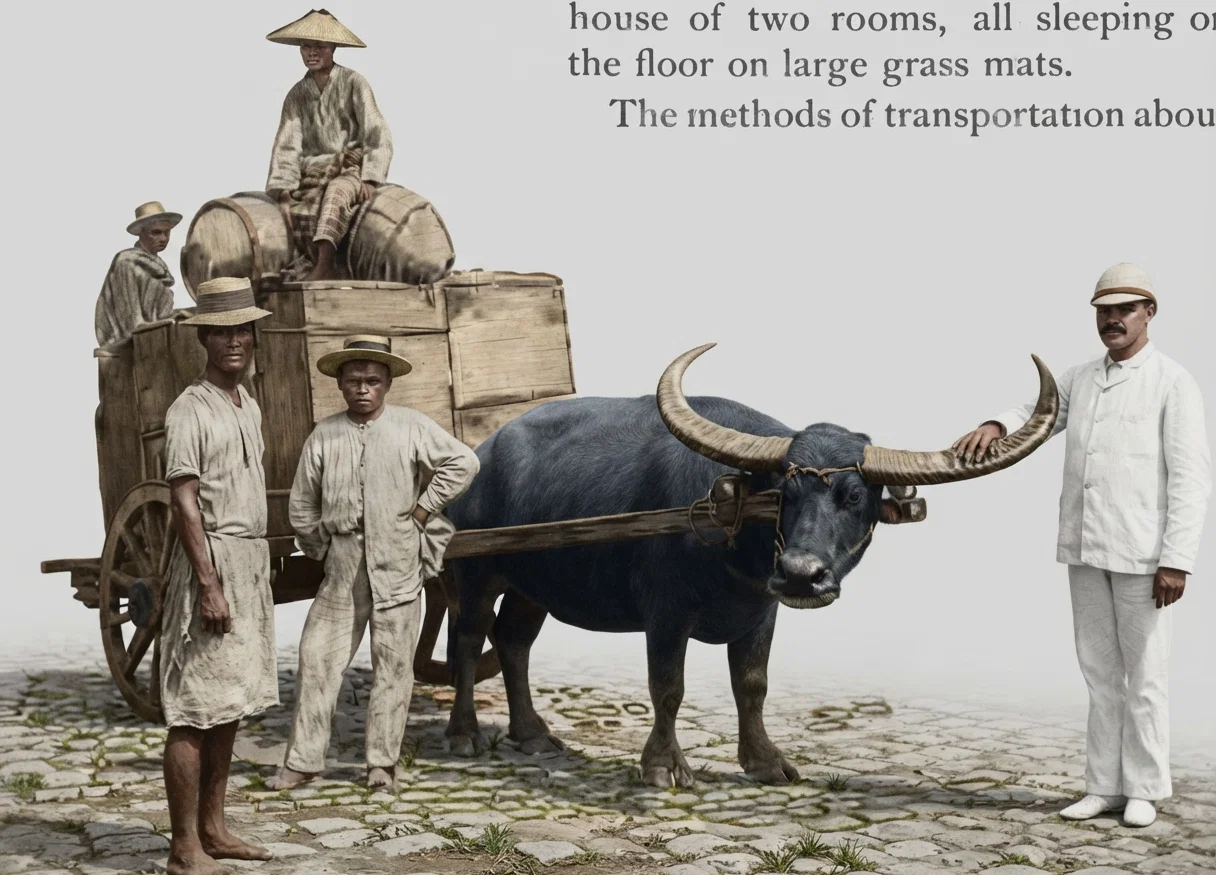
The city of Manila is full of interesting sights to one arriving from the Western world. The oriental customs, the queer-looking vessels, small boats, or bancas, the peculiar-looking little horses and cabs, or caromata, the huge water buffaloes yoked up to carts, the narrow streets, low, flat-roofed buildings with large, open windows and wide verandas, large cathedrals, stone bridges, etc.—these all lend enchantment to the American.
The city is divided into two parts by the Pasig River. That portion on the south is called the Walled City, or Old Manila; that on the north, the New City. The New City is more modern in its appearance; the streets are wider, and the buildings are of more modern structure. Most of the business is transacted in the New City. It contains all the large warehouses, factories, shipping quays, wharves, and railways. Many English, German, and Spanish firms do a large wholesale business with the entire world. They import foodstuffs, hardware, and clothing, etc., to the amount of $25,000,000, and export tobacco, hemp, and lumber, to the amount of $35,000,000 annually in Mexican currency.
The streets are quite narrow, and paved with large flat stones. The sidewalks are usually of stone, in many places not more than three feet wide. The Escolta, the principal street in Manila, is about sixty feet wide, and has sidewalks about six feet in width. All the principal retail stores are here. You find representatives of all nations vending their wares.
One can spend days sightseeing in the large bazaars. They contain most beautiful decorative art, curios from India, China, Japan, Ceylon, Egypt, rare silks, jewels, and precious stones.
The buildings are low and flat, and in the central part of the city they are mostly built of stone, and roofed with sheet iron or tile. They are rarely over two stories in height. The walls are often four to six feet thick; the floors are of tile. The large, cool verandas, with wide, open windows having no glass, but sliding shutters of wood, or thin, transparent shell set in panels, draws one's attention to them with much interest. These buildings are occupied as stores and residences by the European population of the city.
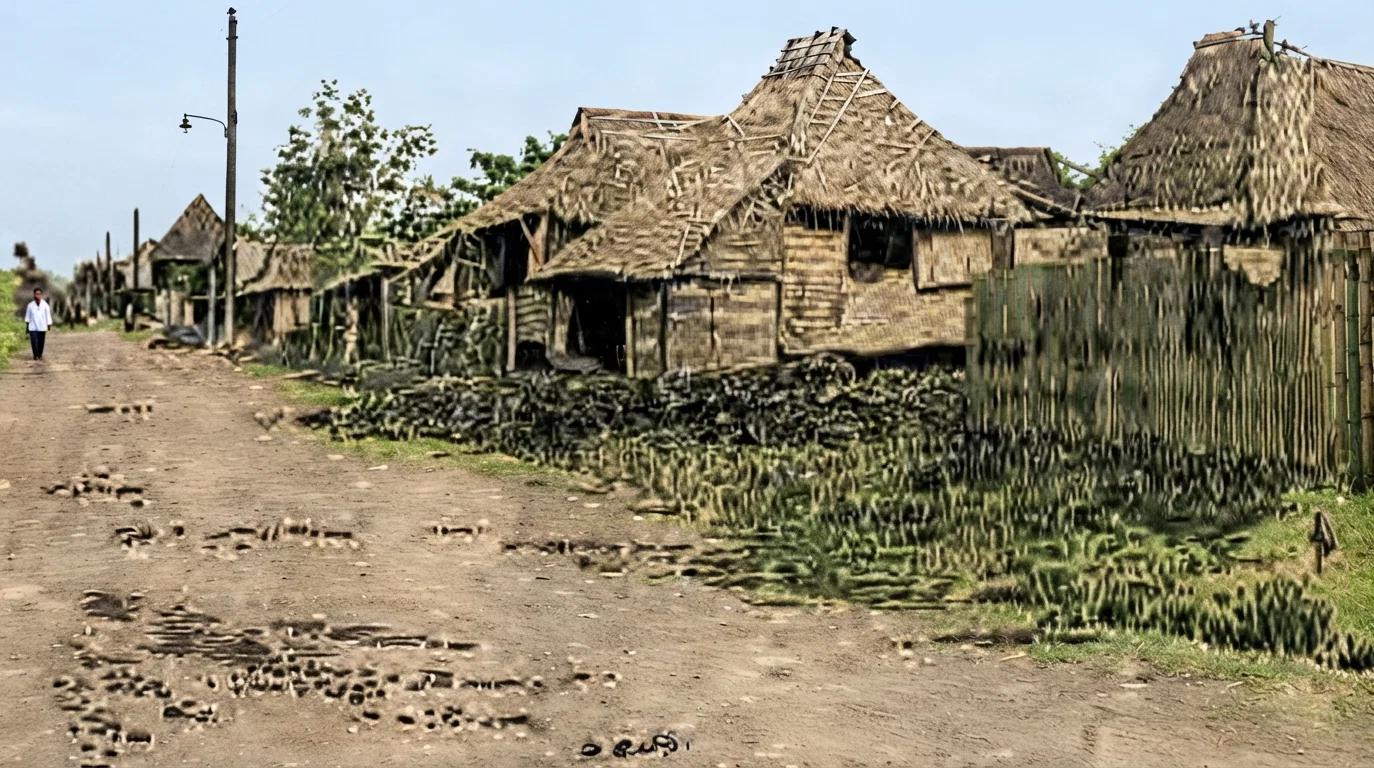
In the suburbs the streets are very narrow, and rarely if ever paved, but usually nothing but the black, sticky soil, which, during the rainy season, forms nothing less than a quagmire. The houses are small, built up four to six feet from the ground, with no sewerage. The main body of the building, or shack, is built of bamboo poles, the sides and top being made of nipa thatch, and the floors of split bamboo. Quite often a whole family, consisting of perhaps eight or ten persons, will live in one small house of two rooms, all sleeping on the floor on large grass mats.
Caraboo and Native Cart.
The methods of transportation about the city are unique. The street-cars, which are small affairs, are entirely open on the sides, with roller curtains of many colors, which serve as a protection from the scorching heat and rain.
The cars are drawn by two small native ponies, a little larger than a Shetland pony. The conductor sells tickets for two cents a section, which is about a mile; then an inspector goes through the car and punches each ticket. The road beds are poor, and the little ponies are often overloaded, and it is not an uncommon thing to see them balk and throw the car off the track.
The small native canoes, or bancas, are used as a means of conveyance to go up and down the river from one part of the city to another.
The caromata, a small, covered, two-wheeled carriage or cart, is a much-used vehicle. The driver sits on a small box seat, and it is drawn by one of the small ponies previously described. You can hire this for twenty cents an hour. The fare is regulated by the government; each driver has a license and number for his caromata. The caromatero is always looking for a new arrival. If he can succeed in getting him into his caromata, he will take him through the most tortuous route possible before landing him at his final destination, and will then demand a most exorbitant sum for his services; and it is often with great difficulty that one gets rid of him.
A Street in the Suburbs of Manila.
The Pasig River is spanned by many massive bridges, one a wire suspension of modern construction, the rest being of stone.
In the northern portion of the New City the Chinese quarters are located. The Chinese control most of the markets and do about all the retail trading with the Filipinos, as well as some wholesale business. In the streets you will see little booths, with gaudy-colored awnings, containing dry goods, jewelry, shoes, rice, nuts, fruit, drinks, cigars, cigarets, etc. These are usually attended by women.
Since the American forces have been in Manila, several hundred saloons and restaurants have been opened. Here the American soldier spends his monthly salary, oftentimes in advance.
Up to July 1 one firm had sold 21,000 barrels, or 2,100,000 bottles, of beer alone, not counting the other intoxicants. The smoking of cigars and cigarets is a universal habit with both woman and man in the Philippines. The La Insular Factory, one of the establishments manufacturing these goods, employs about two thousand men and women.
After looking over the New City, one takes a caromata, crosses the bridge of Spain, and starts for the Old City. As you cross the river looking west, you can see the shipping wharves and vessels discharging their cargo. All of this is done by hand, by cooly and Filipino labor. On the south side of the river the government coal-yards may be seen.
After leaving the bridge you drive over a smooth road for a quarter of a mile, when a great mass of stone looms into sight. Drawing near you see that it is a huge stone wall surrounding the Old City. In the early history of Manila this wall was erected as a protection to the Spanish against the hostile tribes of the islands. Of recent years it has served as a protection against the insurrection. This wall is surrounded by a huge moat, some places being seventy feet wide and quite deep, and so arranged that it can be filled with water at any time. At the present time the wall11presents quite a picturesque appearance, its ponderous gates, moss grown with age, covered with vines and lichens, studded with sentinel towers, and bristling with old brass cannon. The wall itself is from thirty to fifty feet high, and about forty feet thick. The interior is cavernous, divided into cells, and during Spanish rule was used to imprison those who were enemies to the Spanish crown and who would not sanction the actions of the dignitaries of the Catholic Church. If these old walls could speak, they could tell a tale of persecution, of murder, and starvation. Women and men were confined within the cold, damp walls for years because they would not submit to the wrongs perpetrated against them by the church and State. When the American forces entered Manila, in August, 1898, some fifteen of these poor unfortunates were liberated, many of them women, one who had been in those dark cells among the bats and beetles for eight years, because she would not submit to the belief and teachings of the Catholic Church. Passing through the Isabelle gate, the city comes in view. You do not hear the noise and bustle that there is in the New City. Often no one except a dreamy sentinel walking his beat at the gate is seen.
These are the old Spanish quarters. The streets are narrow, and paved with rock. The houses, usually of stone, are painted white, have low, flat tile roofs, and, the windows being covered with iron bars, remind one of a prison. It is here many of the old churches are located. After the fall of Manila, they were used as quarters for Spanish prisoners of war, some of them being large enough to shelter three thousand. The Spanish arsenal and all the government buildings are here.
The palace, as it is called, is about the middle of the city. It is a large stone building, with wide, winding stairs, beautiful tile flooring, high ceilings, and magnificent carved-wood furnishings. The corridors are filled with statuary, and the walls decorated with paintings. At the present time the building is used as headquarters for the U. S. Army.
Passing through the city to the western gate you emerge upon a beautiful driveway, called the Luneta. Going south you pass the band stand and promenade grounds, then into Ermeta and Malata, and through the suburbs, and finally reach Paco Cemetery, with its high walls and multiple vaults.
Cavite, fifteen miles from Manila, is used as a naval station. The American fleet is anchored a mile or more off the quay. The sunken Spanish fleet is in plain view, half submerged.
The suburbs of Manila are occupied almost entirely by the Filipino population. During the present insurrection they have all been laid waste, the houses burned, and the land uncultivated, the population either going back into the interior with Aguinaldo's retreating army, or coming into Manila in a peaceable manner.
One can not realize the desolation war brings upon a land until he experiences what it has brought upon the once peaceful and fertile Philippines. EUGENE G. WOOD.