WHEN Jesus Christ gave Himself up to the mob in the Garden of Gethsemane, He was taken before the priests, from whom He had a right to expect just and merciful treatment. The office and profession of the priest not only required him to be just, but also to "have compassion on the ignorant, and on them that are out of the way." Heb. 5:2. But Christ had spoken against their traditions which had among the people made void the Word of God. He had denounced hypocrisy and sin of which they were guilty. They had endeavored, and failed, to answer Him; and instead of accepting the truths which He taught, and bringing their lives into harmony with them, they turned in bitter hatred toward Him who had spoken in love. They determined to destroy Him who had come to save them.
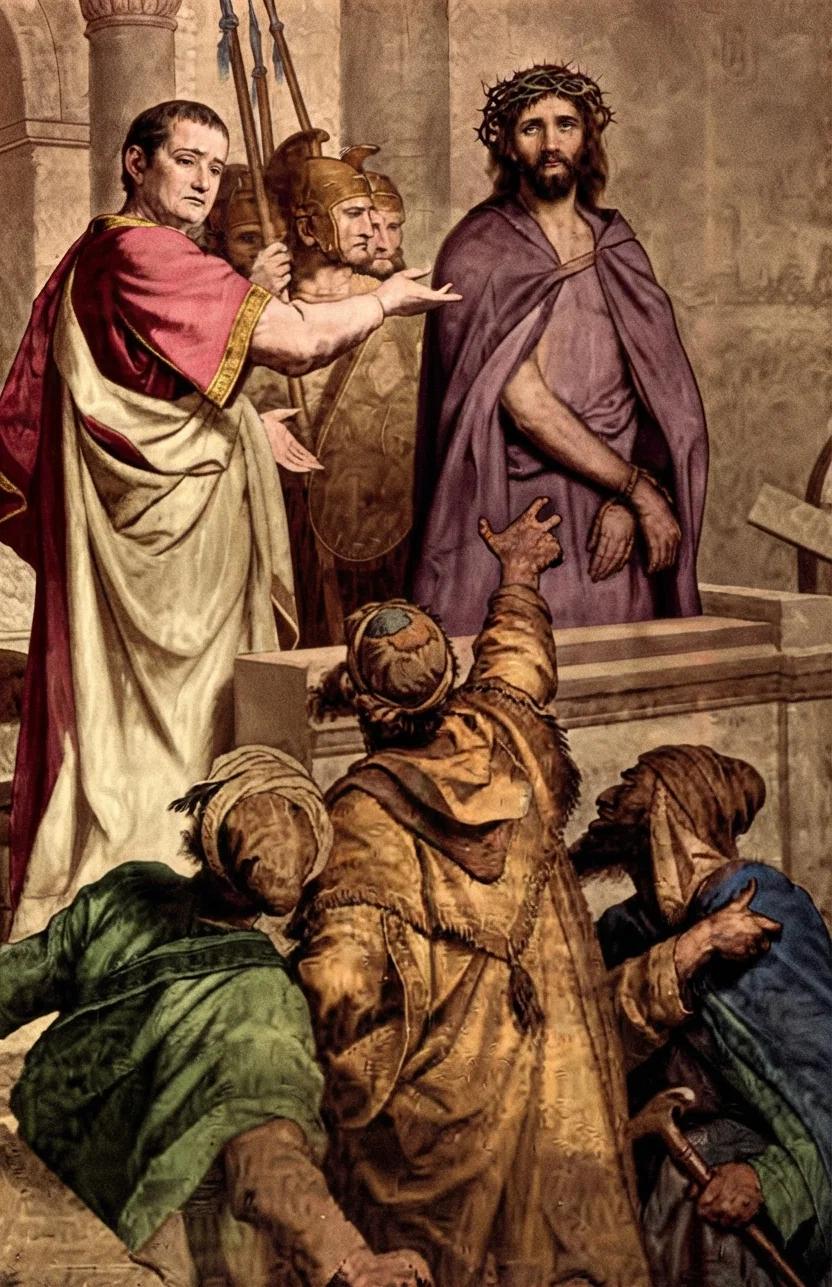
Hofmann Christ and Pilate. "Behold the Man," says Pilate; and in Him behold every other persecuted man for whom that Man stood. Might then seemed triumphant, and priests and Pilate in power; but the Man knew then, as His followers now may know, that in Right is Might eternal.
The blind prejudice of these priests had driven from their hearts all sense of justice and mercy. "And the men that held Jesus mocked Him, and smote Him. And when they had blindfolded Him, they struck Him on the face, and asked Him, saying, Prophecy, who is it that smote Thee? And many other things blasphemously spake they against Him." Luke 22:63-65. The servants were allowed to strike Him with their hands, and spit upon Him. Mark 14:65. This treatment continued through the night. "And as soon as it was day, the elders of the people and the chief priests and the scribes came together, and led Him into their council. . . . Then said they all, Art Thou then the Son of God? And He said unto them, Ye say that I am." Luke 22:66, 70. With this they said, "He is guilty of death." Matt. 26:66.
Such blind bigotry and injustice, which seem almost inconceivable, had come to those men because they had refused to accept the truth which had been taught them by Jesus Christ, altho He taught them from the writings of Moses, in which they professed to believe.
Like Causes, Like Effects
The same causes will produce the same effects, in any age, among any people. In 2 Thess. 2:10-12 it is predicted that just before our Lord comes the second time, there will come upon a class a "strong delusion, that they should believe a lie," because they would believe "not the truth," because they would not receive "the love of the truth." Evidently some message of truth will be given to the world at that time, and to reject it is to go into darkness, believe a lie, and be lost. Let each one ask, "Lord, is it I?"
The priests and elders of the people, together with the council, had fully determined to have Christ put to death. But they had no power to take life. The civil government of Rome had reserved this authority to itself. It was therefore necessary, in order to carry out their purpose, that they get Pilate, the Roman governor, to sentence and execute Christ. "And the whole multitude of them arose, and led Him unto Pilate." Luke 23:1. They then "accused Him of many things." Mark 15:3, 4. To these charges Pilate seems to have given no special attention, except to the one that pertained to the kingdom. The accusers said, "We found this Fellow perverting the nation, and forbidding to give tribute to Caesar, saying that He Himself is Christ a King." Luke 23:2. Pilate, learning that Jesus was a Galilean, and being willing to rid himself of the responsibility of deciding His case, sent Him to Herod of Galilee. Herod, when he had asked Him some questions, and received no reply, mocked and scourged Him, and sent Him back to Pilate. When Pilate saw that he must hear the case, he was disposed to give Jesus a fair trial, and therefore he asked Him, "Art Thou the King of the Jews?" Jesus asked him if he asked this question for his own information, or because of what others had said. Pilate answered, "Am I a Jew?" By these words he meant to disclaim all personal interest in the matter of who was "King of the Jews," as he was not one of that nation. Then he told Jesus that His own nation had delivered Him, and made the charge against Him. In our Lord's answer, while admitting His future kingdom, He said, "My kingdom is not of this world: if My kingdom were of this world, then would My servants fight, that I should not be delivered to the Jews." Jesus declared that He had come into the world to "bear witness unto the truth," and "that every one that is of the truth heareth My voice."4
Pilate acquitted Christ of every charge that was made against Him, and said, "I find in Him no fault." John 18:33-38.
The Two Kingdoms
While Christ admitted His future kingdom, He defined the character of His kingdom clearly; and Pilate saw that it was entirely distinct and separate from that of Caesar. Christ's kingdom was not of this world. Caesar's was worldly in every detail and particular.
Christ's kingdom stood a witness for truth, Caesar's was to carry out his own will, right or wrong.
Christ's kingdom was ruled by love — no fighting, no contention, no strife either in it or for it. Caesar's was built up and maintained by oppression, strife, and the sword.
Pilate could see that Christ was not seeking to obtain the throne of Caesar; He did not want that kind of kingdom.
It was plain that the subjects of Christ's kingdom could dwell in the kingdom of Caesar, and be a blessing to it, tho it was oppressive to them.
The nature of Christ's kingdom was manifested before Pilate in the conduct of its King. In His trial He made no defense. No witnesses were called to testify in regard to His teaching or work. No lawyers were engaged to break down the testimony of the false witnesses who witnessed against Him. No pleadings were offered in His behalf. The accusers were allowed to bring any charge, and any kind of evidence, unquestioned. "He was oppressed, and He was afflicted, yet He opened not His mouth: He is brought as a lamb to the slaughter, and as a sheep before her shearers is dumb, so He openeth not His mouth." Isa. 53:7.
In the ministry of Christ during the years that were past, He had carefully guarded His work, and sought for the most favorable opportunities to teach the people. He invited all to follow Him, but never forced any to do so.
Christ and His kingdom are the same to-day as when He was on trial before Pilate — the kingdom of love.
Caesar's kingdom, civil government, is maintained by force and the power of the sword to-day, the same as in the days of Herod and Pilate.
Spiritual Fornication
For the church to unite with earthly governments is to forsake Christ. It is spiritual fornication to be "unequally yoked" with an unbelieving power.
The Holy Spirit is promised to give force and power to the teaching and work of the church. To use the power of civil authority for that purpose, is to reject the work of the Holy Ghost. To call upon civil government to enforce a sabbath, or any other purely religious institution or precept, is to put that government in the place of God to the church. The church has not been authorized to force, drive, or compel men, but "knowing . . . the terror of the Lord, we persuade men." 2 Cor. 5:11. To do otherwise is to deny them their God-given liberty and freedom of conscience.
Jesus taught us to say to our Father, "Thine is the kingdom, and the power." To call upon the kingdoms of men for power to sustain the church and enforce its teaching, is to turn from and deny the kingdom and power of God. Not far hence, all the kingdoms of this world will be destroyed. They will be "broken to pieces together," and removed "like the chaff of the summer threshing-floors." Dan. 2:35.
When they that use the sword are destroyed, the power of the sword will perish. Jesus said to Peter, "Put up again thy sword into his place: for all they that take the sword shall perish with the sword." Matt. 26:52. Peter was using the sword in defense of his Lord when Christ said that all such should perish with the sword. They may not all be killed by the sword; but when Christ shall set up His kingdom, the sword will be forever destroyed. It will perish with earthly powers that trusted in it; and all, in the church or out, who have trusted in the sword, will then perish with it; while those who have trusted in God's truth and love, and the power of His Holy Spirit, will hear the glad words, "Come, ye blessed of My Father, inherit the kingdom prepared for you from the foundation of the world."