THE Johnston Sunday Bill for the District of Columbia is very similar, both in its phraseology and in its leading provisions, to the old Maryland Sunday law of 1723, which was incorporated into the laws of the District by act of Congress in 1801, when the District became the permanent seat of the National Government. This will be apparent from a brief comparison of the two.
One, the Maryland law, prohibits “bodily labor on the Lord’s day, commonly called Sunday;” the other, “labor at any trade or calling” on “the first day of the week, commonly called Sunday.”
One prohibits “unlawful pastimes and recreations;” the other, “any circus, show, or theatrical performance.”
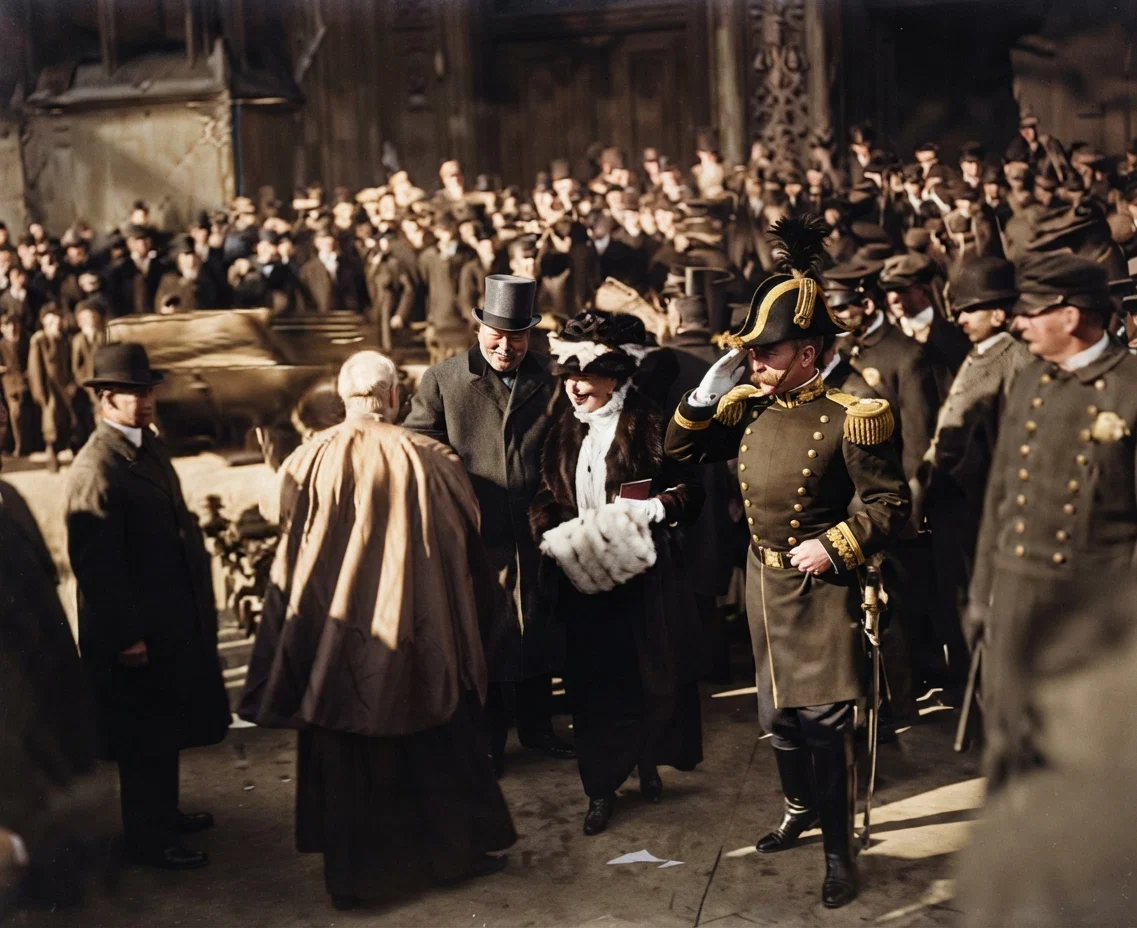
A photograph of President Taft, Mrs. Taft, and Major Butt, arriving at St. Patrick's Church, Washington, for the Thanksgiving mass
One prohibits any one to suffer his “children, servants, or slaves . . . to do any manner of work or labor on the Lord’s day, works of necessity and charity always excepted;” the other forbids any one to “employ, or cause to be employed, his apprentice or servant in any labor or business, except in household work or other work of necessity or charity.”
One forbids any one to “profane the Lord’s day;” the other requires that all shall observe one day in the week, preferably Sunday, “as a Sabbath.”
One provides a fine of “two hundred pounds of tobacco,” or in default, “three hours in the stocks” or “thirty-nine lashes;” the other, a fine of ten dollars, or ten days’ imprisonment, or both.
Neither requires church attendance; but both are religious, and assume to prescribe religious and not civil duties.
January 21, 1908, the old Maryland law was set aside by the District Court of Appeals as “obsolete;” as prescribing “religious and not civil duties,” and therefore unconstitutional; and as “the outgrowth of the system of religious intolerance that prevailed in many of the colonies.” This being so, what can the enactment of the Johnston Sunday Bill, so similar to it, be but the revival of that system of religious intolerance, and an attempt once again, and this time by the National Government itself, to enforce religious duties upon men by law?
Already in no fewer than seventeen of the forty-eight States of the Union, Sunday laws have resulted in oppressing conscientious observers of another day. Even in States, as in Arkansas, where they were exempt from the provisions of the law, the exemption has been repealed, and they have been singled out as special objects of attack, and made to suffer unjustly. From 1885 to 1896, under a revival of Sunday enforcement, over one hundred Seventh-day Adventists in this country, and about thirty in foreign countries, were prosecuted for quietly going about their work on Sunday, resulting in fines and costs amounting to $2,269.69, and imprisonments totaling 1,438 days, and 455 days served in chain-gangs. If such proceedings are possible and have actually occurred under existing Sunday laws, why may we not expect similar results to follow the enactment of a national Sunday law?
The Exemption Clause Examined
The exemption, in the first section of this bill, for observers of another day, contains what may properly be styled the first step toward intolerance. It reads as follows:
Provided, That persons who are members of a religious society who observe as a Sabbath any other day in the week than Sunday shall not be liable to the penalties prescribed in this Act if they observe as a Sabbath one day in each seven, as herein provided.
This exemption places the Government of the United States in the attitude of assuming the right to compel all to observe Sunday as the Sabbath, but of permitting those who observe another day, not to do so — to labor on that day, — a right which they already possess without such permission. This is simply of the nature of toleration. But while, from INTOLERANCE, toleration is a step toward LIBERTY, conversely, from the standpoint of LIBERTY, our present standpoint, it is equally true that toleration is a step, the first step, toward INTOLERANCE. According to Madison and other founders of our National Government, freedom in religious matters is “something which every man may demand as a RIGHT, not something which he must ask for as a PRIVILEGE. To grant to the State the power of tolerating is implicitly to grant to it the power of prohibiting,” whereas the founders of this Government denied to it “any jurisdiction whatever in the matter of religion.” See Appleton’s “Cyclopedia of American Biography,” volume 4, page 165.
There is a vast difference, therefore, between TOLERATION and LIBERTY. It is for the latter that we plead. An exemption of this kind is class legislation, and a permission which may easily be withdrawn. In enacting its “Lord’s Day Act” of 1907, the Canadian Parliament, at the urgent solicitation of certain church elements, refused to insert an exemption of this kind in the act; and according to a report in the “Literary Digest” of October 3, 1908, the efforts of the Federation of Sunday Rest Associations of America to secure a Sunday law for the District of Columbia, were accompanied with a request “that no exception be made on account of religion.” From this it is evident that tho the Johnston Bill should pass with this exemption in it, it would not be in accordance with the ideas and wishes of those most desiring it, and that, sooner or later, the exemption would in all probability be repealed.
Even where such exemptions exist, they are not always respected. The Sunday law of Virginia contains a very plain exemption for conscientious observers of the seventh day; and yet in October, 1910, an observer of this day at Colonial Beach was hailed into court by a prejudiced neighbor for performing a little piece of work on Sunday which his employer, an observer of Sunday, had requested him to perform then, and fined.
From still another standpoint this exemption in the Johnston Sunday Bill condemns it as out of place in civil legislation. Its very presence in the bill is a virtual acknowledgment of the fact that without it the measure would come in conflict with the conscientious convictions and the religious observances of a certain class of citizens. This of itself is sufficient proof that the measure is religious, and therefore improper legislation for Congress.
An Attempt to Settle a Religious Controversy by Law
Moreover, as pointed out in both the Sunday Mail Reports adopted by Congress in 1829 and 1830, the enactment by Congress of any law of this kind would be an attempt to settle by law a religious controversy “in which good citizens may honestly differ in opinion,” and “in which even Christians themselves are at issue,” and to determine and define by human law “what are the laws of God.” As to the results of such attempts, these reports significantly say that “the catastrophe of other nations furnishes an awful warning;” and they add:
If the principle is once established that religion, or religious observances, shall be interwoven with our legislative acts, we must pursue it to the ultimatum. We shall, if consistent, provide for the erection of edifices for worship of the Creator, and for the support of Christian ministers, if we believe such measures will promote the interests of Christianity.—Senate Report of 1829.
If a solemn act of legislation shall, in one point, define the law of God, or point out to the citizen one religious duty, it may with equal propriety proceed to define every point of divine revelation, and enforce every religious obligation, even to the forms and ceremonies of worship, the endowment of the church, and the support of the clergy.—House Report of 1830.
Such are the logical results, and history shows that such are the actual results, of enacting Sunday laws.