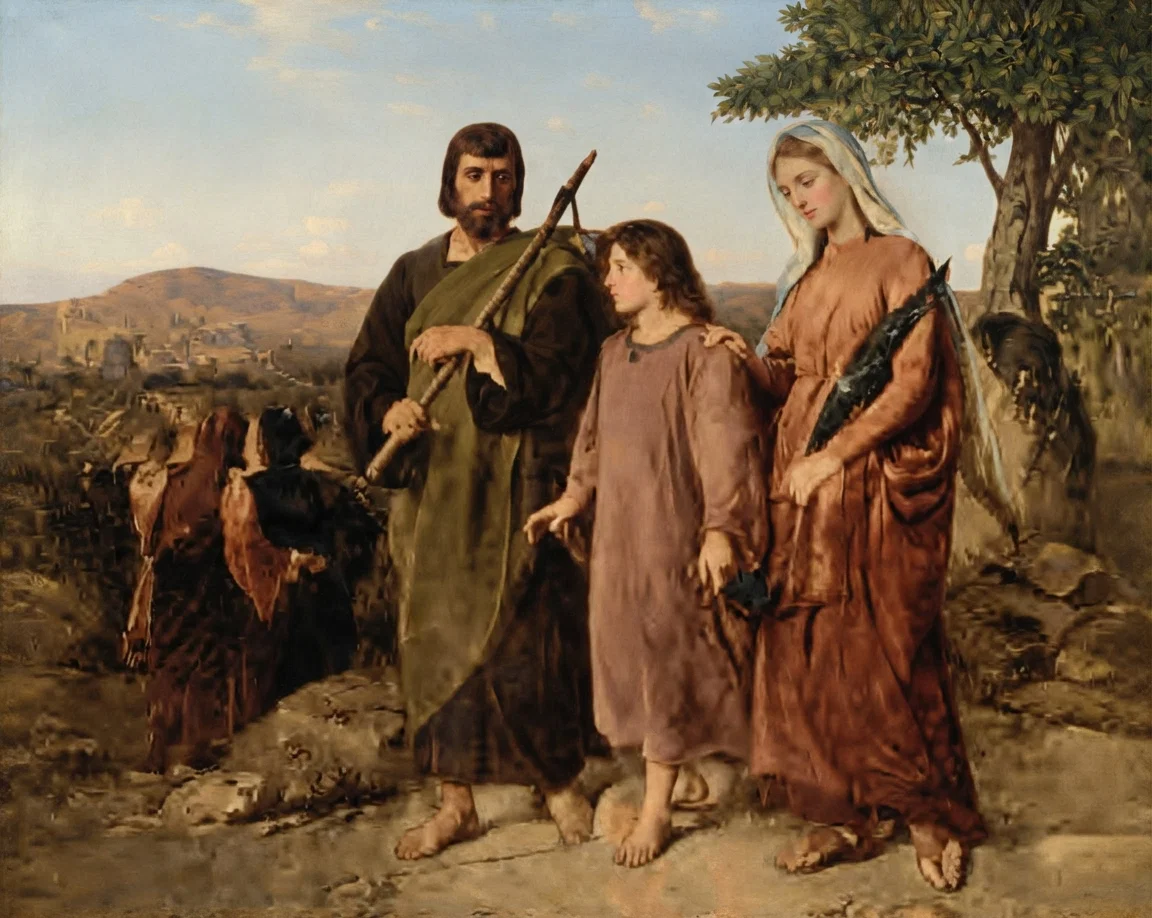
EDITORIAL

5%

Pacific Press Publishing Association · Mountain View, California · Aug 20, 1912

FromSigns of the Times, Vol. 39, No. 32.

Read the full edition

EDITORIAL

Up to Jerusalem

IT was customary for the devout parents of Jesus to attend the Passover at Jerusalem every year. Luke 2:41. They seem to have been careful to observe all the commandments of the Lord, both moral and ceremonial. When Jesus was twelve years of age He went up to Jerusalem to the Passover. According to Jewish custom, a boy became "son of the law" at the age of thirteen, or in his thirteenth year. As a son of the law, in His thirteenth year Jesus attended the feast with His parents. Henceforth He was peculiarly responsible to God. He must meet the obligations required of those older, but He was yet subject to His parents.
SUCH a time must have been of great interest to the religious boy. He was awakening into manhood—He was no longer to be the child, but was to play the man before God. He would go up to the great annual feasts with His parents, and be received as one who would be reckoned in the future as a true Israelite.
To JESUS this must have meant much more than to ordinary boys. His absorption of the sacred books of the Scriptures made the occasion of more than ordinary interest. Quirinus was now Roman governor of Syria. Coponius was procurator at Jerusalem. Annas was high priest. The times were quiet. There were no local wars or uprisings. The entire journey could well be given to conversation and meditation on the purpose and object of the Passover gathering.
WHAT that journey must have meant to the active, fertile mind of the Boy, versed in Jewish history, can only be faintly imagined. He passed through the great plain of Jezreel, or Esdraelon, famous for the victories of Gideon and Barak, and the defeat and death of good King Josiah. Away over to His right, as the company journeyed southward, Mount Carmel reared its head on the western shore of Palestine, by the "Great Sea." Here God had wrought mightily through the great prophet Elijah. At His left arose Mount Tabor, whence
Barak descended to fight Sisera with his nine hundred chariots of iron. A little later He crossed the ancient river Kishon, the swift waters of which swept away the chariots and forces of the Canaanite general, who himself was slain by Jael, the wife of Heber the Kenite. Jesus doubtless called to mind, "The stars in their courses fought against Sisera." He crosses the ground where God wrought with Gideon and his three hundred men. Here His heart must have turned to sadness as He recalled that in this very valley, also, good King Josiah had been killed by Pharaoh-Nechoh. It was a step in the downfall of Judah because of their sins. At His left Mount Gilboa would remind Him of the utter defeat of Saul and Jonathan, the disastrous result of Israel's choice of king.
ON THE WAY TO JERUSALEM
THE BOY recalls, as they pursue their journey southward and pass in sight of Dothan, the faithful Joseph's career, and also the prophet Elisha. Later He leaves at His right Samaria, built by wicked King Omri, capital of the kingdom of the apostate ten tribes with their awful history of disobedience and destruction. He passes through Shechem, prominent in Israelitish history since Abraham built there an altar, and Jacob in that vicinity dug his famous well. In the days of our story it was the headquarters of the Samaritans, as it is today. The Boy and His company pass between Ebal and Gerizim, the "mount of blessing" and "mount of cursing," from which the blessings and curses of the law were rehearsed to Israel shortly after their entrance into the promised land.
HE leaves Shiloh, with its story of that famous boy prophet Samuel, to the left, full of the memories of the checkered history of God's people connected with that one-time center of worship. Later the company pass through Bethel, "House of God," forever made famous in Jacob's experience of discouragement and dream. There were many other places of historic and sacred interest, which we have not space to enumerate.
AND then comes Jerusalem, with the glorious marble temple for its center. The company in which Jesus traveled has now, doubtless, been swelled by many others as the city is near. Joyfully they converse, or chant the "Psalms of Ascent" (120-134)
to the accompaniment of the flute, awakening their souls to the true spirit of worship, as they near the Holy City.
"I was glad when they said unto me, Let us go unto the house of Jehovah." "They that trust in Jehovah Are as Mount Zion, which can not be moved, but abideth forever. As the mountains are round about Jerusalem, So Jehovah is round about His people From this time forth and forevermore."
IF our readers will peruse these psalms, meditate upon them with their ancient use in mind, they will appreciate in their own souls how the fountains of spiritual truth in the hearts of the devout must have been
stirred to their depths as these inspired songs were chanted with the holy city in sight, crowned with the symmetrical temple of marble and gold, "which could hold within its gigantic girdle not fewer than 210,000 souls."
DID the spiritual nature of the Boy Jesus discern all the shallowness of this worship in general? We do not know, but we believe that it did. Never since Solomon's time was the worship more elaborate, the appointments of the temple more ornate and gorgeous. But never, even in Solomon's day, had ritualism and form so dominated and absorbed the controlling elements among the Jewish people. The traditions of the fathers were making void the commandments of God, and the deeper meanings of God's worship were obscured by the selfish rulers who were seeking honor and glory for themselves.
“’Tis not the broad phylactery, the stubborn fast, the stated prayers, that makes us saints.”
THE BOY, reared in the greater simplicity of Galilean life, with reverence for the Word which had been written in His heart from babyhood, must have discerned it all. He must have seen that the saving from Egyptian bondage which the Passover commemorated meant salvation from the heavier, more accursed bondage of sin; that if the sin were not repented of, the sprinkling of blood availed nothing—the doom of Egypt’s first-born would be the fate of all of Israel, God’s first-born tho they were called, who identified themselves with sin. In a few short years from the time when the Boy visited Jerusalem, He would be taken from that city to die, a criminal because of His loyalty to God.
THAT time and those days have mighty lessons for the professed Israel of God in these days. Heart-holiness, acceptance with God, do not depend upon great wealth, massive structures, costly temples of worship, elaborate, ornate ceremonials, robed and mitered priests, learned and critical exegetes, hoary human traditions. Union with God is not found in these. Life eternal does not flow from such broken cisterns, and rarely do such things become the channel through which that life flows. Oftener such traditions bind the soul to the narrow, cramping, crushing, dead forms, put out his eyes to the glory of the simple truth, make void the commandments of God that tradition may be observed; and in consequence the power of the human,—persuasion downward or coercion by civil power,—is substituted for simple faith in the Word of God and loyalty to the person and teachings of our Lord Jesus Christ. He, “the Word made flesh,” is all-sufficient, but He must become incarnate in us. His life must take the place of our life, His law of righteousness and life our law of sin and death, His interests ours, His business our business. In other words, the Spirit and Word of the Infinite must possess us, not cramped, fettered, crushed, by outer forms of men, but molding and shaping all our outward conduct. Even thus may we all journey, not to an earthly Jerusalem soon to be destroyed by the Roman, to be desecrated by the Mohammedan, but to the city of the great King, eternal as its Maker, and where her “children shall be all righteous,” and inherit God’s kingdom forever. W.