The financial problems of this time are creating as much discussion as anything before the world. The “trusts,” the “big interests,” the “money power,” etc., are terms that have become very common, and form the basis of a great deal of discussion both from the rostrum and through the press. How to deal with the great problems of business and finance was one of the leading factors in dividing the Republican Party into the “Progressives” and the “Stand-patters.” It was this same question that split the Republican Party in its recent convention in Chicago, and laid the foundation for the new National Progressive Party that is just being formed. It was around the problems of business and finance that the most heated discussions of the Baltimore convention centered. Mr. Roosevelt, in his speech before the National Progressive convention in Chicago, which speech was supposed to sound the key-note of the new party, devoted most of his time and thought to questions that are purely economic, and that therefore radiate from the financial and business problems that are before the world.
This discussion is not confined to America. The same problems, altho with slightly differing conditions, are confronting England and France and Germany, and practically all of the rest of the civilized world.
In view of the fact that these problems and issues are world-wide, and that they are uppermost in the discussions of the time, and in view of the further fact that it is admitted on every hand that unless they are settled properly we will have world-wide revolution in consequence, has it ever occurred to you that such momentous and such far-reaching questions might have crossed the vision of the ancient prophets? It is quite universally conceded that the difficulties that center in the question of finance in this time present a menace to the world greater than anything that has appeared in past history. In this connection let us read a few short verses from the Bible, using the American Standard edition: “But know this, that in the last days grievous times shall come. For men shall be lovers of self, lovers of money, boastful, haughty, railers, disobedient to parents, unthankful, unholy, without natural affection, implacable, slanderers, without self-control, fierce, no lovers of good, traitors, headstrong, puffed up, lovers of pleasure rather than lovers of God; holding a form of godliness, but having denied the power thereof: from these also turn away.” 2 Tim. 3:1-5.
Now observe that this prophecy is very definite and specific in a number of particulars. In the first place, it says that it applies in the “last days.” It says that in these last days “grievous times shall come.” The leading occasion for these “grievous times” is that men shall be “lovers of self” and “lovers of money.” Then self-love and money-love are to make the last days grievous.
This scripture has been in existence for over eighteen hundred years. It was woven in and out through the literature of the Middle Ages, as well as that of modern times; hence it is not fraudulently brought forward in these times and made to fit the case. It fits the case in hand accurately, but the striking part of it is that it was written more than eighteen hundred years ago. For all of these centuries we have been told that the last days would be grievous, because men in that time would be filled with self-love and money-love.
Observe, however, that there are many other important specifications that are to apply in the times when these men are filling the world with grievousness because of their selfishness and greed for money. These people are to be boastful. They will be telling of their mighty achievements, and of the wonderful things that have been accomplished through their mighty aggregations of wealth. They have been able to tunnel the mountains, build lofty structures, span the great rivers; and of this they are boastful. And the prophecy says also that they will be haughty, and railers; furthermore, they will be disobedient to parents, and unthankful, and unholy; they will be slanderers; they will be without self-control, fierce, and no lovers of good. Moreover, they will be “lovers of pleasure rather than lovers of God.” And with all these, they will still hold “a form of godliness,” but in their lives they have denied its power.
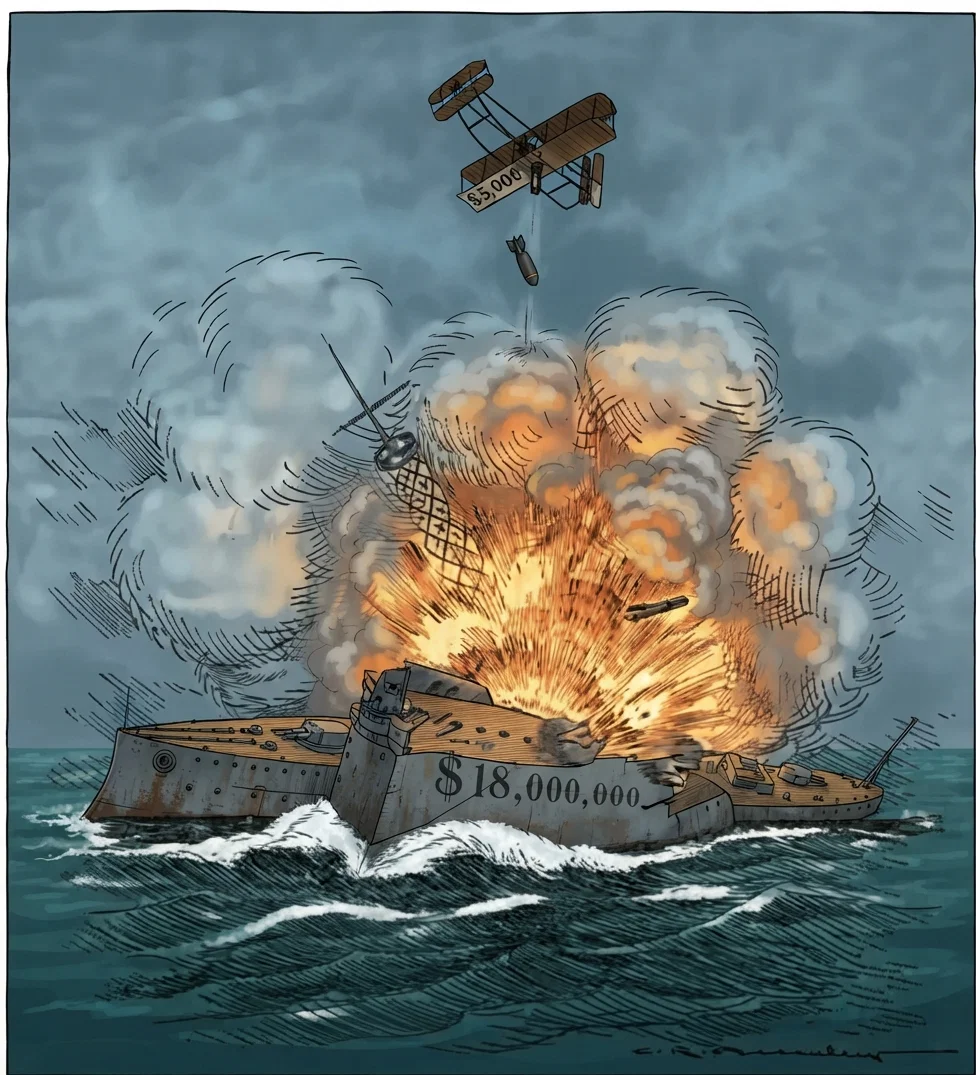
In the above illustration the artist shows how a $5,000 air-ship may drop a bomb that will destroy an $18,000,000 battle-ship. The air-ship may not be developed to the place at the present where it can do such a thing as this, but it is very rapidly approaching the degree of perfection and capacity that will enable it to do it. This is only one of the myriads of illustrations which serve to show the spirit of intensity that is in the world, driving men forward in the great struggles of war preparation.
Now notice particularly that this prophecy goes into detail in its description of the individuals who will make the last days perilous. It gives a list of some eighteen specifications of the men who will be doing the deeds that cause the grievousness and the peril. This prophecy calls for so much that not all can be fulfilled without definitely showing its accuracy and its divine truthfulness.
Let your mind run over the list of great financiers at the present time, and you will find that a large number of them are professedly Christians. Some of the most grasping and greedy of them even claim to be very devout. True, there are a few of them that hold to forms of skepticism, but in the main they hold the “form of godliness.” Doubtless many of them think that because they have hoodwinked the great mass of mankind, they will be able to deceive the Almighty; but this prophecy ought to make it clear to them, and to every one else, that they can not deceive Him, for He has had them described, and their description has been on record for more than eighteen centuries.
Now we ask every candid reader to study carefully this prophecy, and to note how marvelously it is fulfilled in these very times in which we live. Financial problems of the magnitude that are confronting the world to-day never confronted it before, and in the very nature of things never could, for we never had such colossal financial organizations. Individuals have owned great wealth in the past, but it remained for the American nation within the last hundred years to invent the creature of law known as the corporation, and then followed the trust, or combine, which organizes the corporations into one.
Next week we will give Scripture testimony which shows that other prophets have seen the same thing exactly that Paul saw as he wrote this letter to Timothy. And with these prophecies before us, and with the facts before us as they exist in the world to-day, there should be no question in regard to the times in which we are living. T.