TONGATABU

6%

Pacific Press Publishing Company · Oakland, California · Jul 15, 1897

FromSigns of the Times, Vol. 23, No. 27.

Read the full edition

TONGATABU.

The Friendly Islands consist of three principal groups, as follows: Tonga, in the south; Hapai, in the middle; and Vauvau, in the north, besides some less important groups, numbering in all about 100 islands, located between parallels 18° and 20° south latitude and meridians 173° and 176° west longitude, with a population of 20,438, all under the Tongan Government.
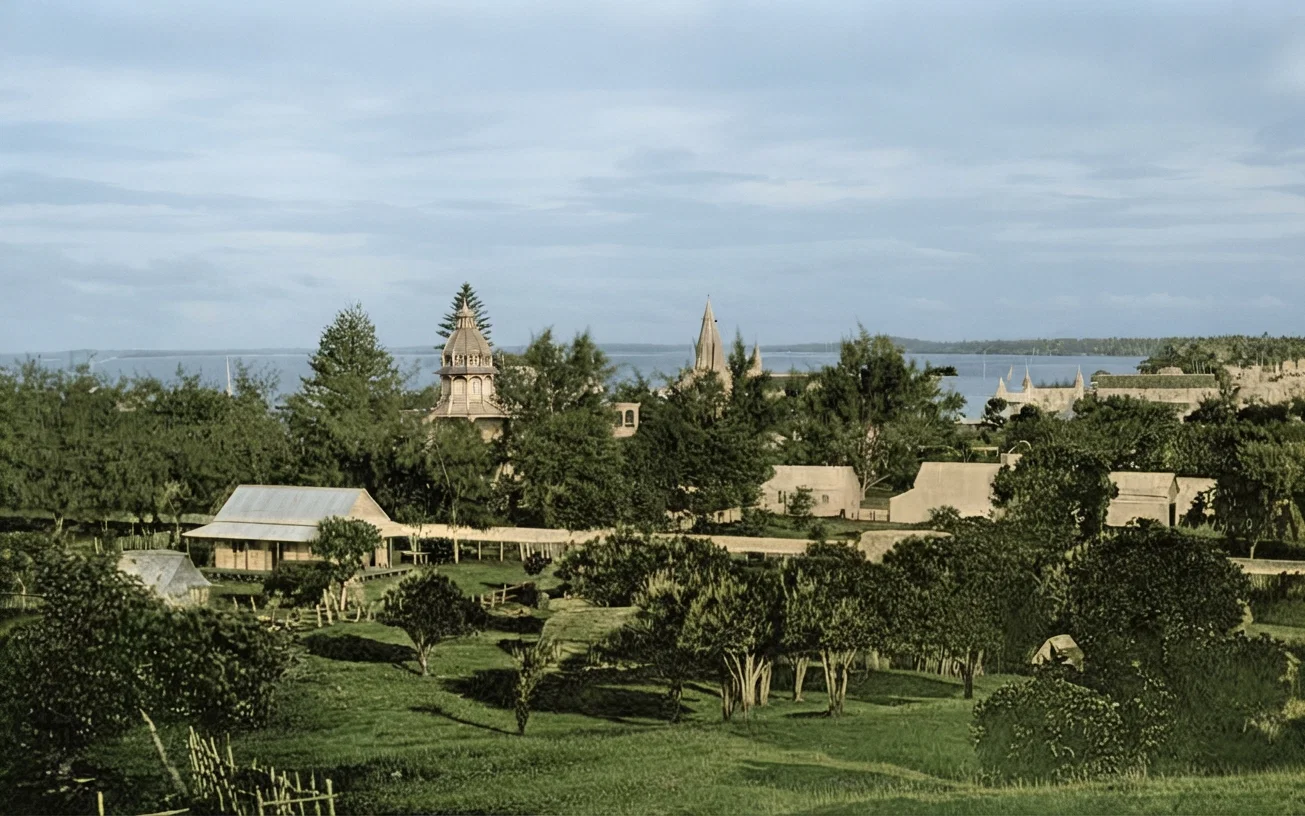
Nukualofa, on Tongatabu, the only inhabited island of the Tongan group, is the capital. As seen in the photograph, the village fringes the shore, while stately coconut palms form a beautiful background, but which do not appear in the picture. The cupola in the picture is on the king's palace, a wooden building surrounded by a neatly kept yard, inclosed by a wall seen in front. The spires are on the "King's Church," which is also a frame structure, well finished in modern style.
The eighteenth day of May was a day of special importance to the village of Nukualofa, and to the Tongan people generally, because on this day Parliament, the legislative body, convened and was formally opened by his majesty King George II., at whose opening address the Europeans and Americans had the privilege of being present by special invitation.
The Parliament consists of thirty-one nobles who inherit their position, subject to election by Parliament, and thirty-one representatives chosen by the people just before each session, which meets once in three years. Their term of office expires with the last meeting of the session.
There is here a government college for the sons of chiefs, in which the common branches, the English language, and some of the elementary sciences, are taught. Connected with the college is an orchestra, entirely of natives, which rivals the average orchestras of leading nations where opportunities and advantages in music are much greater.
The Wesleyans also have a college here well equipped, which admits both sexes. There is a Catholic school also, for both native and English children. Less than two years ago the Seventh-day Adventist missionaries started an English school, which gradually has grown in influence and increased in numbers. Recently the king determined to have all the children taught English, so the government erected a new schoolhouse and procured a teacher, thus adding another to the list of English teaching schools.
NUKUALOFA, TONGATABU, FRIENDLY ISLANDS.
The average Tongan child has a bright mind and learns very rapidly when his enthusiasm is aroused. We have been informed that nearly all the Tongans read their own language. They have schools in the different villages where the children are taught. They all live in villages.
All the South Sea islanders I have seen are fond of music, and the Tongans are no exception. Many of the natives I have heard, however, have a high, shrill voice, which strikes the ear as strained, with a rasping effect, lacking real resonance and melody. But not so with the Tongan voice. They simply open the mouth slightly, and, without any seeming effort on their part, volumes of music pour forth in cheerful sweetness. The deep, mellow bass bursts forth in swelling waves, then reverberates in echoes so soft and sweet, and bursts again in glad surprise, rivaling the noted bass of the "Old Tennesseeans."
Religiously the Tongans are divided between Wesleyan, Roman Catholic, and Free Church, a local organization modeled after the Wesleyan. Almost all the people attend church regularly, being members of the different churches, and seem to enjoy religious exercises and love the Bible. It is not an uncommon sight to see them reading the Bible on entering their fale (cabin), and frequently they will ask you to read and pray with them. One feels to rejoice in what Christianity has done for these people, when comparing this with their former condition.
At Hihifo, the west end of the island, are some large spreading trees, on which may be seen hanging, with heads downward, and moving their wings as if fanning themselves, thousands of flying foxes, a large species of bat. These creatures were once an object of worship, and the "great chief" of Hihifo feeds them at these trees, nor suffers them to be disturbed. The old chief has gone to his rest years ago, but the flying foxes still spend their days on the same trees, and fly off at night in search of food, returning with the dawn. They remain a testimony to the depth of darkness and superstition to which the "image of God" may be prostituted: "Because that, when they knew God, they glorified him not as God, neither
were thankful; but became vain in their imaginations, and their foolish heart was darkened." They "changed the glory of the uncorruptible God into an image," "the truth of God into a lie, and worshiped and served the creature more than the Creator." Altho they have turned from such gross idolatry, the great need so apparent in the islands—and not the islands only, but everywhere—is the vitalizing power of the Spirit of God, which works in men "both to will and to do of his good-pleasure." What is needed is not more profession, but more possession of the "power of God" working to his glory; for failure to glorify God and cherish thankfulness always leads to darkness and only darkness, whether in the tutored or untutored, and the darkness is in proportion to the light rejected. Also with darkness comes the inability to perceive one's true condition; so while spurning the gross forms of idolatry he may worship at another shrine equally fatal, congratulating himself that he is "not as other men are." There is a German adage something like this, "Good is the greatest detriment to the best." Having gone a few steps in the right direction, man isso apt to admire himself for what has been accomplished, and become satisfied with his condition.
Rather than press toward the mark placed by God, he sets his own mark, which the force of gravity carries down with the beholder. There must be the power from above to lift men up or they will inevitably gravitate downward. "Walk while ye have the light."
EDWIN S. BUTZ.
Tonga, Friendly Islands.