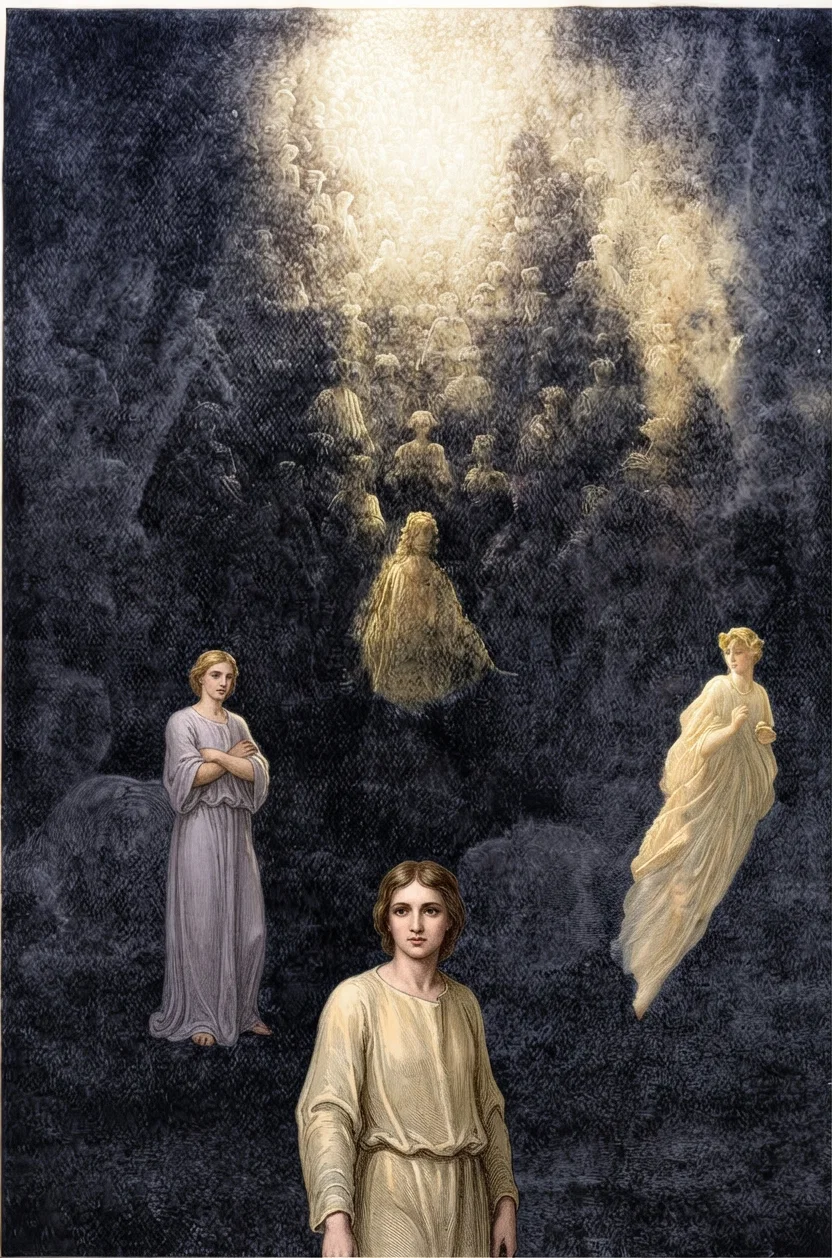
THE ANGELS OF GOD

6%

Pacific Press Publishing Company · Oakland, California · Dec 2, 1897

FromSigns of the Times, Vol. 23, No. 47.

Read the full edition

THE ANGELS OF GOD.

THAT there are beings celestial as well as terrestrial, the Word of God plainly indicates. John says, "And I beheld, and I heard the voice of many angels round about the throne." Daniel, in describing the majesty of the ancient of days, God the Father, says, "Thousand thousands ministered unto him, and ten thousand times ten thousand stood before him." The few thoughts we may have to present upon this interesting subject we will classify under the following heads:—
1. The Origin of the Angels.—Some have believed and teach to-day that the angels are the disembodied spirits of persons that have once lived on this earth. There is, however, no scriptural warrant for this belief. On the contrary, the angels of God are represented as having existed before death entered into the world, and for that matter, even before our world was formed. The Lord inquires of Job, "Where wast thou when I laid the foundations of the earth? . . . when the morning stars sang together, and all the sons of God shouted for joy?" Job 38:4-7. And in the third chapter of Genesis, last verse, it is stated that when God drove man out of the Garden of Eden, he placed at the entrance of the garden, cherubim, or angels, to keep the way to the tree of life. Hence, as angels existed previous to the creation of man, and therefore previous to the death of any member of the human family, they can not be the disembodied spirits of the dead, but they must be a separate and distinct order of being than man.
2. Their Nature.—They are real beings. This is clearly represented in every reference where they are introduced. In the tenth chapter of Daniel, and the fifth verse, it is stated that the heavenly being which appeared to the prophet possessed a body, and as parts of that body, Daniel saw his face, his eyes, his arms, and his feet, and he heard his voice speaking. But, altho in the form of men, and possessing body and parts like unto men, they yet are not of the same nature. In Hebrews, second chapter, and the sixth and seventh verses, the apostle states that man was created a little lower than the angels. Hence, we must conclude that, altho the angels possess a body like man, it is a body of higher organism and nature.
3. Their Work.—Of this Paul says (Heb. 1:13): "But to which of the angels said he at any time, Sit on my right hand until I make thine enemies thy footstool? Are they not all ministering spirits, sent forth to minister for them who shall be heirs of salvation?" Jacob, in the dream given him by the Lord, saw a ladder reaching from earth to heaven, and upon that ladder were the angels of God ascending and descending. The angels are the associates of Jesus Christ in the work of redeeming the lost and fallen world. They are his servants, his agencies, by which he conveys his Spirit and blessing to his children on this earth.
4. Their Number.—If, as previously shown, the angels of God are ministering spirits to the heirs of salvation, reasonably it would require no small number to render the service required. Christ indicated, in some degree, the number of the heavenly host in the rebuke rendered Peter for seeking to defend him by the power of the sword: "Thinkest thou that I can not now pray to my Father, and he shall presently give me more than twelve legions of angels?" A legion in the Roman army consisted of 7,000 men; hence it was in the power of the Father to render Christ the assistance of 84,000 of the heavenly messengers. But in this number the strength of the heavenly host is not fully shown. John, after stating that he heard the voice of many angels round about the throne, says, "And the number of them was ten thousand times ten thousand, and thousands of thousands." Ten thousand times ten thousand would be one hundred million, and this is not enough to express their number, so the revelator adds, "and thousands of thousands." Hence, in the provision God has made for his people, he has provided a sufficient number of the heavenly beings to meet every demand which might be made upon heaven's resources.
5. Their Power.—At the resurrection of Christ, the mighty stone at the door of his tomb, which required the whole force of the Roman guard to put it into place, and which the women that followed Jesus confessed that they were unable to roll away, was turned back at a word of command of the messenger of the Lord. When Jerusalem was encompassed with the armies of Sennacherib, as recorded in 2 Kings 19:35, one angel of the Lord was sufficient to slay 185,000 men of valor in the camp of Assyria in a single night. But the power of the messenger was only the power of God, whose representative the angel was.
6. Their Guardianship.—As already stated, angels are heaven's ministering spirits to convey to the people of the Lord on earth assurances of his grace and the blessings of his Spirit. But closer than this general relation is the relation sustained to every child of God. In the twelfth chapter of Acts, and the fifteenth verse, the disciples of the Lord judged from the description of Peter given by Rhoda that it was Peter's angel instead of Peter himself.
"Are they not all ministering spirits, sent forth to minister for them who shall be heirs of salvation?" "Ministers of His that do His pleasure."
They evidently understood that a particular angel, Peter's guardian angel, had charge of this servant of the Lord. The same thought is contained in the words of our Saviour, as brought to view in the eighteenth chapter of Matthew and the tenth verse, "Take heed that ye despise not one of these little ones; for I say unto you, That in heaven their angels do always behold the face of my Father which is in heaven." Hence, it is but reasonable to conclude that if Peter had an angel, and the "little ones" have angels, every child of God has a particular angel appointed to look after his interests. This thought is further strengthened by a reference to the fifth chapter of Ecclesiastes, where, in speaking of vows made to the Lord, from which the one making the same may desire to be released, it is said, "Neither say thou before the angel, that it was an error." Then there is a particular angel connected with each person, who records the vows made, and whose record the child of God is exhorted not to dispute.
7. They Keep the Record of Men's Lives.—This is evident from the scripture just quoted. It may also be strongly inferred from Mal. 3:16, where it is stated that a book of remembrance is written before the Lord "for them that feared the Lord, and that thought upon his name." In the twentieth chapter of Revelation, it is stated, "And the books were opened; and another book was opened, which is the book of life; and the dead were judged out of those things which were written in the books, according to their works."
We have met those who argued that were a record of men's lives literally preserved in heaven, heaven itself would be filled with books and manuscripts containing the same. In claiming this, the power of the infinite God is compared with and circumscribed by the capabilities of his finite creatures. This was impressed on my mind recently while passing the falls of Niagara on a railway train. The newsboy had for sale wares of various kinds. Among other things was a little trinket about three-fourths of an inch long, about the size of a lead-pencil. Through this little rod-shaped instrument was a little hole lengthwise, no larger than the head of an ordinary sewing needle. Holding this little trinket up to the light, and looking through the hole, one could distinctly see six different views of the Niagara Falls, with the name of each view underneath in type that appeared even larger than the type in which this article is set. In still another little trinket of the same size and dimensions could be seen the Lord's prayer, every letter brought out in bold relief. As I witnessed this manifestation of man's inventive genius, and considered how much had been compressed into such a small space, I said to myself, "If man with his finite powers can do this, what limit is there to the infinite power of God?" If man could write the Lord's prayer upon a space no larger than the head of a small sewing needle, might not the infinite God write the record of a man's life upon even a smaller area if he chose so to do?
8. They Assist in the Judgment Work.—It is but natural that they should do this. Having been ministers of God to the heirs of salvation, having been the guardians of the children of God, having kept the record of the life, and having been associated with all the experiences of that life, it is but reasonable that the angel should have a part in determining whether or not the individual has complied with the conditions, and is worthy through Christ of eternal association with God and with themselves. Dan. 7:9, 10.
9. They Come to Gather Home the People of God in the Last Great Day.—Matt. 13:14-43; 24:29, 30. We do not believe it is any fancy dream to picture the angels of God as interested in all of man's salvation and his experiences. A subject of the kingdom of Satan is redeemed for God. He becomes an heir of salvation. A heavenly being is made his ministering spirit, his guardian angel. Faithfully and tenderly does that angel watch over him while he lives, rejoicing in his successes in the Christian race, grieved at his failures. Day by day the record of his life is recorded. Faithful to his trust, the angel prosecutes his work until at last the history is complete, the life it records is yielded to God, and the child lies down to rest. Carefully the angel marks the spot, and, closing the record, places it in a niche of God's great library to await the time when its secrets shall be disclosed. That time comes. The heavenly court convenes. God himself sits as judge. Christ, our Elder Brother, appears as man's advocate. One by one the names of the heirs of salvation are pronounced, and, as that is done, the angel having charge of each particular case brings the record and places it before the court. Is it too much to imagine that the great Judge asks, as each case is presented, "Is there any reason why judgment should not be pronounced in this case?" And then it is, if the case under consideration be that of a child of God, that the efficacy of Christ's blood prevails. He rises in his place as man's advocate, and pleads the merit of his own precious blood, shows the marks of the wound in his side, and the prints of the nails in his hands. And as the omnipotent Judge looks upon that dear face and upon that marred form, and realizes his sacrifice for the redemption of humanity, he says of the case under consideration: "It is enough. Blot out his sins, and retain his name in the Lamb's book of life." And then, it seems to me, a shout of triumph must rise from that heavenly throng, not the gloating cry that is sometimes heard in our courts for the release and freedom of some wicked criminal, but rather the shout of joy and exultation and praise to the Lamb that was slain, and who has redeemed from sin's pollution one for whom he gave his own precious blood.
And when the work is all completed, and the divine fiat goes forth, "It is done," and court is adjourned, and the supreme Arbiter lays aside his mantle of judgment, and Christ, the Lord of lords and King of kings, attended by his body-guard of shining heavenly ones, returns to this earth to take his children home, with what happy hearts the angelic host descend to awake from their slumber those in whose case they have taken such supreme interest! The voice of the Life-giver awakes the sleeping saints. They are caught up to meet their Lord in the air, forever to enjoy the companionship of celestial beings.
Great and marvelous are the works of God, and his ways past finding out. Gracious provision has he made for our salvation. May we avail ourselves of heaven's resources, and enjoy forever the companionship of Jesus Christ and those associated with him in the work of our redemption. F. M. W.