THE INHABITANTS OF THE PHILIPPINES—THEIR CUSTOMS AND PECULIARITIES.
By Eugene G. Wood
THE aboriginal inhabitants of the Philippines are a race called negritos (little negroes), supposed to have originally come from New Guinea. They are small in stature, quite muscular, of a dark bronze color, and have coarse black kinky hair, often reaching down below their waists. At the present time one sees few of the negritos around the large cities, but they are still found in small numbers through the interior of the islands. During the recent outbreak of the insurgents, three regiments of them came down from the mountains and volunteered their services to Aguinaldo. They were put in the place of honor, directly in front of the American trenches. How wise it was for them to volunteer their services to Aguinaldo remains to be seen; but by so doing they were taught a lesson not easily forgotten. From that time until the present neither the Americans nor Filipinos have seen a negrito. After the first day's battle they returned to their mountain homes, apparently much wiser for their experience.
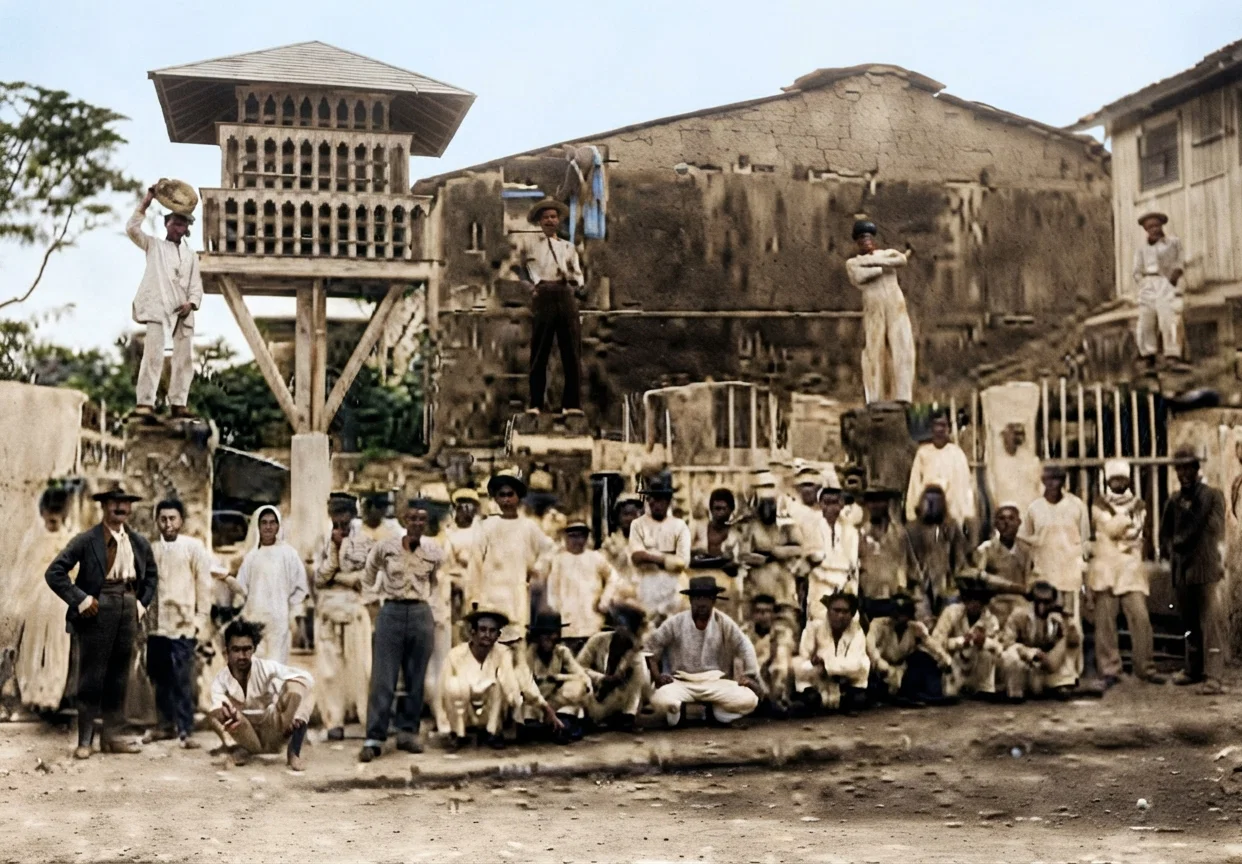
A Group of Filipino Prisoners.
It was a curious sight when the American forces made an advance, on February 5, 1899, to see the way strewn with feather decorations similar to those worn by the American Indians, bows, arrows, spears, wooden shields, etc., cast aside by the negritos in their rapid retreat for the hills.
The negrito, like the American Indian, will soon be a race of the past. They can not stand the vices of civilization.
The native which to-day forms the greater part of the population of the Philippines is supposed to be a descendant of the Malay race. They are a people with few good traits, usually taking life easy, letting nothing bother them, and making little effort to better their condition financially or socially. The Spanish rule to which they have been subjected has done much to harden them. They have been a persecuted, downtrodden people, with little encouragement for them to better their condition.
The typical Filipino is satisfied in his little bamboo shack, so long as he has the bare necessities of life.
The womankind do most of the work, carry the water, wood, etc., gather the fruit from the forest, till the garden, and attend to the little household duties, while the umbra puts in most of his time coaching his game cock for the Sunday's fight.
The game cock seems to be an indispensable luxury to the Filipino. He takes more care of him than he does of his family. He gives him his daily bath, brushes his feathers, feeds him on the choicest luxuries afforded, keeps him in the house with the family, and puts in a large portion of his time teaching him the art of fighting.
One noble trait to be admired in them is the love shown their young children and old folk. They seem most affectionate with them, and, so far as they know how, give them the best of care.
They are a superstitious people; the wise among them are always working their charms upon the uneducated and simple. They are taught to believe in charms against bodily harm and disease. It is believed that if Aguinaldo goes into battle with a certain blue coat on which he has in his wardrobe, no harm can come to him, and, should any one fire at him, the bullet, after leaving the rifle, will return and kill the one firing the shot.
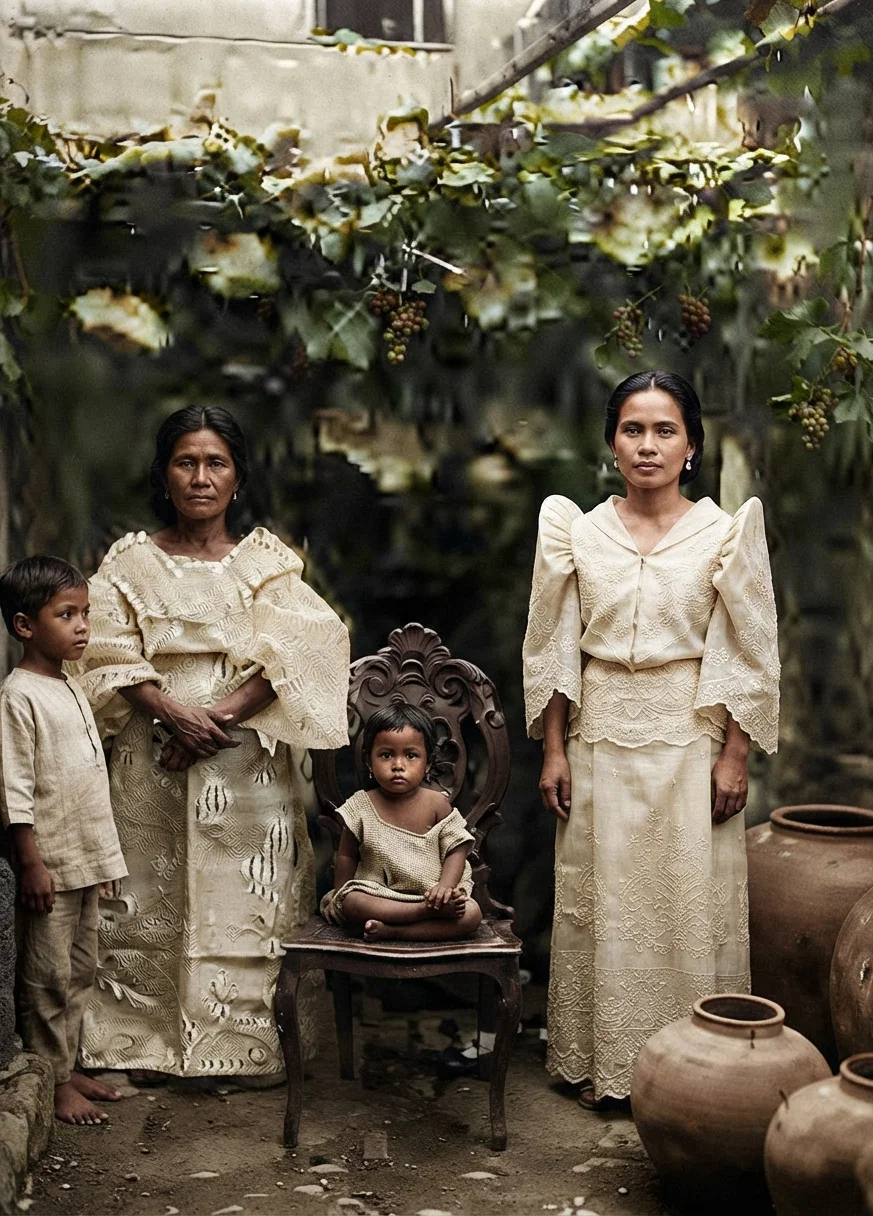
A Filipino Mother and Three Children.
Among the natives of Luzon the chief bane of the priests is the "Angting Angting." It is a belief that the sorcery possessed by certain plants, rude images, and relics, imparts to the possessor an invulnerability whereby disease or death may be defied with impunity. However, it is only the possessor of a superior "Angting Angting" that is enabled to do any injury to a person through his greater magic. To the primitive savage the weird voice of the night wind, the cries of the wild beast, the moan of the sea, and the muttering of the volcano, tell of a hundred spirits to be conciliated and new stories of magic to be sought as safeguards against ills to which mankind is heir.
The Filipino is the model of politeness with strangers and will put himself out to any degree to please them, but will allow the women of his own household to do all manner of drudgery without offering the slightest assistance.
Cleanliness is another virtue of the Filipino. Never do you see more spotless linen than is seen in the most lowly home of Luzon, and a daily bath is a part of their lives.
He loves excitement, and, being secretive and hopeful, he is an inveterate gambler to a greater or less degree. For gambling he will abandon work and even his wife and children. When money is lacking to indulge in this vice, which is to him second nature, he will sell any part of his clothing, or anything in his house, or, if necessary, will pawn or mortgage his children for the amount wanted, the child remaining in bondage until the debt is paid.
The Filipino possesses the remarkable faculty of learning anything he sees done, so there are among them barbers, shoemakers, tailors, wood carvers, etc. He does not confine himself to any one thing. He may be a cook to-day and to-morrow a blacksmith or a coachman. Such is his extraordinary power of imitation11that it is only necessary to show a model and say, "Parejo," and your Filipino workman will make an exact copy. In order to do so he may have to make from one to twenty attempts, but the result will usually be satisfactory. He is fond of imitating anything he sees a white man do, giving no thought whether it be right or wrong; as long as it is European he thinks it must be the model of perfection.
The Filipino is one of the happiest beings in the world. He never despairs and is never elated, taking the knocks and blows of fortune in a matter-of-fact way. Everything which occurs to him in life, be it good or evil, is considered as a direct dispensation of providence, or "talaga nan Dios."
Filipinos are fond of music. Each family usually possesses a musical instrument of some description. They play almost entirely by ear. I was very much surprised to hear a village string orchestra playing selections from some of the most difficult operas with comparative ease. They have little talent for singing; only occasionally is one seen with a fair voice. All their singing is either in the Spanish language or their native island dialect.
The Filipino is docile and obedient when he recognizes in the one who commands him a superior intelligence to his own. As servants they do not compare with Chinese. They do not care to accumulate money. They would often rather go without than work. This laziness is the result of their being sure that, altho they may not work, they will not go hungry, as they can count on some friend or relative supplying their wants, and they can find a square meter of ground to sleep on—without covering or any other comforts.
The field is open, and the harvest is ripe for those seeking foreign missionary experience. May some one feel the burden and go among these people and teach them the way to everlasting life.