ROME

6%

Pacific Press Publishing Company · Oakland, California · Jun 14, 1899

FromSigns of the Times, Vol. 25, No. 24.

Read the full edition

ROME.

A RIDE through Switzerland and across the Alps, viewing scenery which the Europeans claim to be the grandest in the world, is a fitting experience for one who is going to visit Rome, because in the mountain one is impressed with the sublimity of God and the grandeur of His handiwork; while in Rome we see the crumbling remains of man's greatest effort in building. The great tombs which were intended for lasting monuments have either disappeared altogether, or are a heap of ruins. Rome is very choice of these antiquities because they bring so many visitors and revenue, and we can not but notice how suitable in comparison with the government itself are its colossal ruins.
American travelers in Europe necessarily have very different ideas of what they see, as some seek antiquities, some, perfection in arts, and some, society; but to the Christian who awaits his Lord's appearing, there are signs on every hand which show that that event is not far distant. For in spite of the fact that we naturally try to hide it from our minds, the world is degenerating in many ways; and while inventions give an appearance of progress, yet a glimpse at even the ruins of ancient work shows us that we are weaker than our forefathers.
To-day, as we paused on an eminence along the Appian Way (the road by which Paul entered Rome), and viewed the massive walls which surround the city, being sixteen miles in circumference, and saw the remains of the baths of Caracalla, built nearly one thousand seven hundred years ago, and noted the great Colosseum, and recalling the experience we had just had in the Catacombs, with their eleven miles of underground passages, we asked the guide if such work could be performed now. He shook his head and said, "Where are the men to design them? and if designed, where are the strong, skilled workmen to do the work? and if done, where is another Michael Angelo or Bernini to adorn them?" We think it wonderful, with all our machinery, to bring an obelisk from Egypt, yet Augustus Cæsar brought several, and they stand in the public squares in Rome to-day.
A little chapel along the Appian Way attracts considerable attention, because of its connection with the book "Quo Vadis," which has been in such demand of late years. It is believed by many that Peter, the apostle, started to flee from Rome to escape persecution, and met Christ at the place where the chapel now stands. This inscription is over the door: "Hæc Petrus a Xsto Petiit, 'Domine, Quo Vadis?'" ("Here Peter asked of Christ, 'Lord, where goest thou?'") The legend is that Christ answered, "Venio iterum crucifigi" ("I go again to be crucified"), and then vanished, leaving a footprint.
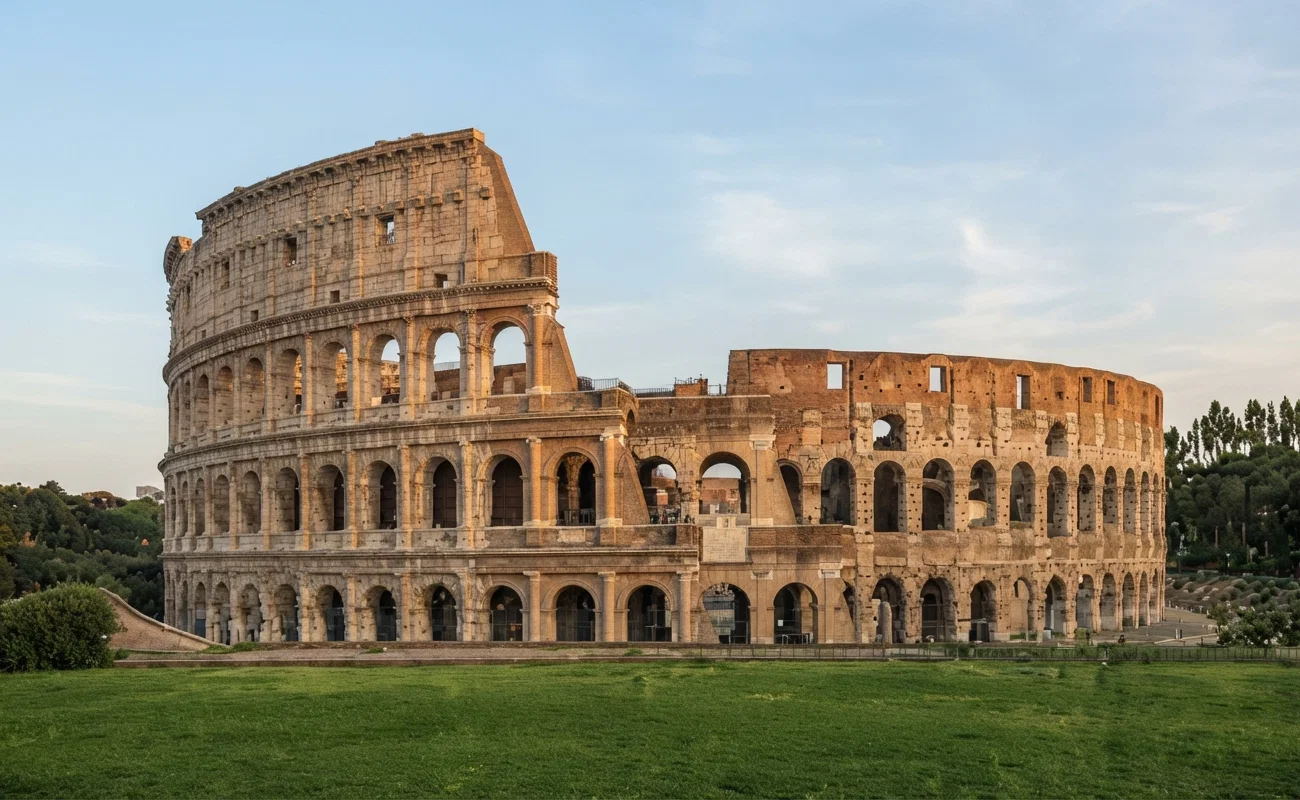
Ruins of the Colosseum or Amphitheater.
Peter understood this, and returned to Rome and was crucified head downwards. The footprint is now preserved in a church near by and worshiped by the deluded people.
Come with us, reader, as we pass through the Porta S. Sebastiano into the old city. Turning to the right, we go by the Arch of Constantine, built over the Via Triumphalis, with its three arches and eight columns of the Corinthian order, raised A.D. 315 to commemorate Constantine's victories over Maxentius and Licinius, and stop in front of the gigantic Colosseum. A feeling of sacredness seems to steal over us, as we think of the trembling ones who, no doubt, have entered this same passage to seal with their life's blood their faith in Jesus Christ, and that in a most barbarous manner, yet happy to suffer with their Saviour and witness before the many thousands. May God give us such faith if He should will to again purify His church by such trials. But let us listen to our guide.
This amphitheater was begun by Vespasian in A.D. 72, on the site formerly occupied by the fishponds of the garden of Nero. It was completed by Domitian. The height of the outer wall is 157 English feet. It is composed of three stories of arches, eighty arches to each story. The style of architecture varies at each tier. The first being Doric, the second Ionic, and the third Corinthian. The length of the arena is 278 and the width 177 feet. It was capable of containing over a hundred thousand spectators. The emperors and their families, the vestals, the senators, the patricians, and the priests, had a separate place allotted to each class. We shudder as our intelligent guide describes the bloody contests which took place right where we stand, how the gladiators and the wild beasts fought, until we almost imagine we see fierce eyes gleaming in those dark recesses under the amphitheater.
With a lingering look we leave the Colosseum, and, turning northwest, ascend the Palatine Hill. On our right are the ruins of the home of the Cæsars. (See p. 13.) What a mammoth place it must have been! Its great arches are still standing, and the hill under it seems to have been a perfect labyrinth of passages. We are all familiar with the debauchery, drunkenness, and crimes perpetrated within its walls, and now all is silent, and we speak with bated breath as we view it. It is a monument to the truth that, "All is vanity;" "Man is but grass;" "But the Word of God endureth forever."
What is this excavation in front and to the left of us, some twenty feet deep, three or four hundred feet wide, and twice as long, with a company of men in it excavating with great care? It is the remains of the Roman Forum. Here and there stand a few marred columns, marking the spot where once stood the beautiful temple of Castor and Pollux, Saturn, Vespasian, the Vestal Virgins, and the temple of the deified Julius Cæsar built on the spot where Cæsar's body was burned. The temples have perished, as have the honors of the gods for whose worship they were built. We next notice the spot where Cæsar fell, and the rostra from which Cicero addressed the people.
There is one place we must not overlook. Situated near the temple of Concord, is the church of "S. Giuseppe dei Falegnami, with the chapel of S. Pietro in carcere below it." Under the latter is the traditional prison of S. Peter, the ancient carcer. In its rock floor is the miraculous (?) spring.
There are five other forums in Rome, surrounded by magnificent monuments, but, as in the Roman Forum, the statues have been removed to some museum.
Rome is full of interesting places, but perhaps that which attracts the most attention in the modern world is St. Peter's and the Vatican. Volumes have been written concerning them, and it would be useless to attempt adescription here. They must be seen in order to be really appreciated. "It required three and a half centuries to bring the building of St. Peter's to completion. At the close of the seventeenth century its cost was estimated by Carlo Fontana at ten millions of pounds" ($50,000,000). In the Vatican is an immense art gallery, museum, and library.
Rome and vicinity is dotted with costly churches. We asked our guide, "Who pays for all this elegance?" He answered, "Those poor people kneeling before the altars, clothed in rags, pay a great deal, but we pay most of it." We asked whom he meant by "we." He told us that the people paid taxes, and their taxes went to support the church. He said it was not right, but they could not help it. Poor down-trodden people! but the government must be supported; those soldiers who are found everywhere must be fed and clothed. The army of monks and priests that are so common here must be cared for. And the pomp and show of royalty must be kept up.
Night is about us and, with the exception of a few late revelers, sleep has silenced the multitudes. Many are weary with the day's sight-seeing, more with toiling for the sustenance of life. Then there are those crowds of beggars, large and small, maimed and decrepit, whom one meets at every turn, and who, in the poorer parts of the city, flock around you asking alms. In the sight of their needs you wonder how the public granaries could have ever been discontinued. But now the people of Rome are quiet, some resting on downy beds, others on the stone pavements. But decay and destruction are still going on. Moment by moment those great monuments and baths are crumbling into dust. The angel of death is hovering over many, and we think of Xerxes, who, after having counted his vast army of over 5,000,000 men, wept at the thought that in one hundred years not one would be alive.
Many centuries have passed since then, each giving stronger proof of man's weakness. "For all flesh is as grass, and all the glory of man as the flower of grass. The grass withereth, and the flower thereof falleth away; but the word of the Lord endureth forever." 1 Peter 1:24, 25.
"Swift to its close ebbs out life's little day, Earth's joys grow dim, its glories pass away; Change and decay in all around I see; O Thou who changest not, abide with me!" H. A. HENDERSON. Athens, Greece, Hotel Alexander the Great.