LOVING OUR NEIGHBOR

2%

Pacific Press Publishing Company · Oakland, California · Jun 14, 1899

FromSigns of the Times, Vol. 25, No. 24.

Read the full edition

LOVING OUR NEIGHBOR.

DOROTHY hurried through her work and was soon almost ready to go, but before she had put on her wraps, there came a knock at the door.
"Why, good afternoon, Ruth! I am so glad to see you," exclaimed Dorothy; "will you come in?"
"Only for a few minutes," replied Ruth, "I must go down to see little Jane Blackwell, she is one of my Sabbath-school scholars and is quite ill, you know."
After a few minutes pleasant conversation Ruth rose to go. "I am going to see Grandma Finly," said Dorothy, "and if I may, I will go with you."
"O, do!" answered Ruth; "I shall be so glad to have you."
The girls separated at a corner a few blocks away, each feeling refreshed by having been in the other's company.
Grandma Finly was very much pleased to have Dorothy come. "I have been so lonesome," she said, "indeed, it seemed sometimes that I could not endure the solitude. Each day it seemed that surely Delia would come; I could not realize that she would not come any more, but I am so glad, Dorothy, that you thought of poor old me."
Was it by chance that Dorothy opened her Bible to the nineteenth chapter of Matthew?
"That's what it means to love our neighbor," said Grandma Finly. "The rich man thought he loved his neighbor as himself, but the Lord knew he did not; and the rich man himself realized, to a certain extent, that he did not, when he refused to sell his goods and go and give to the poor. Dorothy, how few of us love our neighbors as ourselves."
"Yes," said Dorothy, "The Lord has shown me how far short I have fallen, and with His help I mean to get nearer the high standard upon this point."
"What a nice time I have had!" thought Dorothy as she hurried toward the tumble-down cottage where crippled Grace lived. "How many things we have to learn before we can love our neighbor as ourselves."
Little crippled Grace lay in her white bed, counting the flowers in the border about her bedroom. "I wonder why God wanted Delia Deen to go to sleep," thought she; "now if I had died"—here she was interrupted by a knock at the door.
"Come in," she called.
"Good afternoon, Grace," said Dorothy, "perhaps you don't know me. My name is Dorothy Deen, my sister Delia used to come and sing for you, you know, and I thought perhaps you would like for me to."
"O, indeed, I would!" said Grace. "Can you sing, 'He loves Me Too?'"
In a clear, sweet voice Dorothy sang the song. And Grace clasped her hands with joy as she finished.
"Now, won't you please sing, 'My Days are Gliding Swiftly By'? Mama would like to hear you sing, and so would lots of the folks around here," said Grace, as Dorothy finished.
She thought one moment, "Yes, that would be loving my neighbor," and then said, "If you will tell your mama to come up to my house this evening, and bring all of her neighbors who want to come, I will sing for them."
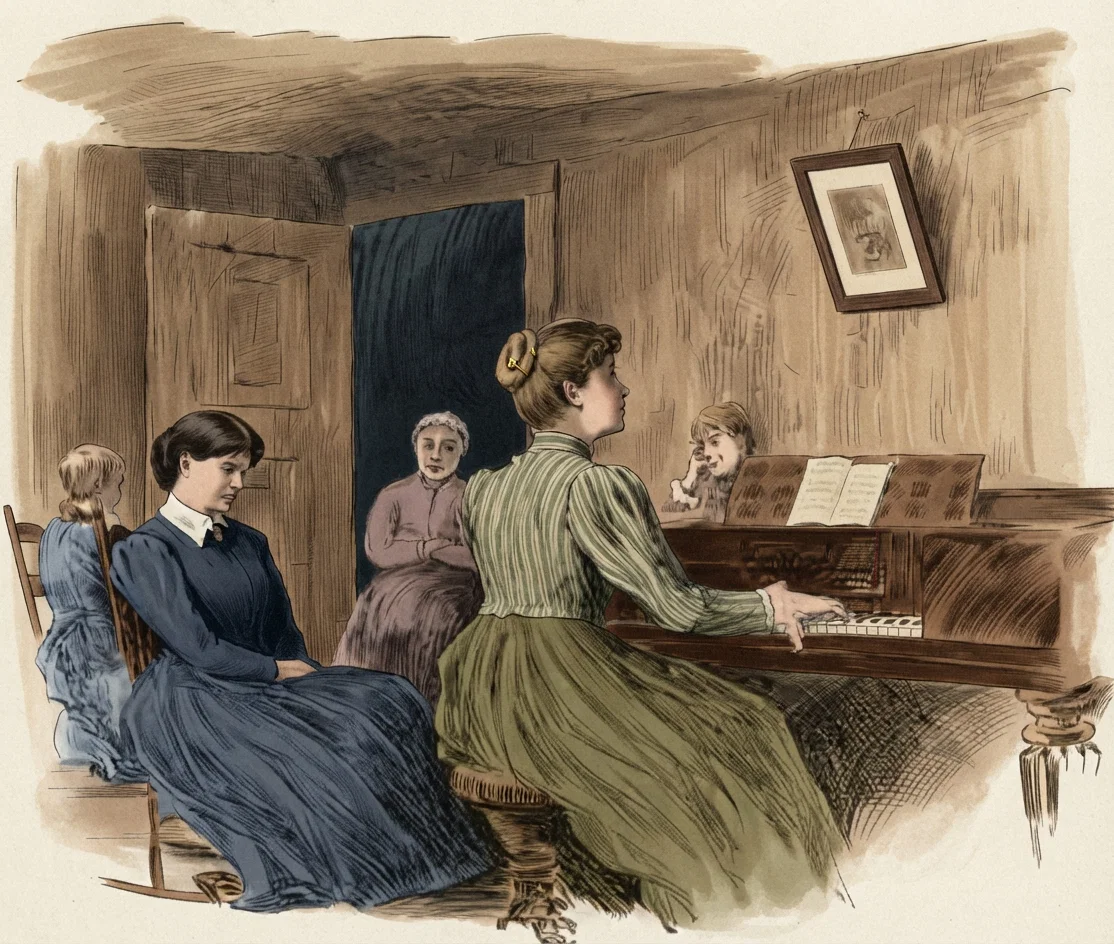
“Dorothy sat at the piano, her fingers ran softly over the keys.”
"That will be so nice," said Grace; "I know mama will come."
"I would like to go over and see old Mr. Lane," thought Dorothy, "but it is getting late, and papa will be home for his supper; so I must hurry."
"Why, Ruth!" she exclaimed, as her friend came up close beside her. "Have you had a nice afternoon?"
"O, splendid!" said Ruth, "I have been to several places, and have had a real good time. How much dearer our neighbors—for these poor are our neighbors—seem when we go out among them."
"There is something more about our neighbors," thought Dorothy; "I wonder if every one is thinking of them this afternoon." She then told Ruth how thoughtful little Grace had been of her neighbors, and asked if she could not come and help her sing.
"I will try," called Ruth after her, as she hurried toward her home.
"Papa," said Dorothy, at supper time, "there are several people coming here this evening from Lowly Row, to have me play and sing for them, and I would like to have you here so much. Won't you come?"
"I will think about it," said Mr. Deen, as he hurried away.
Dorothy knelt and asked the Father in heaven to go with her papa and bring him safely home. She then cleared the table, washed the dishes, lighted the lamps in the parlor, and waited for some one to come. Soon Ruth came, and soon after a crowd of poorly-dressed, but expectant people. The girls sang "Rock of Ages," "Nearer, my God, to Thee," and many others of these dear old hymns that brought to each of them such tender recollections.
Dorothy listened anxiously for her father's footsteps, and still he did not come. She felt sure, however, that he would come, for had she not asked that he would? and had not Jesus said, "Whatsoever ye shall ask in My name, I will give it you?"
"Will you sing 'The Ninety and Nine' for us?" asked one of the old ladies.
"You please sing it, Dorothy," said Ruth. Dorothy sat at the piano, her fingers ran softly over the keys. What a world of memories that old tune brought? It was her mother's favorite song. As she sang, she seemed to forget there was any one present; she sang with such tender pathos, she did not hear her father enter the house. He came
into the hall and stopped, as he heard her voice singing that old song—
"Lord, Thou hast here Thy ninety and nine, Are they not enough for Thee? But the Master answered, It is to Mine own That has wandered away from Me."
"That means me," said Mr. Deen to himself, and as Dorothy sang the next verse, Ruth was startled to hear a sob in the hall; but thinking it was one of the visitors or that she was mistaken, paid no further attention. Mr. Deen hurried to his room. How many times he had heard his wife sing that song, and she had asked him to meet her. He knew full well that the closing scenes were upon the earth and he was not saved.
"O God, help me!" was all he could say as he knelt there. The guests had all gone.
Dorothy sat alone thinking of the events of the day and wondering why her father did not come. Suddenly his voice startled her by saying, "Daughter, will you sing that song again?"
"Why, papa! I did not know you were here; which one do you want?"
"The Ninety and Nine," dear, you know it was your mother's favorite song." Dorothy wondered at her father's tones, but sang the song again.
"Daughter," said her father as she finished, "this night the Lord has forgiven my sins, and I am a new man in Christ Jesus."
Dorothy's heart was filled with an unutterable joy. Surely the Lord is good! What a nice time she and her papa had talking over this new-found happiness; and when at last Dorothy went to her room and knelt in thanksgiving beside her bed, this thought came to her, "Surely it pays to serve God. This has been one day's loving my neighbor."
"Do you know, mama," asked Ruth that evening after she had returned to her home, "that when we love our neighbor as ourselves, we see so much good in them, and so little in ourselves, that we are not tempted to speak evil of them?"
"Yes, my child," said Mrs. Wiley, "let us pray that the Lord may give us of His love, and of that charity which thinketh no evil."
AVA ELTHYN BARNES.
Pueblo, Colo.