THE Gospel of our Lord and Saviour is neither one-sided, nor restrictive. It embraces blessings for man in all three departments of his existence,—spiritual, mental, and physical. It recognizes the fact that between the body and spirit exists a most intimate relation, and that no true glory can be rendered to God by one irrespective of the other. The laws governing man's physical existence are as truly a part of the great system of principles regulating our relations to Divinity, as are those laws pertaining to moral conduct. The Gospel, then, is a gospel of physical health, as well as spiritual blessing; it has to do as well with man's physical as his spiritual relations. To learn nature's laws, and to render obedience to them, is to elevate the spiritual nature to a higher and truer appreciation of the love and goodness of God.
In recognition of this great truth, the people represented by this journal have realized the duty they owed to physically suffering humanity, as well as to those who were held in the thraldom of sin. For years they have advocated reforms in the matter of healthful living. By medical missions, and medical missionaries located in our large cities and sent to foreign lands, they have endeavored to show that in Christ we have promise both of this life, and of the life which is to come. Their work in so-called philanthropic lines has been carried on largely through the medium of sanitariums and hospitals located in different parts of the world. The parent institution, established at Battle Creek, Michigan, has been long and favorably known. In connection with this institution there has been carried on for years a nurses' training school, from which many devoted young men and women have gone forth to minister to, and alleviate the sufferings of, afflicted humanity. At the present time this sanitarium has a family of four hundred patients, and more than that number of helpers, and those undergoing training for medical missionary work.
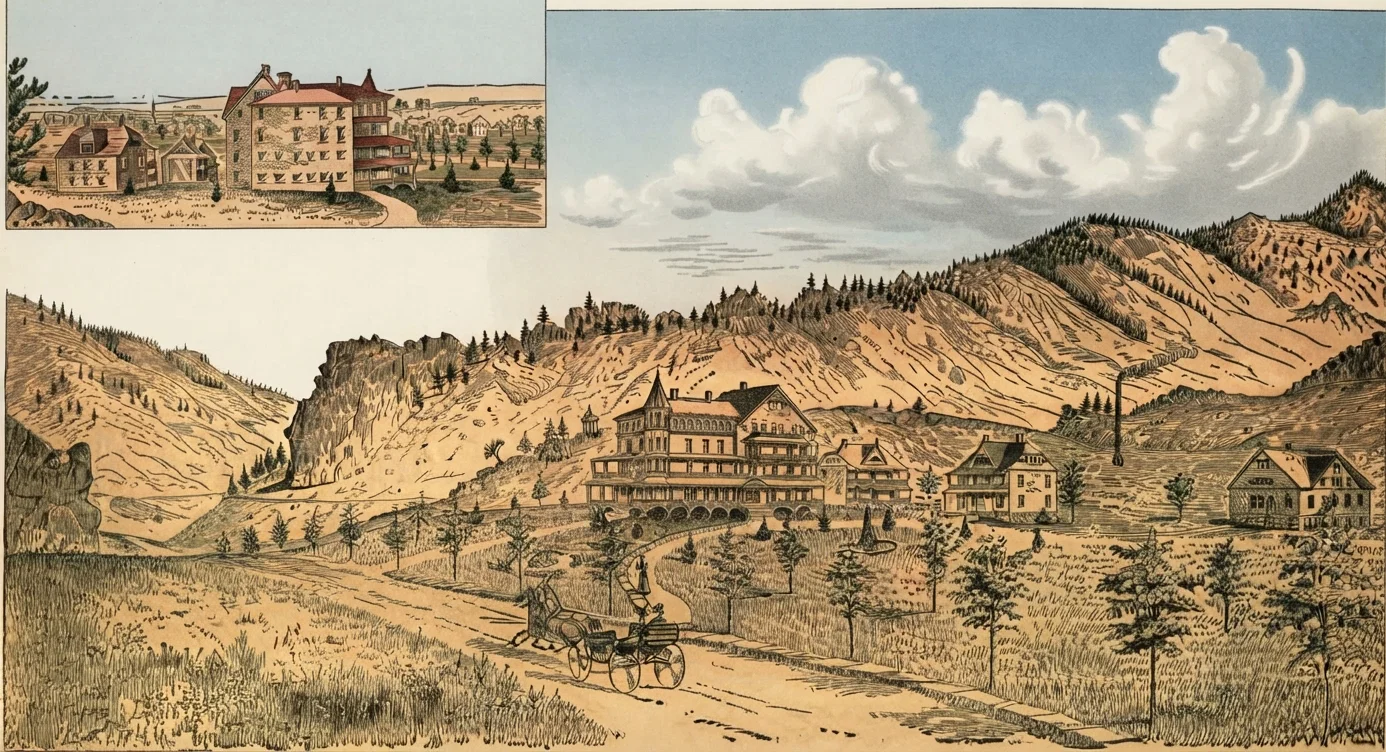
Other institutions have been established at Lincoln, Nebraska, and St. Helena, California, the same excellent results attending the efforts put forth. The work has likewise been extended to other lands. Hospital sanitariums have been located at Guadalajara, Mexico; Basel, Switzerland; Cape Town, South Africa; Sydney, Australia; and a site for one in or near Calcutta, India, is now being secured. As supplying another link in the chain of these institutions in this country, the sanitarium located at Boulder, Colorado, as illustrated in the accompanying cut, has been established.
None of these sanitariums are conducted as money-making institutions. While the majority are organized as stock companies, there is no division of the profits, the entire proceeds going for the benefit of those who are unable to pay for the treatment received, or to further enlarge and increase the facilities for carrying on the work.
While conducted as religious institutions in that the management and helpers are Christian men and women, the work is not carried forward in any sense on sectarian lines. It is conducted rather in recognition of the great principle of the fatherhood of God and the brotherhood of man. It is sufficient to know that any soul is sick and suffering (whatever may be his nationality and religious convictions) to call forth for him the most earnest efforts, and devoted attention.
Without detracting in any degree from the pleasant situation, and excellent work being done by older institutions, it is but appropriate to say that the sanitarium located at Boulder, Colorado, enters upon its life-work with most flattering encouragements to success. As illustrating these advantages, the following enumeration will be of interest:—
1. Its Situation. Boulder, the beautiful little city in the suburbs of which the institution is located, is a town of six thousand inhabitants. It is a city both of the mountain and of the plain. Crowded close up against one of the spurs of the great Rockies, the high peaks, with their everlasting snows, form the background of the scene; while stretching away to the north and east lies the rolling plateau of fertile farming country, dotted here and there with little lakes, making to the wearied vision of the poor invalid a most refreshing scene. The sanitarium itself is located near the mouth of the famous Boulder Cañon, and a few minutes' walk from the grounds brings one into as rugged and picturesque mountain scenery as may be found anywhere in America. All of the advantages of nature in her primitive and diversified forms, combined with the benefits of organized society and modern civilization, are found in the location of this institution.
2. Climate. The fact that this sanitarium is located in the state of Colorado is, of itself, sufficient guarantee of the health-giving climate to be enjoyed. Colorado is a synonym for good climate. The entire state is a sanitarium. Its reputation for climate and scenery is world-wide. To it belong the sun, the mountain breeze, the balmy air. Located on the backbone of the continent, midway in the Rocky Mountain region, it is removed both from the biting blasts of the north, and from the humid heat of the11south. It possesses in reality more sunny days in the year than does the famous "Sunny South," or many parts of the beautiful Pacific Slope. The accompanying table for the five years ending with 1895, gives the number of sunny hours for each month during this period.
The effect of such weather in the efforts of the invalid to win back life and health is certainly invaluable. The weakest patient can spend a great portion of the time in out-of-door life.
Such diseases as chills and fever are entirely unknown. Dyspepsia, on account of the bracing effect of the high altitude and the dryness of the air, finds speedy relief. Nor is it found, as many suppose, that such difficulties as heart disease and kindred ailments are the worse from a sojourn in the altitude of this state, especially at an altitude not higher than that in which the Colorado Sanitarium is located. Of the benefits to be derived in such diseases as asthma, catarrh, and consumption, from a sojourn in Colorado, it is quite unnecessary to speak. For years this state has been known as one especially adapted to the needs of this class of sufferers. Statistics show that fully one-third of those coming to this climate for lung troubles entirely recover; another third have their lives greatly prolonged; and the remainder only die from their failure to seek relief at an earlier stage of the disease.
3. Facilities. A large four-story brick building, one hundred by one hundred and twelve feet, heated by steam, lighted by electricity, with all the modern improvements and conveniences of a first-class hotel, is open for the reception of patients. Three large cottages, in close proximity to the main building and with the same conveniences, are likewise owned by the company. The plant thus established furnishes capacity for more than one hundred guests.
Five departments for the treatment of chronic diseases are maintained, namely:—
Diseases of the Nose, Throat, and Lungs; Diseases of the Nervous System; Diseases of the Stomach and Digestive System; Diseases Peculiar to Women; Diseases of the Eye and Ear.
Competent and experienced physicians of both sexes have charge of each department. These men and women are graduates from the best medical schools of the east, particularly Ann Arbor, and in addition have taken extensive postgraduate training. The superintendent of the institution, Dr. W. H. Riley, was for years one of the leading physicians of the parent institution at Battle Creek, Michigan, and brings to his work here a ripe experience, and a thorough knowledge of medical science. Every means of value known to the medical profession is employed in the sanitarium treatment. These include electricity in its various forms; baths of every description, including the electric light bath; massage; Swedish manual movements by trained manipulators, etc.
In addition to the efficient corps of physicians connected with the institution, trained nurses of both sexes are in constant attendance, to administer the prescribed treatment, and otherwise minister to the needs of the suffering.
In the Laboratory of Hygiene, bacteriological, chemical, and microscopical investigation is carried forward. Special advantages in the way of medicated air compartments for continuous inhalation for patients suffering with catarrhal, bronchial, asthmatic, or other lung troubles, are at the disposal of these classes of invalids.
Particular attention is likewise paid to those needing surgical operations; aseptic operating rooms and surgical wards are maintained in the institution.
The rates for room, board, and treatment vary according to the location and size of the room, and the amount of treatment required. These may be had on application.
It will thus be seen that this institution is established upon a broad basis for the treatment of all chronic diseases. Offensive patients are not received. At the present time there are about eighty patients, representing some eight or ten different states and territories. Among these are found those suffering with dyspepsia in its various forms, with throat and lung difficulties, nervous disorders, and in fact almost all the common chronic ailments afflicting the human family. Most surprising results are seen in the majority of cases. The dry, bracing air and the high altitude serve to quicken the efforts of nature in throwing off sickness, and restoring the wasted tissues and diseased organs to their normal condition.
Nor is the institution alone corrective in its efforts. It aims to be educative as well. Lectures upon physiology, the various forms of disease, and the remedies to be used in correcting the same, are given three times a week in the sanitarium parlor. By gymnastic exercise and Swedish movements, the patients are taught to develop their physical powers, and so overcome the tendencies to weakness and decay.
Reference has already been made to the large training class in connection with the Battle Creek Sanitarium. Similar work, altho much smaller in its scope, is going on at the Colorado Sanitarium. A class of twenty bright young people has been organized, running through two years, for the purpose of receiving instruction in scientific nursing.
Were the Colorado Sanitarium a worldly, money-making institution, we would not present its advantages to our readers. But we believe it to be truly philanthropic in its character. Fully one-third of its proceeds thus far have been devoted to the care of those who were unable to pay but a small part, if anything, toward their necessary treatment. To those who are in need of such advantages as the institution affords, we can unhesitatingly recommend it, and if our friends will extend the notice of its work by calling the attention of the afflicted in their vicinity to the advantages it affords, we are sure it may not only be the means of saving many lives, but also of helping on a truly noble work,—that of Christlike ministry to the sick and suffering.
For further information regarding the institution, correspondence should be addressed to W. H. Riley, M. D., Colorado Sanitarium, Boulder, Colorado.