To attempt to give a list of the places where strikes are in actual operation, or else are seriously considered as a thing for the near future, would be indeed a very tedious task. For there is social unrest and strikes or rumors of proposed strikes in every quarter of the globe, both in the Old World and in the New.
The conditions in England, in France, in Spain, in Germany, in Austria, and elsewhere in Europe and Asia, are too well known to require more than the merest mention to bring the facts of the general unrest to mind. In this country we are led to hope that the locomotive engineers' strike has been overcome and averted; we are beginning to have the same hopes in regard to the coal-miners' strike that threatened to make a coal famine that would have been nation-wide. And then there are the smaller strikes in numerous cities and villages throughout the length and breadth of the land.
Hundreds of books are written upon the subject of ways and means to settle these social difficulties. There is no end to newspaper and magazine articles discussing the same topic. Each one has some plan or plans, and theories in great variety are presented, and each supporter of these different notions is sure that if his theory could only be fairly tried the troubles would all be ended. But most of these plans have been tried to a greater or less extent, and the conditions keep on getting worse and worse.
There is no mistaking the fact that society is in a state of excitable turbulence, and it takes only a little spark to start a great conflagration. Some are saying that all this spirit of turbulence is caused by the agitators that are allowed to make so many inflammatory speeches, and to write and circulate such disquieting literature. But are there not conditions that are causing all this? Do not these agitators have real rather than imaginary things to talk about? Unmistakably there are great problems before the world. Men may differ in regard to their theories as to how these problems shall be treated, but there is no difference of opinion on the actual existence of these social conditions that can not help making trouble.
The two great political parties of this nation are split into factions over the social issues that confront us. And aside from the two leading parties that are thus divided, we have still other parties with a large following that owe their excuse for existence to the conditions that have formed a great part of the basis for the splits in the older political organizations.
The unprecedented aggregations of capital on the one hand, and the unequal divisions of profits with labor on the other, is one of the favorite topics. And connected with this is the extravagant expenditure of the wealthy in foolish pleasures, whims, and luxuries, while there are thousands upon thousands of others who are in distressing, hopeless need.
Hundreds of men and women see the dangers that these conditions portend, and they are lifting their voices in warning notes. Senate and house committees in State and nation are struggling with the problems that are forced upon them by the greed and avarice of the controlling trusts and combines that are gathering the wealth of the world into their coffers at an appalling rate. Citizens' committees and other voluntary organizations are formed in city and town in order to grapple with the graft and greed that center in those places. But still the all-controlling power of money goes on like a resistless avalanche, and everything is ground beneath it.
Whenever and wherever in the past money has gained the power to dominate affairs, there has been the unvarying rule of history that vices, corruptions, and the luxuries that debase men are the result. The greed for gain and the luxuries that wealth brings, shut men away from the suffering and afflictions of humanity. The squalor of the poverty-stricken alley is so repulsive to the delicate tastes of luxury, that the hopeless misery of the poor is effectually shut away from the wealthy. They are not aware of its existence. Luxury seems to put the man in the place where inconsistencies do not appeal to him. The man of great wealth and luxurious tastes will tell of his difficulties in properly supporting himself and family on $50,000 a year, and then contend that the laboring man is unreasonable and inconsistent because he talks of "striking" to have his wages increased twenty-five cents a day, from $1.75 to $2.00.
Along with the sentiments of luxury goes the spirit of haughty superiority that makes the man of wealth a sort of superior being. He shuns the man of poverty, and treats him with disdain and contempt, as if he did not belong to the same race. Many of these poorer men and women are the superiors, both mentally and morally, of the haughty individual of money and wantonness. And the air of superiority assumed, and the menial service required, are doing their full part to widen the breach between these two classes.
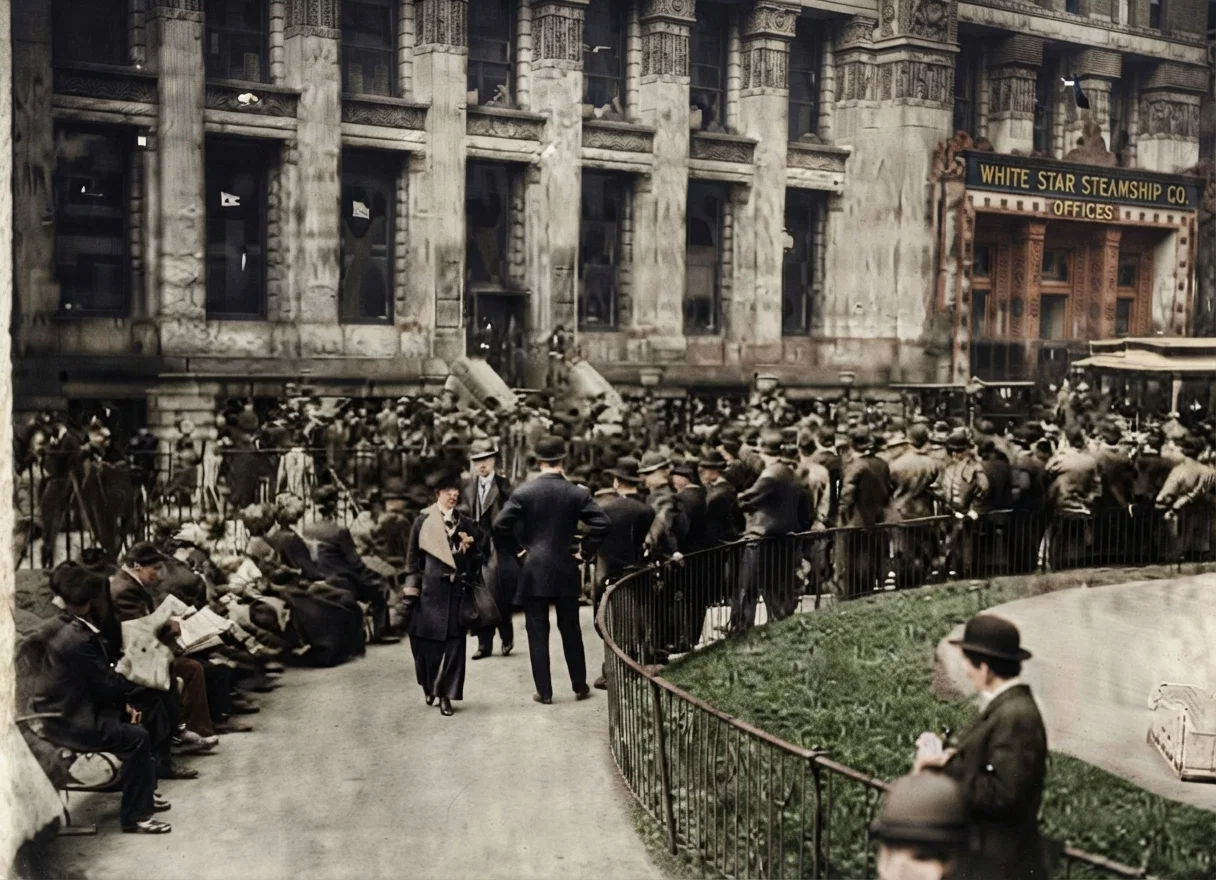
Crowd in front of the office of the White Star Steamship Co., New York City, anxiously awaiting news from the ill-fated Titanic, even tho it was given out that all hope was gone
When the vices that come with luxury are confined to some small locality, or afflict only one nation, there is always hope that the evil will be corrected. But in this time the contagion has become world-wide, and is so strong that there are no powers that can cope with it, except the infinite arm of the Almighty. Men seemed to toy with these problems at first, and laughingly and often deridingly said that the difficulties would take care of themselves. We have been told over and over again that the "civilization of the twentieth century would have no difficulty in meeting every problem that came to it."
But some of the best men of the nation and of the world are coming to take a very serious view of the conditions that confront us. College presidents, leading lawyers, statesmen, and journalists are becoming alarmed. And while they sound a note of hope, yet the tone is such that it shows that the note is coming from a hopeless heart. The God of heaven has known from the beginning what would be the end of the history of this world's career in sin, and He has spoken plainly of these very times in which we now dwell. His words are:
And there shall be signs in the sun, and in the moon, and in the stars; and upon the earth distress of nations, with perplexity; the sea and the waves roaring; men's hearts failing them for fear, and for looking after those things which are coming on the earth: for the powers of heaven shall be shaken. And then shall they see the Son of Man coming in a cloud with power and great glory. And when these things begin to come to pass, then look up, and lift up your heads; for your redemption draweth nigh. Luke 21:25-28.
The foregoing scripture makes it clear that the coming of the "Son of Man" is immediately preceded by "distress of nations." And furthermore, it is a distress of nations that has "perplexity" in it. And it is a "distress of nations" with such "perplexity" as to cause "men's hearts" to be "failing them for fear" as they are "looking after those things which are coming on the earth."
The very conditions that are called for in this prophecy are even now looming big above the world's horizon. God can not be mistaken; therefore we should give careful heed to what He is saying in His Word.
Another scripture that speaks of this time says:
But know this, that in the last days grievous times shall come. For men shall be lovers of self, lovers of money, boastful, haughty, railers, disobedient to parents, unthankful, unholy, without natural affection, implacable, slanders, without self-control, fierce, no lovers of good, traitors, headstrong, puffed up, lovers of pleasure rather than lovers of God; holding a form of godliness, but having denied the power thereof: from these also turn away. 2 Tim. 3:1-5.
This text says that the "last days" shall be marked by "grievous times," or, as in the Authorized Version, "perilous times." The text explains what is the cause of these "grievous times." Love of self, love of money, boastfulness, haughtiness, disregard for parental authority, the loss of the natural affections that tie families together, stand at the head of the list. And then there is the slanderer, the man who has no self-control, and who is fierce; and all these people are "lovers of pleasure rather than lovers of God." And yet they are "holding" to "a form of godliness." They are professors of religion, but in their lives they have "denied the power" of the God they claim to worship.
This last text most strikingly shows that the "last days" will be strongly marked by the glaring inconsistency of great religious professions on the part of men who are making the times "grievous" or "perilous" by their self-love, and money-love, and ferocity, etc., etc., to the end of the list.
Take these Scripture presentations of the conditions that are to prevail in the last days, and put them side by side with what is taking place in society to-day, and it may readily be seen that the conditions are in exact harmony with the predictions. To the one who is unacquainted with these prophecies, or who disregards them, the social outlook may indeed be very dark and foreboding. But to him who knows God's Word the outlook is freighted with joy. For are not the indications clear that Jesus is coming again very soon? And Jesus is the world's Redeemer, and He is coming to save everlastingly every one who trusts in Him.
Never was the immediate future before this world so bright as now. For the doom of misery and sin is about to be sounded, the resurrection day that will unite the good and true of all the ages lies just before us, and soon, O, very soon, the evergreen wreath of immortality will deck the brow of every one who is prepared for the glorious day.
Social problems will grow darker and darker. Violence and strife will spread their pall of gloom over the world. But none of these things can drive joy from the mind of him whose heart is palpitating with the delightsome hopes that center in the incontestable evidence that the "Desire of all nations," the Christ of the living God, is about to return for His own. T.