BRIEFLY and imperfectly, we have reached in our studies the last chapter of this wonderful book. God, the pre-eminent Teacher, the Revealer, the Deliverer, the Ruler, the Preserver, the Judge, has spoken as one who sees the end from the beginning; He has forewarned us of perils to come, of promises to be fulfilled. With unerring delineation has He marked the boundary, the rise, and the fall of empire, the opposing and apostate kingdoms of earth, until He whose right it is shall stand up to reign forever. We could have spent much more time profitably on the book, and still far from exhaust its wonderful treasures of prophecy, and their fulfilment in history. In our brief journey we have reached the last chapter. Let us first learn —
The Answer of the Text
1. What will occur when, in the culmination of history, earthly powers come to an end?
And at that time shall MICHAEL STAND UP, the great Prince who standeth for the children of thy people. Verse 1. Note 1.
The 2,300 Days of Dan. 8:14
2. What awful occurrence comes synchronous with the beginning of Michael's reign?
And there shall be a TIME OF TROUBLE, such as never was since there was a nation even to that same time. Verse 1. Note 2.
3. How will God's people fare?
At that time THY PEOPLE SHALL BE DELIVERED, every one that shall be found written in the book. Verse 1. Note 3.
4. What other event will then occur?
And MANY of them that sleep in the dust of the earth SHALL AWAKE, some to everlasting life, and some to shame and everlasting contempt. Verse 2. Note 4.
5. How will God's followers then be vindicated?
And they that are WISE SHALL SHINE as the brightness of the firmament; and they that turn many to righteousness as the stars forever and ever. Verse 3. Note 5.
6. What was Daniel told to do?
But thou, O Daniel, SHUT UP the words, and SEAL THE BOOK, even TO THE TIME OF THE END: many shall run to and fro, and knowledge shall be increased. Verse 4. Note 6.
7. What did the prophet then see?
Then I, Daniel, looked, and, behold, there stood other two, the one on the brink of the river on this side, and the other on the brink of the river on that side. Verse 5. Note 7.
8. What question was asked by one of the other?
And one said to the man clothed in linen, who was above the waters of the river, HOW LONG shall it be to the end of these wonders? Verse 6. Note 8.
9. What solemn answer was given?
And I heard the man clothed in linen, who was above the waters of the river, when he held up his right hand and his left hand unto heaven, and sware by Him that liveth forever that it shall be for a TIME, TIMES, AND A HALF; and when they have made an end of BREAKING IN PIECES THE POWER OF THE HOLY PEOPLE, all these things shall be finished. Verse 7. Note 9.
10. What plea did Daniel make?
And I heard, but I understood not: then said I, O my lord, WHAT SHALL BE THE ISSUE of these things? Verse 8. Note 10.
11. What answer was made him?
And he said, Go thy way, Daniel; for THE WORDS ARE SHUT UP AND SEALED TILL THE TIME OF THE END. Many shall purify themselves, and make themselves white, and be refined; but the wicked shall do wickedly; and none of the wicked shall understand; but they that are wise shall understand. Verses 9, 10. Note 11.
12. What second period of time was given?
And from the time that the continual [burnt offering] shall be taken away, and the abomination that maketh desolate set up, there shall be a thousand two hundred and ninety days. Verse 11. Note 12.
13. What third period is mentioned, and how?
Blessed is he that waiteth, and cometh to the thousand three hundred and five and thirty days. Verse 12. Note 13.
14. What assurance was given Daniel?
But go thou thy way till the end be; for thou shalt rest, and shalt stand in thy lot, at the end of the days. Verse 13. Note 14.
Note and Comment
1. AND AT THAT TIME.—At the time when the king of the north, notwithstanding the confederacy which supported him, comes to an end, when all earthly rule perishes, Michael shall stand up. "Stand up," we have seen throughout this prophecy, means to reign.
Michael, it has been shown, is none other than our Lord, with angel nature, acting as an angel, servant, or messenger; and because chiefest Servant, the Chief of all the angels — the Archangel. See Jude 9; 1 Thess. 4:16; John 5:28. The very name means "who is like God," and He is identified with our Lord by the expression "who standeth for the children of thy people." Only Christ stands up against all the usurpers and persecutors and de facto persecuting powers of this world. Only Christ reigns forever with His people. Then He will leave the throne of the Father, where He has reigned as King-Priest to save from sin, and take the throne of His glory. Rev. 3:21; Heb. 8:1; Matt. 25:31. Then the time of the end will be over, the kingdoms of this world will have become "the kingdom of our Lord, and of His Christ; and He shall reign forever and ever." Rev. 11:15. Prince Emmanuel then reigns "from sea to sea, and from the river unto the ends of the earth."
2. A TIME OF TROUBLE.—Not the time of tribulation such as never was, of Matt. 24:21, 22; for that tribulation was upon the righteous,—the persecutions referred to in Daniel 7 and 8 and 11, Revelation 12 and 13, and elsewhere. The "time of trouble" of our text is upon the wicked. It is constituted by the plagues of God's just and unmitigated wrath. Rev. 14:9-11; chapter 16. This time of trouble is God's work, His strange work, but it is necessary to the cleansing and stability of His kingdom. Isa. 28:21, 22.
3. AT THAT TIME.—While the time of world-wide, culminating trouble will be upon those who have rejected the only refuge, God's people will be delivered. Jehovah is their Rock and Fortress. To each one comes the assurance: "He will deliver thee from the snare of the fowler, and from the deadly pestilence." "His truth is a shield and a buckler. Thou shalt not be afraid for the terror by night, nor for the arrow that flieth by day; for the pestilence that walketh in darkness, nor for the destruction that wasteth at noonday. A thousand shall fall at thy side, and ten thousand at thy right hand; but it shall not come nigh thee. Only with thine eyes shalt thou behold, and see the reward of the wicked." See Psalm 91. In all the past the blood of the martyrs and the sufferings of God's people have been in nourishment to the church, and an incentive to faith; but this is needed no longer, and God saves and shields them from the physical perils. Are their names in the Book of Life? Then shall they be kept. Luke 10:20; Rev. 17:8; 20:15.
4. MANY THAT SLEEP.—Just before our Lord died He told the unbelieving Jews, "Ye shall see the Son of Man sitting at the right hand of power, and coming on the clouds of heaven." Matt. 26:64. John declares, "Behold, He cometh with clouds; and every eye shall see Him, and they also which pierced Him." Rev. 1:7. To see Christ, they must be living when He comes. At His coming the righteous are raised from the dead (see 1 Thess. 4:16); but the general resurrection of the wicked does not take place until 1,000 years after. Rev. 20:5. The natural conclusion is that the resurrection of which Daniel speaks is a special resurrection at the beginning of the time of trouble, in which many will rise, some of the righteous and some of the wicked, the first to life everlasting, and the second to shame and death. It is fitting that it should be so, and the scriptures cited seem clearly to demand it.
5. THEY THAT ARE WISE SHALL SHINE.—"The fear of the Lord, that is wisdom; and to depart from evil is understanding." Job 28:28. But we learn, in the previous chapter, that souls who became wise in God were those who were persecuted. Such have been counted fools in all ages of the world, and have been covered with contumely, ignominy, and reproach, have suffered persecution and oftentimes death, for Christ's sake. Their time of vindication is coming. Those who have been wise in God, those who have instructed others in the way, shall be vindicated. When the wisdom of the world shall be set, in God's light, over against the "foolishness of God" (1 Cor. 1:25), then shall the truly wise and the devoted teachers of truth shine out resplendently in everlasting glory, as the stars and suns and constellations and galaxies of sidereal brightness, forever and ever. Such can afford to wait God's vindication.
6. SHUT UP THE WORDS.—The vision was not to be known or understood by Daniel, or later souls, in its fulness, until the time of the end. God's seal was upon it until that time. It would teach great general truths, but its marvelous scope, its last-day lessons, its fulness of instruction, must wait until the time of the end, which, as abundantly shown, is at the end of the 2,300 evenings and mornings. Then many should search to and fro, uncover buried treasures of orient lands, study the everlasting Word, plead with God for light, and understand Him concerning the evil times; "and knowledge shall be increased,"7the seal shall be broken, the book opened, and God's message for the hour shall go forth. See Revelation 10. "Run to and fro" is, by Wintle, "when many shall have searched;" the Septuagint, "till many have taught;" the Douay version, "till many shall pass over, and knowledge shall be manifold;" the "Bible Commentary," metaphorically, "to read through earnestly and thoroughly." There will be manifold knowledge in arts and sciences; but pre-eminently the text refers to the knowledge of God's Word of prophecy, and those who learn it shall carry the glad tidings to earth's remotest bounds, and many shall be taught the way of life.
Great Time Periods
7. THERE STOOD.—Daniel sees three—two angels and our blessed Lord. May it not be that the angel on the hither bank of the river, or flood, represents God's children in the land of sin and suffering and sorrow, that the one on the thither side stood for eternal deliverance, and the turbulent flood dividing the two is a symbol of the years of strife yet to be, but on whose waters was the victorious One who spans the gulf between the uncertain, terrible NOW and the blessed, eternal THEN?
8. HOW LONG?—It is a question of the ages, rising from the long procession of the suffering people of God. It is a repetition of the question of chapter 8:13. And when the voice of the suffering ones ceases, their very graves seem to voice the cry of eternal justice. Rev. 6:10. The question is asked by the angel, "How long shall it be to the end of these WONDERS?" The Hebrew word "peie," from which "wonders" comes, refers to miraculous manifestations, and is used with direct reference to the resurrection of the dead. See, for instance of its use, Ex. 15:11; Ps. 88:10; 136:4. The resurrection of verse 2, and the deliverance of God's people, must be included in the wonders. But God gives no such definite time even to the angels, or for His people. He does recall a definite period before given to the prophet, and names others, that the fulfilment of these may make double assurance of God's care, overruling providence, and power to perform His promises. Let us consider the first,
9—The Time, Times, and a Half
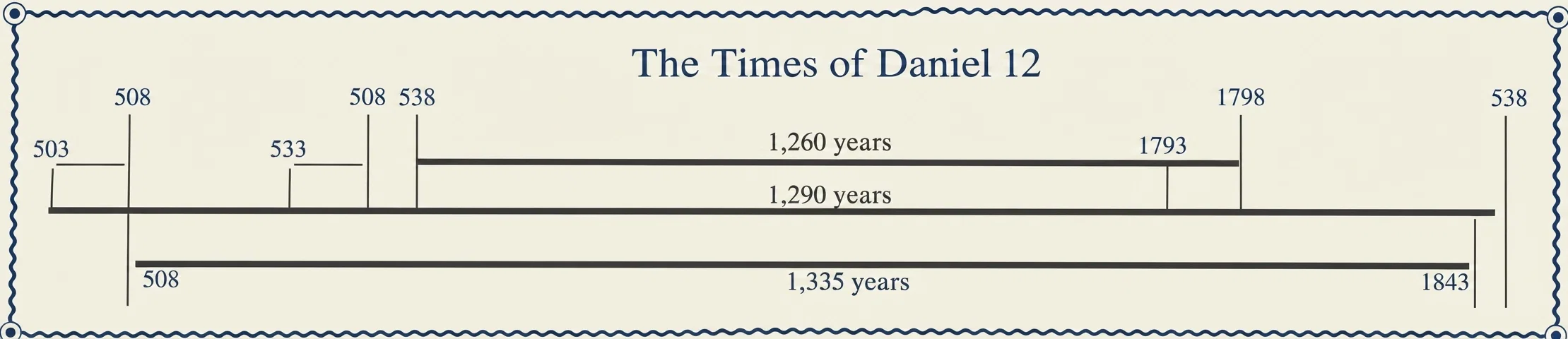
This period has before been brought into Daniel's vision, and there directly applies to the persecutions, or "wearing out of the saints," by the little horn, when the saints should be given into the hand of that power for "a time and times and half a time." Dan. 7:25. In chapter 12 it is said to apply to the breaking in pieces of the power of the holy people,—the great tribulation, Jesus calls it (Matt. 24:21), during which time God's church was not only rent by heresy, deluded by false teachings, but scattered in the wilderness, hunted, and persecuted. Rev. 2:10; 12:6, 13, 16. These times—three and a half years, forty-two months, 1,260 prophetic days—symbolizing, according to Eze. 4:6, a "day for a year," mean 1,260 years of wasting, division, and persecution. These days began in that period of 533-8, before shown in a decree by Justinian, then emperor of Rome, who in 533 decreed that the bishop of Rome should be "the head of all the holy churches," whom he honors as head of all bishops, and "the true and effective corrector of heretics." See "Signs of the Times" of March 19, 1912. Baronius Annales, tome 7, page 197, Antwerp edition; Croly's "Apocalypse," edition of 1838, pages 134 and 135. This is confirmed by Little's "Encyclopedia of Classified Dates," which says, "533, Constantinople, the Greek emperor first acknowledges the pope's supremacy." This decree was not carried out in Rome, as the pope was trinitarian, and the Arian Ostrogoths ruled in the "eternal city." But the practical plucking up of the Ostrogoths, the third of the symbolic horns which fell before the little horn, occurred in 538, when the breaking blow was given. The Ostrogoths were not then entirely destroyed. They made a strong stand in 551 to 553, under Totila; but the weakening blow was bestowed in 538, when Rome was cleared of the heretics by Belisarius. If the Roman general had not been removed, in all probability the Goths would never have recovered; but his recall through jealousy gave the nation a new lease of life, and another crushing defeat became necessary. But the great victory was won by the Roman general in 538. Says one writer: "When Pope Silverius, by a succession of intrigues, had been banished from Rome under Justinian, in the year 538, he came to Patara, the bishop of which city went to the emperor, 'and called to witness the judgment of God respecting the expulsion of the bishop of so great a see, saying that there were in this world many kings, but not one as that POPE IS, OVER THE CHURCH OF THE WHOLE WORLD,'—the very words, almost, of Justinian's decree in 533." (Quoted from Baronius by Allies's "See of St. Peter," page 176.)
The same work, pages 193, 194, quotes Pope Vigilius in a letter written in 538, as declaring that "the Roman church is the foundation and mold of the churches," and that the Roman church "holds the primacy over all churches," and that "the causes of all bishops who appeal to the apostolic see, and the proceedings in all greater causes, are known to be reserved to that holy see, especially as in all these its decision always must be awaited, and if any bishop attempts to resist this course, let him know that he will give account to that holy see, not without endangering his own rank."—Id., quoted from Mansi 933.
This seems to be direct reference to Justinian's decree subjecting "all to the Roman see." Here the primacy of the bishop of Rome was established as the head of the church, and the definer of heresy. Opposing powers had been overthrown.
The period of 1,260 years from 533-8, brings us to another pregnant five-year period, 1793-8. It is the time of the French Revolution. "The eldest son of the church" is in war to the death with the mother. Recoiling from the darkness and superstition of the Dark Ages, and having rejected the saving power of Protestantism, France went almost body and soul, so far as government was concerned, into infidelity. In 1793 begins the Reign of Terror, in which thousands, irrespective of age, condition, or sex, perished. Napoleon springs into light as a warrior. The influence of France is felt throughout the civilized world, and religious faith seems almost to be lost. September 16, 1793, the National Convention suppresses the faculty of theology throughout France. November 10, 1793, the convention declares Christianity abolished, and the worship of the Goddess of Reason is substituted. A few months later, God was abolished by a decree of the same body. November 24 was established a new era, Year One beginning September 22, 1793, in the place of the Gregorian calendar. The power of the French threatens Europe. In 1796 Pope Pius VII makes submission to the French republic. The following year, on February 19, the pope cedes to France Bologna, Ferrara, the Romagna, and Avignon with its territory, and pays a tribute of fifteen million francs, besides valuable art treasures, to France. This humiliating treaty, signed by the pope, is known as the "treaty of Tolentino." In 1798 the pope was taken prisoner by General Berthier, who acted under the orders of the French Directory. Previous to this, in 1776, Austria, a strong Catholic power, had, under Maria Theresa and Joseph II, granted religious toleration to all believers. America had the same year declared her independence, and opened the door for the oppressed of all nations. The working of the Reformation had weakened the power of the Papacy over the nations, and France had given the finishing stroke to the beast power of persecution against so-called heretics, held for 1,260 years, and the fifth head of the apocalyptic beast received its deadly wound. Rev. 13:3. Protestantism and Protestant powers were in the ascendancy. The holy people were no more to be scattered, the great tribulation was at an end.
10. "I HEARD, BUT I UNDERSTOOD NOT," says Daniel. He had heard of this before, this 1,260 years of persecutions, but he would learn more. What about the perpetual headship of the prince which was to be taken away, and the cleansing of the sanctuary, and the restoration of God's worship? What shall be the issue, the latter end of these things?
11. GO THY WAY.—God does not rebuke the aged prophet, but the unfolding of the great visions of the last days is not for him to witness, save in symbolic vision. They shall be shut up to the ignorance of the Dark Ages, sealed to the wise men of generations to come, until the time of the end is reached; and then, when the last great period of all the visions reaches its definite termination, a great flood of light will fall upon its truth, prophetic, historic, spiritual, until the Word is aglow with light, and so shining more and more to the perfect day. How true has this been since 1844! Light on the plan of salvation as revealed in the sanctuary and priesthood of past and present, light on the great eternal law of God, light on the world-wide Sabbath question, light on man's nature and destiny, on liberty, on all the great Bible topics of present truth, light growing, increasing, and manifesting ever more and more of the fulness of God in Jesus our Lord! "The wise," those having the fear of God, will understand; the wicked will scoff on to destruction, willingly ignorant. 2 Peter 3:5.
Another Period—Verse 11
12. FROM THE TIME THAT THE CONTINUAL SHALL BE TAKEN AWAY.—The thought is as expressed by Wintle, "from the time that the daily shall be removed, even to set up" the abomination of desolation. The enemy of God removes the one, that he may set up the other. We have shown in our issues of March 12 and 19, current volume, that this occurred in the putting of man in the place of God in the church. That occurred in another five-year period, 503-8, in both Eastern and Western Rome. The bishop of Rome was made the head of the church, subject to no earthly tribunal, supreme in all matters spiritual. Allies quotes the defense of Ennodius (503), cited in past numbers, as follows:
By the voice of holy pontiffs the dignity of his see has been made venerable in the whole world, since all the faithful, everywhere, are submitted to8it, and it is marked out as the head of the whole body.—Page 175.
It was established in Western Rome in 508 through the ascendancy of Clovis. This headship culminated in 533, in an acknowledgment of the claims of the Papacy by the civil power, and ended with the time of that persecuting period, in 1793-8, when the power of the Papacy as a persecutor was taken away. Then began the reviving of Gospel work, and the sowing preparatory to the restoration of the “daily” in a fuller, clearer sense, in the light of the study of the sanctuary to be cleansed. Dan. 8: 13, 14.
13. BLESSED.—Another period is given, 1,335 days, beginning evidently with the 1,290 days, but carrying us still further, even to the very close of the 2,300 days, and the dawning of the glorious effulgence of the light from the heavenly sanctuary; for 508 plus 1,335 carries us to 1843. Then believers in the prophecy were happy in the belief that Christ was to come. But mistaken tho they were, out of their very disappointment, even as out of the disappointment of the disciples at the first advent, came the open door to new light, in one great, united message to be given to all the world. The angel clothed with a cloud had over him a rainbow of hope. A cloud was in the disappointment of advent hopes in 1843, before the ending brought the promised fruition of the angel and the prophesying again to the whole world. See Revelation 10.
14. THOU SHALT REST.—Daniel must wait. His sleep in the grave shall be rest. Under his Maker’s care he is safe. But when the end comes, the time of judgment begins, which is a part of the closing work of our Master in 1844. Then Daniel will stand in his lot. “Thou shalt rise again to thy inheritance,” a rendering quoted by Wintle. “Stand up for thy lot,” Wintle renders. As the earthly Canaan was divided by lot, so God will give to every faithful soul a portion of “Abraham’s farm,” the earth made new. The judgment determines this. Daniel and the faithful of all ages will each be remembered.
And so, also, it is the earnest prayer of the writer that all who have followed these studies, devoted student or caustic critic, Protestant or Catholic, may find in Christ our Head, our Prince, the salvation assured, and in Him stand in the lot of their eternal inheritance when the Master comes.