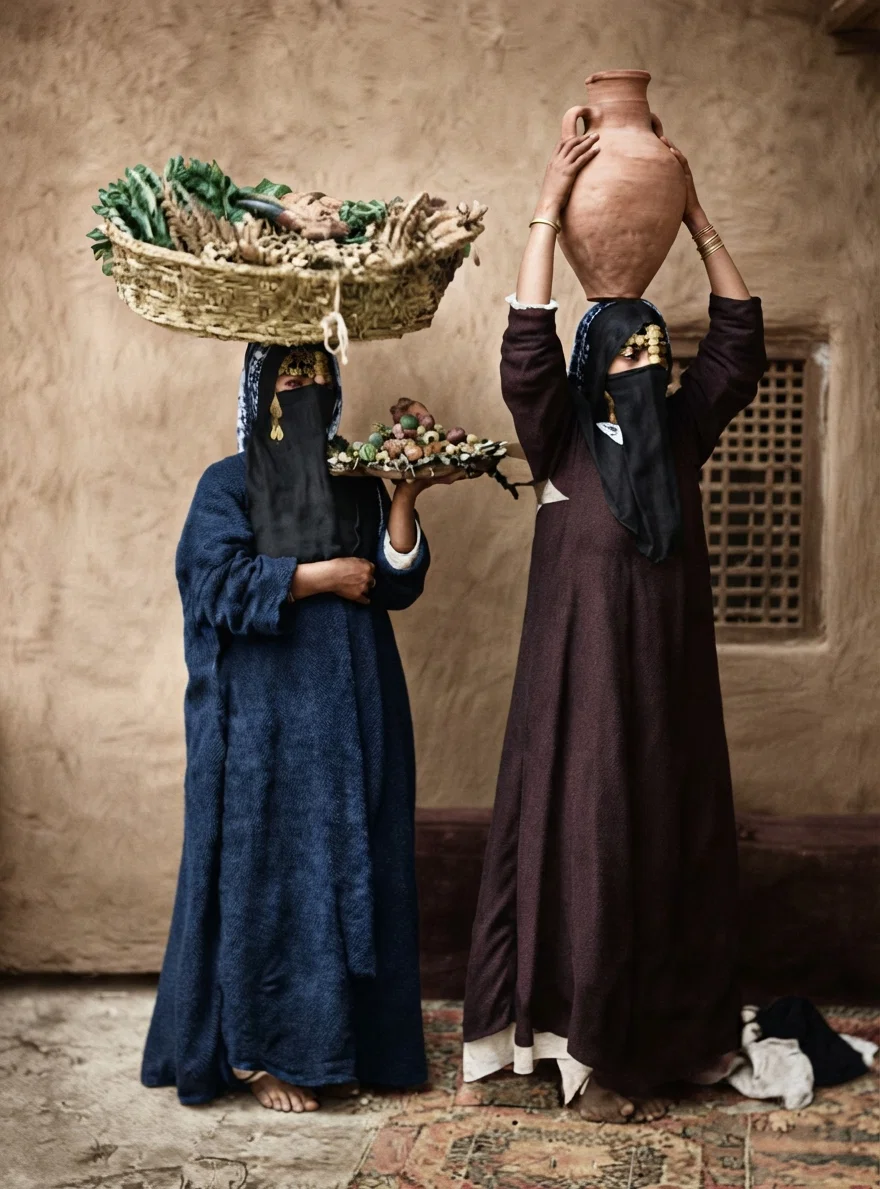
ON visiting a Turkish city for the first time one is struck by the absence of women on the streets. Standing at the end of the main bridge across the Golden Horn at Constantinople, one has before him a sea of red caps, but among the hundreds of men in view very few women are seen. The chief reason for this is that the Mussulman's wife must not be subjected to the vulgar gaze of others. Only her husband, members of the family, and female guests are permitted to see her face. For this reason, the windows of the Turkish house are closely latticed, so that while engaged in their household duties the women can not be seen from the street; and the house is so constructed as to inclose a court, where the usual out-of-door work can be done without observation from the street or near neighbors.
When a Turkish woman appears on the street she is closely vailed, not with the transparent vail of the European, but with an opaque covering, with but a slight opening for the eyes. On the street this vail is kept so tightly closed that passers-by can form no idea of the face within, not even discern the color of the eye. When traveling along a country road, the vail is left open, but when travelers are met, the parts are quickly drawn together. In Constantinople where European ladies appear on the streets unvailed they are a constant gazing-stock to the curious Mussulman. This is a manifestation of brazenness that he can not understand. Rather than become so disagreeably conspicuous, most European ladies in Constantinople wear vails.
Another peculiar feature of the dress of Turkish women is an ornament worn on the forehead, and extending down the nose, as seen in the illustration. This article is usually made to represent a column of gold coins; and being situated between the eyes, it is not an infrequent cause of cross-eyes. But tho it interferes so radically with the delicate organs of the body, the demands of fashion must be obeyed. Doubtless American ladies wonder at the stupidity of the Turkish woman in wearing such a senseless ornament which is capable of producing deformities, but at the same time will herself cling to her corset, which is capable of working much greater mischief with her vital organs, and finally the ruin of her health.
On the whole, the dress of the Turkish woman is much more healthful than that of her civilized and enlightened American sister. Her dress is free from restriction about the waist, and in some districts in the interior, where much of the out-of-door work is done by women, we see a practical solution of the question of divided skirt. The lower portion of the skirt is divided till above the knee, and a piece is cut out on the bias, leaving the lower part of the skirt the narrowest; these parts being joined and fastened about the ankles, leave the lower limbs perfectly free in motion, without exposing the form. Such dresses are a common sight on the streets of Tarsus.
Our illustration presents two women of the laboring class, one bearing a basket of vegetables and green figs, and the other a water jar. One of the most common sights on the markets11in Turkey is green figs,—ripe, undried figs. In this form the fig is much more used than in the dried form; the difference is fully as great as between the fresh apple and the dried apple. The form of the water-jar shown in the illustration is also in general use in the east. As in ancient times, the work of the potter is here quite prominent.
On the whole, customs have changed little in the east since Bible times; but of late years some of the customs of Europe are creeping in; and, tho it may seem surprising to some, in proportion as these customs are adopted, the health of the people is impaired. But this lesson, which has for centuries so oft been repeated and demonstrated with such national calamities, is not yet learned. But few comprehend that simplicity conduces to health and purity, while luxury in dress and diet leads to disease, corruption, and death. That Gospel simplicity leads to health is usually better illustrated among the heathen than among professed Christians. This is but another demonstration of the fact that whoever obeys the principles of the Gospel reaps the unfailing reward. Every transgression of the laws of nature,—the principles of the Gospel,—is a step towards death; and every obedience to these laws is a step towards life. The Gospel is life; its absence is death; the only way to live is to continue in obedience to the principles of the Gospel in eating, drinking, dressing, and all that pertains to life.