The Sanctuary

11%

Pacific Press Publishing Association · Mountain View, California · Apr 30, 1912

FromSigns of the Times, Vol. 39, No. 18.

Read the full edition

The Sanctuary

II—The Second Yearly Feast in Type and Antitype
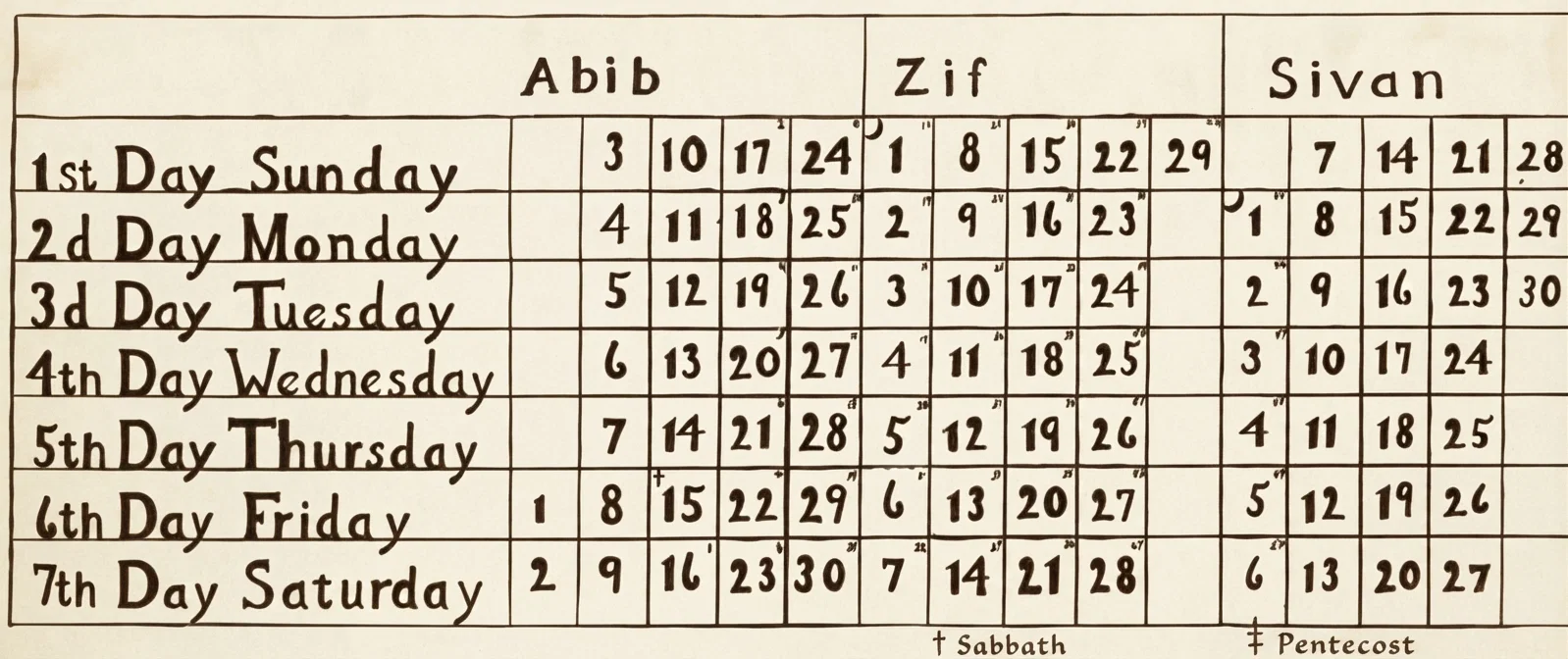
FOR authority, we turn to Ex. 23: 16, where we find this feast enjoined, and called the "feast of harvest," or "first-fruits of thy labors;" or to Ex. 34: 22, where it is called the "feast of weeks." The children of Israel were instructed to compute from the Passover seven weeks complete, even to the day following, or fifty days, to locate the second great festival of the year. A careful reading of Lev. 23:5-16 will establish the following facts: In the fourteenth day of the first month, Abib, at even, or sunset, the Passover lamb was killed, and was eaten in the night following, Abib 15.
The fifteenth of Abib was a sabbath, without reference to the day of the week on which it came, as was also the twenty-first of Abib. And these yearly sabbaths occurred on different days of the week, even as our national holiday, July fourth, occurs on a different day each year from the year preceding.
The day following the sabbath, the children of Israel were to bring a sheaf of the first-fruits of the harvest to the priest to wave before the Lord, and were to offer on that day, also, a lamb without blemish for a burnt offering to the Lord. And from this day they were to count fifty days. Now note briefly these facts: Abib 14 at sunset the Passover lamb was slain. Abib 15 was the first sabbath of Passover week. Abib 16, or the day after the sabbath, the sheaf was waved and the burnt offering was made to the Lord. This day, Abib 16, was the first day of the fifty which were to be counted to locate the second yearly festival. The fiftieth day, a type of the great Pentecostal day recorded in Acts 2:1, was also a yearly sabbath. The calendar presented herewith, of the first three months of the year in which our Lord was crucified, will make this matter plain.
NOTE 1.—Abib 14 at sunset, the Passover lamb was slain, and eaten in the night following, Abib 15. In this year Christ was crucified on Friday, Abib 15, which was one of the yearly sabbaths of the ceremonial law. On the next day, Abib 16, which in this year fell on God's Sabbath of the eternal, unchangeable, moral law, the wave-sheaf and burnt offering were waved and offered to the Lord. And on this day began the fifty days to the feast of weeks, or typical Pentecost. Pentecost then fell on Sivan 6, the seventh day of the week, God's Sabbath. Read Lev. 23:5-16, especially verses 15 and 16, and remember that Abib 15 was a sabbath and Abib 16 was the Sabbath.
NOTE 2.—In Lev. 23:15 the "morrow after the sabbath" was Abib 16, and in A.D. 31 was the weekly Sabbath.
We have found, therefore, that the second yearly feast, the "feast of weeks," or "first-fruits," was a type of the great Day of Pentecost which occurred fifty days after Christ's crucifixion. The wave loaves offered at the feast of weeks by the Israelites typified the completed gift of the Holy Spirit as witnessed on the Day of Pentecost, even as the sheaf of the Passover week signified the beginning of the fulfilling of the promise in Christ.