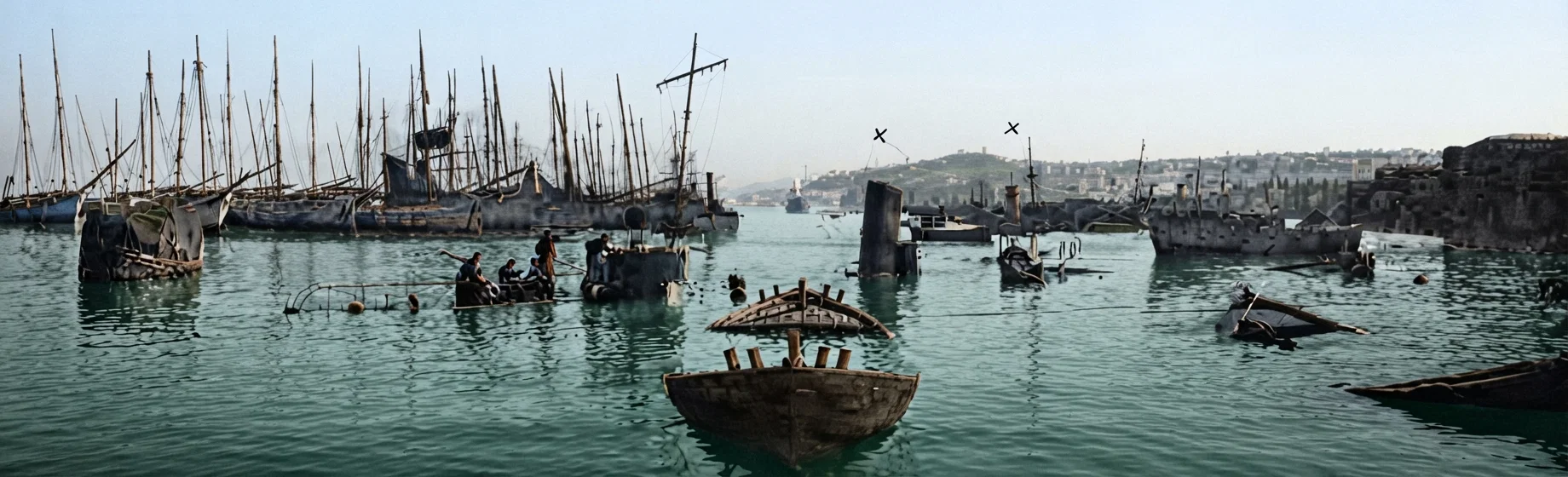
On Sabbath morning, February 24, we were greatly surprised at hearing several cannon-shots. We thought, however, that some foreign man-of-war had come into port, since it is customary for them to come here from time to time; and when they arrive, there are the usual salutes. At about nine o'clock on this particular morning some of the brethren, on coming to Sabbath-school, brought the news that two Italian war-ships had taken their station just in front of the harbor. Then we understood what the shots meant. We discussed the possibility of trouble; because for some time Italy had threatened to bombard our city, but so far the foreign powers had prevented it, and for the moment we did not realize the gravity of the situation. But we were made to realize it when, like a thunderbolt from a clear sky, a regular bombardment ensued.
We are located in what is called Ras Beirut, somewhat higher than the main part of the city, and so we could watch one of the cruisers as it was firing. At every discharge, we could see the guns flashing as they sent their projectiles in the direction of the city, causing a very unpleasant sound as the shells were rattling and whistling through the air, some of them rolling like balls in a bowling-alley. We were reminded of the text in Joel 2, which in speaking of the day of the Lord, says, "Before their face the people shall be much pained: all faces shall gather blackness." Such was really the case here.
Our brethren who had assembled for the Sabbath-school, felt that it would be best for them to return to their respective homes. Before separating, we knelt in prayer, asking God's care upon us, and that His protecting hand might be over the city. As we separated, there were many expressions of hope that we might all see each other again, safe and sound.
On the way home some of the persons who were shot in the streets were seen. After a time the shooting ceased, and there was general relief, especially when it could be observed that the cruisers were taking their way back to the open sea. During the bombardment various reports were circulated of what had been going on in the city; but fortunately it did not all prove to be true.
Among other things, we were told that the foreign post-offices were on fire; but on investigation this proved to be false. The cruisers returned to fire a few shots, and then put out to sea again. Later in the day, we started down to the city, and found the streets all deserted, except for some soldiers that were on patrol duty.
Rumors were circulated that the Moslems intended to massacre all foreigners, and hence all such were counseled to return to their homes and remain out of sight as much as possible. One Turkish cruiser and a torpedo-boat were sunk, and their funnels could be seen projecting out of the water. More or less serious damage had been done to the surrounding buildings; but it appears that the Italians were very careful in their aim at the objects that they desired to destroy, and as little damage as possible was done to other buildings, but of course a number of buildings centrally located had their roofs damaged by pieces of shells that were fired in that direction.
The reason that the cruisers returned for the second attack, was that one of the Turkish vessels had not been entirely sunk in the morning.
Martial law was immediately proclaimed, and newspapers were not published until four days after the battle. The general version is that the cruisers announced their arrival by the first shots that were fired on Sabbath morning, and then the deputation of the government went to see what their request was. They demanded the delivery of the two war vessels. There are others, however, who hold to the opinion that the Italian commander sent a note to the governor and the German consulate (the latter being in charge of the Italian consulate), demanding that within an hour his demands should be granted. Of course this was not much time, and it is said that the note reached the governor only twenty minutes before the hour expired. Then there are others who say that the Turkish cruisers and the barracks opened fire in reply to the challenge from the Italian cruisers.
Over 120 persons lost their lives in the short battle, while a number of others were wounded. Large numbers of the populace fled to Mount Lebanon. Others went into the neighboring villages along the coast, while hundreds of families were crowding the public buildings of the foreigners, and stayed there overnight.
Under the cross at the left is the torpedo-boat, and at the right the cruiser, sunk by the Italian war-ships.
During the day, there was no traffic; but on the following night, the street-cars were kept busy transporting troops to patrol the city. Immediately after the opening of the fire, the different foreign flags could be seen hoisted on a large number of buildings. Whoever was in possession of a foreign flag was sure to unfold it. This was a good lesson to us of how God's children should ever unfurl their colors, that they may be seen, not only in times of trouble, but in times of peace, so that the attention of the world can be attracted to the salvation that is now offered to every man who will turn to Christ and find His peace. Soon the time will come when we will be surrounded by trouble on all sides, and in that time we will not have tranquillity in which to study the Word of God. We will finally reach the point where there will be no intercessor before the throne of God, pleading in behalf of the sinner. Men will wander from one side of the earth to the other to find the consolations of God's Word, but will not be able to find it. See Amos 8:11, 12. These occurrences, which are merely preliminary to the great war of Armageddon that will soon fill the world with terror, should be a strong appeal to every person to profit by this time of grace, while probation is still lingering.
Naturally, this bombardment has caused considerable unrest in the city; and we have the unfortunate circumstance that in addition to the external foe, there are our internal troubles. We are kept in constant fear of some violence by the Moslems against Christians. When these threats against the Christians have been so constant in the past, it is not difficult to see why such fears should immediately rise in any time of trouble like this one. Further color was given to this fear, because of the fact that the government had supplied the people with arms, but as a matter of fact the Moslems themselves were the ones who were appealing for them. Troops of cavalry, however, were brought down from Damascus; and in the meantime a French man-of-war has arrived, and at the present there seems to be no reason for fear.
Since the people have been counseled not to leave their houses in the evenings, we have been compelled to discontinue our public services until the situation clears up. This is a lesson to us of how quickly the work of15proclaiming this last message can be brought to a standstill. We feel the importance of praising God that He is holding these winds of strife. As we see the unrest that is abroad in the world, it enables us better to estimate the power that is required to hold the agents of evil strifes in check. God alone has power to do this. None of our people have been injured. It is evident that if the government here had been better prepared to meet the Italian challenge, the effects would have been much worse.