HUMILITY IN VICTORY

8%

Pacific Press Publishing Company · Oakland, California · Feb 8, 1899

FromSigns of the Times, Vol. 25, No. 6.

Read the full edition

HUMILITY IN VICTORY.

EVERY event connected with the earthly life of our Saviour is one of thrilling interest. From the time He was born a babe in Bethlehem's manger to the time His life was expiated on the cross, and afterwards to the day of His ascension, every word and act becomes, in every age, a subject of closest study to the devoted disciple. It should be so; for Christ, the divine Lord, is set forth as man's perfect example; and if it could be borne in mind that this divine Example never uttered a meaningless word, nor performed a meaningless act, with intense interest to the believer's heart would the Lord's earthly ministry be fraught!
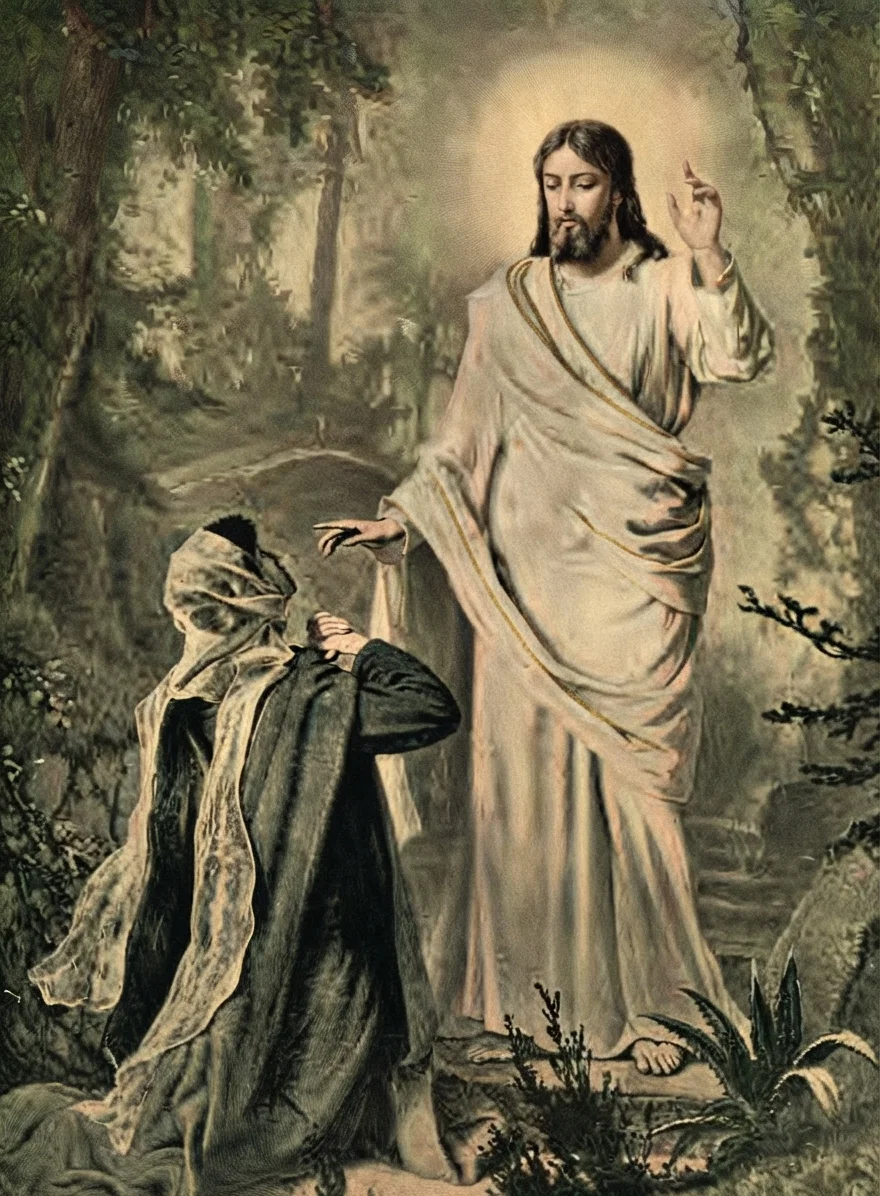
The accompanying illustration presents Mary in the act of worshiping her risen Lord. But a few short hours before she, with the other disciples, had lain His lifeless body in the rocky sepulcher. With bursting hearts of grief and sorrow, they had turned away from the tomb to their lonely homes, with their expectations cut short and their once bright hopes sadly dimmed, if not entirely gone out in darkness. The one whom they thought would have redeemed Israel, in breaking the galling yoke of Rome and restoring the kingdom to its pristine glory and grandeur, had been wickedly slain by the cruel hands of those He came to save; and those who had identified their life's interests with His, who by their influence and means had supported His cause, were now left the gazing stock and reproach of the noisy rabble and the gaping multitude.
But tho Jesus had disappointed their hopes, they could not regard Him as a deceiver. Had they not heard Him give utterance to the divinest truths that ever fell from the lips of man? Had not His words and life given the lie to hypocrisy and deception? Had they not found in His earthly ministry and every-day life a personification of the purity and righteousness advocated in His doctrines? Had He not taught that He was Christ the Lord?
MARY WORSHIPING THE RISEN SAVIOUR.
And did not all His mighty miracles witness to this truth? Hope and doubt contended for the mastery in every heart. Love for the crucified One was stronger than fear of the displeasure of the chief priests or Roman guard. Especially was this true in the case of Mary, in whose life had been wrought such a wonderful transformation by the power of Jesus. She had been forgiven much, and she loved the more. The Sabbath has passed, and she returns to the sepulcher to manifest her love for the One who had been so much to her.
Instead of finding the Roman guards in their position of watch, Mary sees the stone rolled away from the door of the sepulcher. In great haste she returns to the city to acquaint Peter and John with this fact. John, in his haste, is the first to reach the tomb, and while he is anxiously peering within, impulsive Peter enters the door and finds that the Lord has indeed left the sepulcher. But his observations convince him that it is not the work of grave robbers, and that no hasty or indiscriminate work in connection with the removal of the Lord has been done. Order and system have been observed; all the burial clothes are folded, and each is laid by itself. The matter becomes all the more a mystery to the minds of the disciples. Unable to fathom it, Peter and John return to their own homes, but Mary can not tear herself away from the sacred spot. She stands without the sepulcher weeping bitterly, "and as she wept, she stooped down, and looked into the sepulcher;" and now, to her astonished vision, another scene presents itself. Where the body of the Lord lay are sitting two angels, clothed in white, and one of them addresses her: "Woman, why weepest thou? She saith unto them, Because they have taken away my Lord,
and I know not where they have laid him. And when she had thus said, she turned herself back, and saw Jesus standing, and knew not that it was Jesus." He propounds to her the same question. She, supposing that He might be the gardener, said unto Him, "Sir, if thou have borne Him hence, tell me where thou hast laid Him, and I will take Him away." Then it is that Jesus reveals His identity. He pronounces her name, "Mary." How often had she listened to that voice! She has hungupon its very accent and inflection. In the person before her she sees no longer the gardener, but Jesus, her blessed Lord. With the cry of, "Master," she is about to prostrate herself before Him in adoration, but, with tenderness and yet with dignity and authority, Jesus restrains her from this act of worship. "Touch Me not," He said; "for I am not yet ascended to My Father; but go to My brethren, and say unto them, I ascend unto My Father, and your Father; and to My God, and your God."
The question naturally arises, Why did not Christ receive the proffered worship of this redeemed woman? On a later occasion, during the same day, according to Matthew, He received the worship of His disciples, who "came and held Him by the feet, and worshiped Him." Did Christ in the interim, between the manifestation of Himself to Mary and the manifestation of Himself to His disciples, as recorded in the last chapter of Matthew, ascend to His Father? The conclusion is obvious that such was indeed the case, for Mary's worship was refused on the plea that He had not ascended. For what purpose was this ascension made? In this, while we are left largely to conjecture, arguments present themselves which are not at all unreasonable. Christ had taken upon Himself the nature of man. He had lived as a man. He died as a man, and yet He was the Son of God. He died not for His own sins, but to make an atonement for the sins of the human race. He came into the world to bridge the gulf that sin had made between a rebellious race and an offended God. Was His atonement acceptable to the divine Father? Before continuing His earthly work, Christ must have the evidence from His Father's lips that the sacrifice was complete, and that through the merits of His blood guilty man would be reconciled to the government of heaven. That, doubtless, was the occasion of His ascension to the Father. Angels of strength and honor carry Him to the courts of glory. Before the Father's throne He presents the results of His earthly work, reveals in His hands the prints of the nails, in His side the scar of the piercing spear, and He pleads with the Father that all the promised blessings of redemption may fall to the lot of those who accept the merits of His shed blood, and that His people may be identified with Him in reward and in glory.
The decree goes forth from the royal lips, "Let all the angels of God worship Him," and the vaults of heaven ring with glad acclaim to the Lamb who was slain but who is alive forevermore.
Having received this evidence of the divine favor, and being assured of the success of His mission, Christ returned again to earth, to finish the work so nobly begun, and to impart the added blessings bestowed in consequence of His victory over sin and the grave. In this act, as well as in every other act of His divine earthly ministry, we see Christ's self-abnegation, His modesty, His humility. Unlike Lucifer, He would not assume the privileges of the Most High, nor receive the honor which was not His by right. The Father must first pronounce upon His work the divine benediction before He would accept the proffered adoration of men or angels. In the day of triumph He did not forget His relation to the Father or to the government of heaven.
O, the mystery of the union of God with man, as exemplified in Christ! May Christ, the hope of glory, produce in us the same fruits of righteousness unto eternal salvation.
F. M. WILCOX.