IN our last we considered seven specifications of the prophecy concerning the origin and work of the little horn of the fourth beast of Daniel 7. We found as follows: (1) That it arose in a ten-divisioned empire, namely, the Roman, between the years 476 and 538; (2) that three of these divisions or kingdoms were plucked up before the little horn, namely, the Heruli, Vandals, Ostrogoths. These Arian powers were destroyed before the rising power of the Papacy; (3) that great strength and assumption have been manifest in this power even as the prophecy declared; (4) that it was a diverse power, the Church dominating the State; (5) that the Papacy has also had "eyes," and is much more shrewd and far-seeing than other contemporary powers; (6) that it has been a blasphemous power, and so has also fulfilled this specification; (7) that it has worn out the saints of the Most High all history of the Dark Ages bears witness. The other particulars of the prophecy are as follows:—
8. It should think to change the times and law of a power whose law it could only think to change, namely, God’s times and law. Verse 25.
9. The saints and the times and the law should be given into the hand of this power for a certain definite time, called “time and times and the dividing of time.” Verse 25.
10. Its power as a persecutor would be destroyed at the end of that time, and following that its dominion should be taken away. Verses 25, 26.
11. Yet it would at the very end of the age be a persecutor, showing that its power to persecute would be restored. Verses 21, 22.
8. The law referred to must be God’s law; for it is a law which the power represented by the little horn can not change, but which it will only think to change, or, as the Douay version reads, shall think himself “able to change.” It is nothing for one human power to change the law of another human power; but no human power can change the law of the eternal God; it can only think to do so. The Revised Version reads in the singular: “He shall think to change the times and the law.” So also the Septuagint. Spurrill reads, “the appointed times and the law.” Has the Papacy done this? Let us see.
Among the appointed times which God has bestowed upon the world are the day, composed of evening and morning, and the week. The first is marked by the sun; for the Bible begins the day at sunset, not at midnight. The week is marked by the regularly recurring Sabbath, the memorial and sign of God’s power in creation and redemption. The Sabbath commandment is the only part of God’s law which relates to time. How has the Papacy related itself to this part of God’s law? In the first place, as “Vicerere of Christ” the Papacy claims power to change and make laws and bind consciences. Take note of the following.3
In “Butler’s Catechism,” a work used in Catholic schools, the first and second commandments are counted as one, and the fourth is counted the third. Upon the third, or Sabbath, commandment are the following questions and answers:—
Ques.—Say the third commandment.
Ans.—Remember that thou keep holy the Sabbath day.
Q.—What is commanded by the third commandment?
A.—To spend the Sunday in prayer and other religious duties.
But all know that the above is what is not commanded by the Sabbath commandment.
The “Doctrinal Catechism,” pp. 101, 174, 351–355, offers proof that Protestants are not guided by Scripture. We present two of the questions and answers:—
Ques.—Have you any other way of proving that the church has power to institute festivals of precept?
Ans.—Had she not such power, she could not have done that in which all modern religionists agree with her,—she could not have substituted the observance of Sunday, the first day of the week, for the observance of Saturday, the seventh day, a change for which there is no scriptural authority.
Q.—When Protestants do profane work upon Saturday, or the seventh day of the week, do they follow the Scripture as their only rule of faith?—do they find this permission clearly laid down in the Sacred Volume?
A.—On the contrary, they have only the authority of tradition for this practise. In profaning Saturday, they violate one of God’s commandments, which he has never clearly abrogated,—“Remember that thou keep holy the Sabbath day.”
In another Catholic work, called the “Abridgment of Christian Doctrine,” the Catholic Church asserts its power to change the law, in the following manner:—
Ques.—How prove you that the church hath power to command feasts and holy days?
Ans.—By the very act of changing the Sabbath into Sunday, which Protestants allow of; and therefore they fondly contradict themselves by keeping Sunday strictly, and breaking most other feasts commanded by the same church.
Q.—How prove you that?
A.—Because by keeping Sunday they acknowledge the church’s power to ordain feasts, and to command them under sin; and by not keeping the rest by her commanded, they again deny, in fact, the same power.
Later authorities, such as Cardinal Gibbons and Archbishop Ryan, say emphatically the same thing. The Bible day begins with nature at sunset. But the Roman Catholic Sunday, often erroneously called Lord’s day, begins at midnight. Thus has the Papacy changed the appointed times of God, and so changed the law of God so far as man can change God’s law. Nevertheless, that law remains the same; for “it is easier for heaven and earth to pass, than one tittle of the law to fail.” Luke 16:17.
9. The saints, times, and law should be given into the hands of the power represented by the little horn, even as Job was delivered to Satan. God’s saints may be slain or burned, but he will bring them forth to life. His law may be trampled underfoot, seemingly lost to sight, but “forever, O Lord, thy word is settled in heaven.” But for a time God suffered this power to work its will, that all the world might know just what man would do who usurped the place of Jesus Christ in the church.
The time mentioned in the prophecy is “time and times and the dividing of time.” A “time” in Scripture is a year (see Dan. 11:13, margin); “times,” the dual number, the least that can be expressed by the plural, two years, and “the dividing of time,” a half a year, make altogether three and one-half years. Elsewhere in the Bible the same period is referred to as forty and two months, twelve hundred and sixty days, etc. (See Rev. 11:3; 12:6, 14; 13:5.) This is symbolic time, a day representing a year, just as short-lived beasts are used to represent long-existing kingdoms.
The rule God has given us himself, a “day for a year.” Eze. 4:6. Here then we have stated the time during which this power should dominate and persecute those whom it might adjudge heretics, and should seemingly change the law of God.
This time began, as we learned last week, when the bishop of Rome became Head over all Bishops, and True and Effective Corrector of Heretics. This was in 538, when the last Arian power, the Ostrogoths, fell, and the bishop of Rome became the Corrector of Heretics. If to 538 we add 1,260, we are brought to 1798. The authority of the Papacy, unconnected with earthly governments, is simply ecclesiastical. Its power during the 1,260 years, from 538 to 1798 A.D., we have denominated spiritual domination. The Church of Rome was given authority to define what men should profess and practise, and power sufficient to pronounce and execute, through her agents, the temporal penalty which she adjudged due to those whom she was pleased to call heretics.
In order that the Church of Rome might do this, it was necessary that kings and rulers should submit to the authority of the holy see, and this was done, intermittently, it is true, by some, but, tho hindered for a time by some just or ambitious ruler, Rome found means to bring him to her feet, or to remove him. In other words, the governments into which the Roman Empire was divided, acknowledged generally what Rome claimed, either because it was believed, or for reasons of policy. And Rome claimed authority to define and punish heresy, with the lofty and blasphemous assumptions concomitant to such a claim. This led to blasphemy and the persecution of the people of God; and this it is that the prophecy presents before us.
One thought in this connection: When religion is made a part of a government, it becomes, from its very nature, the most important part; and those who stand at the head of the religion, or the ecclesiastical body, have in consequence the most influence in shaping the affairs of the State. This was most manifest in the Papacy during the Dark Ages. The pope was almost supreme, and none had greater power at the courts of Europe than the envoys and ambassadors of the Vatican.
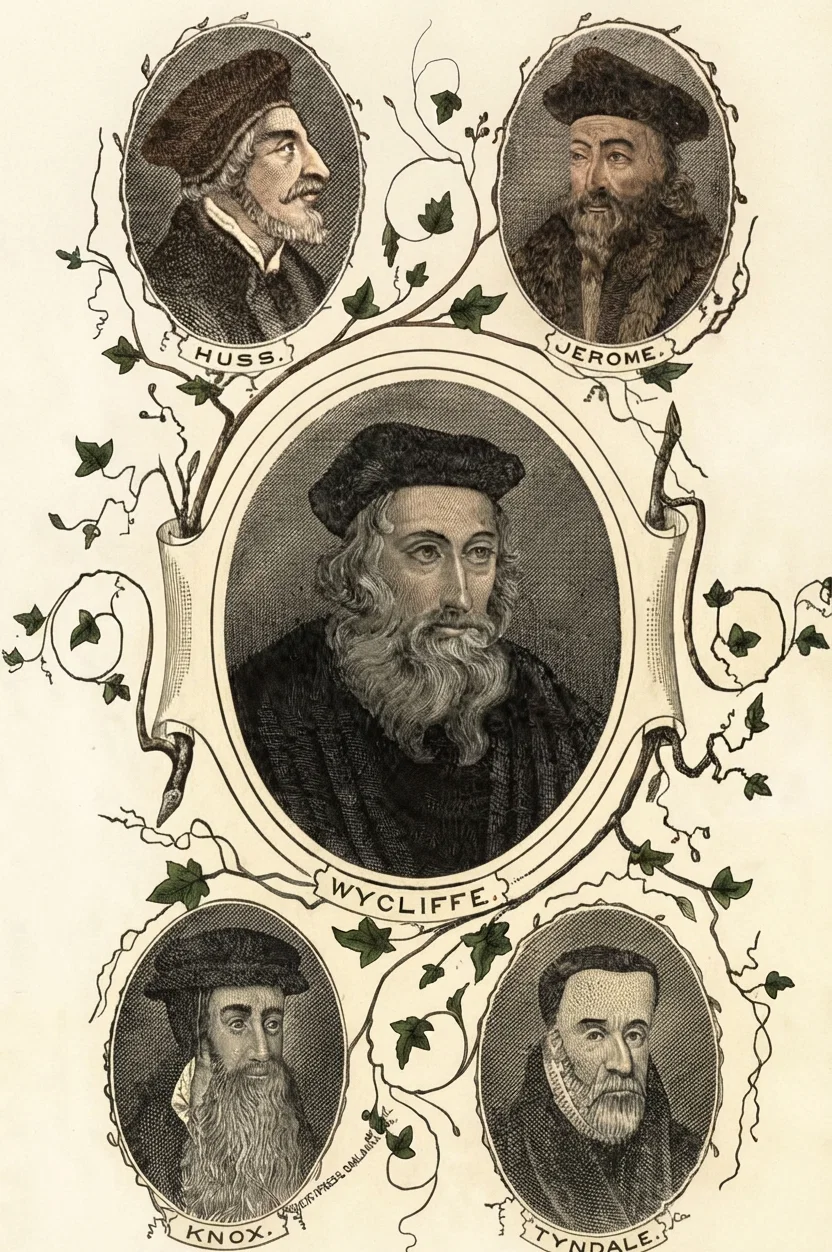
John Huss, the Reformer of Bohemia, was born in 1370, educated at the University of Prague, becoming rector of the university and confessor to the queen. Through the writings of Wickliffe he was led to see a part of the truth of the Gospel, and by contrast the errors and corruptions of the Roman Church. Against these he preached, and against him the pope launched his bulls. A reformation began in the university through his teaching. He was tried by a council, thrown into prison, and finally sentenced to be burned. He perished at the stake, praying and singing, in 1415. His ashes, and the soil on which they lay, were thrown into the Rhine. But as the waters of the Rhine carrying the ashes of Huss went forth to the ocean, so the Gospel, preached anew by the Reformer, were destined to be spread throughout the world.
John Knox, a celebrated Scotch Reformer, was born near Haddington, in 1505. He was educated at the University of Glasgow. He was ordained priest before 1530, and so remained up to 1544. He was forty years old when he publicly professed Protestantism. The instrument of his conversion was the learned and amiable George Wishart, to whom Knox was devotedly attached. He spent nineteen months as a galley slave in France. After this he spent ten years in Europe, a voluntary exile preaching for the Reformed Church. He returned to England, served as chaplain to Edward VI., refused a bishopric, went to Frankfort, then to Geneva, became a friend of Calvin, returned to Scotland, largely founded and established the Presbyterian Church in Scotland, and died in 1572. He did not see all things clearly, or he would not have been instrumental in founding a State Church.
Jerome of Prague was born of a noble family of Prague, Bohemia, about 1365. He studied at Oxford, England, about 1396, and then learned of the Gospel through the writings of Wickliffe. He studied at Prague, and subsequently at Paris, when he took his degree of Master of Arts, returning to Prague in 1407, and entering into hearty sympathy with the work of Huss. He bore important responsibilities in connection with the educational work in the Roman Catholic Church. But his work in connection with Huss brought him under the condemnation of the church. After the death of Huss he was urged to retract, and finally did, but he soon after returned to the Lord, and was burned at the stake, in Constance, May 30, 1416, a noble witness to the faith of Jesus and to the intolerance of the papal system.
William Tyndale was born in Gloucestershire, England, 1484. He was educated at both Oxford and Cambridge. He served as a priest in the Roman Catholic Church. Having learned the doctrines of the Reformation, he devoted himself to the study of the Bible, which he determined to translate into the language of the common people. To do this he went to the Continent, 1524. The printing of his New Testament was begun at Cologne in 1525, and completed at Worms. The Pentateuch appeared in 1530. His study and work during his years of exile were simply marvelous, in both quantity and value. He was indeed a mighty apostle of liberty from the true standpoint, the Scriptures. He died a martyr to truth and liberty, strangled and then burnt, Oct. 6, 1536. His last words were, “Lord, open the king of England’s eyes.” But, while he is dead, his work abides.
John Wickliffe, or John de Wickliffe, or John of Wy-clif, the last name being spelled in twenty different ways, was born in England about 1324. His ability, piety, and talents, gave him high position and influence in the church. Having openly preached against the corruptions of the Roman Catholic Church, he was deposed, the pope condemning him for heresy. But the troubles in the Catholic Church at this time prevented the execution of the papal sentence on the great Reformer. His most important work was an English translation of the Bible, the first English version of the Scriptures. For this and other reasons he is often called “the morning-star of the Reformation.” He died in his own bed in 1384. Twoscore years after his death his remains were exhumed, burned, and cast into the River Swift, which bore them through the River Severn to the sea, an emblem of his work, the influence of which went out to all nations.
The Reformation.
What led to the destruction of this spiritual domination was the Reformation. When the Roman Church had reached as an organization that condition that no reform could affect it, God raised up men in whose hands and hearts he placed his Word, upon whom he poured out his Spirit. Among these were John Wickliffe, “the morning-star of the Reformation;” William Tyndale, who declared that he would make the boy who followed the plow as familiar with the Scriptures as the learned doctors, and who gave his life to give the Gospel to his people; John Huss and Jerome of Prague,4who were stirred into activity by the Gospel through Wickliffe, both of whom died martyrs to Jesus Christ. Great and many are the honored names enrolled on high who counted not their life dear only so they could witness for Christ. Among these were Luther, Zwingle, Melancthon, Knox, Farel, Ecolampadius, Wishart, and many more. The ideas of the Gospel preached by them brought into Europe the freedom which cast off the spiritual domination of the pope; and when Pius VI. was taken prisoner by the French in 1798, there were no nations as nations to do him homage. His power to prosecute or persecute was gone. The church that had joined herself to the world was a widow.
Different Phases of the Papacy.
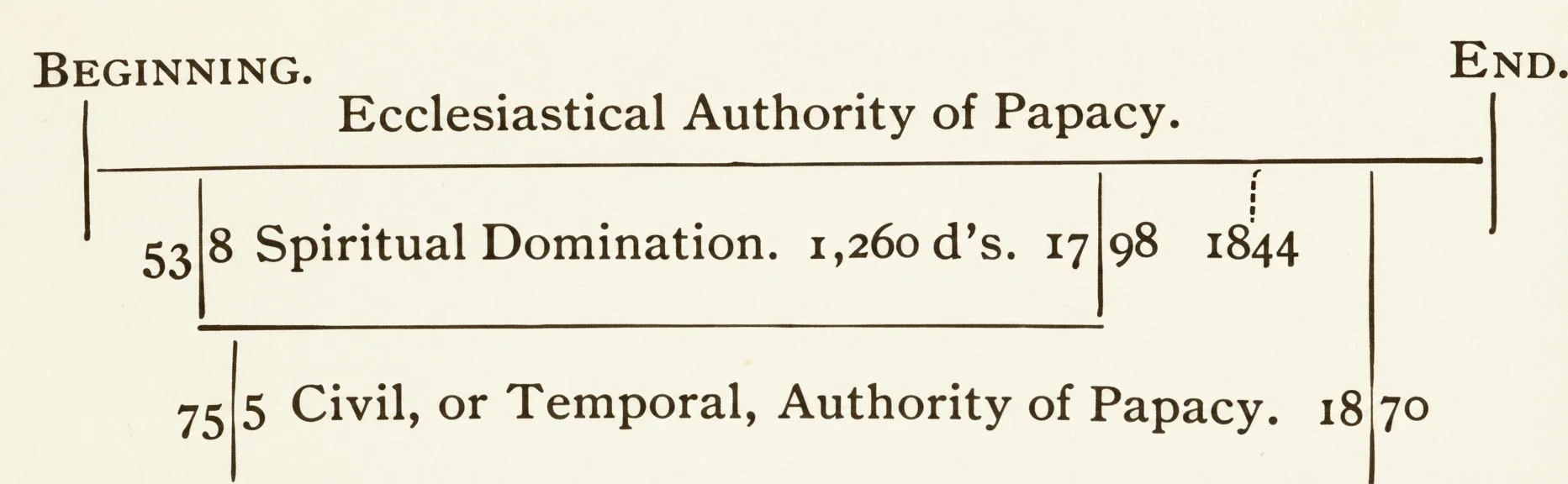
10. But while the power of the Papacy as a persecutor was taken away, its dominion as a little horn, a civil power, still existed. As an ecclesiastical system purely the Papacy was not a persecutor. As an ecclesiastical system it is not noted in the prophecy. It is placed there because it is a persecutor and destroyer of the people of God. It became a persecutor through the legal acknowledgment of its claims by earthly powers. This power to persecute did not exist by reason of papal civil power, for this was not possessed by the Papacy till 755. It did not exist by virtue of ecclesiastical authority, for this Rome had prior to 538, and still has. It existed by virtue of acknowledgment of Rome’s position as Head over all the Churches and Corrector of Heretics by the governments of earth. This power the Papacy possessed in a degree between 538 and 755, when she had no civil power. The civil power or dominion of the Papacy began in 755. It ended in 1870. The differences between these three phases of the Papacy may be more apparent to the reader by the following diagram:—
The ecclesiastical authority of the Papacy is that which it exercises among the members of its adherents, even as any other church or religious body. The spiritual domination of the Papacy is that authority exercised over the consciences and faith of men by virtue of recognition as Corrector of Heretics by the powers of earth. The temporal authority is that which the Papacy possessed as a distinct kingdom defined by certain limits. Its dominion as an ecclesiastical body is over the members of the Roman Catholic Church, as a church. Nominally this is all that it possesses at the present time as a world power. Its dominion as Corrector of Heretics, and hence as a persecutor, is as wide as its recognition as such by the powers of earth, manifest still in a limited degree in some of those countries where the Roman Catholic Church is the established church; but in the light of the prophecy this power is taken away. Its dominion as a temporal power was over the States of the Church between 755 and 1870.
Its Temporal Dominion.
The taking away of the power to punish heresy at the close of the 1,260 years in 1798 is called in another prophecy a “deadly wound,” and a going into “captivity.” Rev. The judgment here mentioned is the same which is presented in verses 9 and 10. It is the investigative portion of the judgment, which began in 1844. Immediately after this occurs, the prophet sees the dominion of the little horn removed. “They shall take away his dominion.” “They” evidently refers to the other horns, or the governments symbolized by them. And history upon this point is in harmony with the prophecy. In 1844 the Papal States, or States of the Church, had an area of 16,000 square miles, and a population of 3,000,000. Four years afterward, the revolution of France and northern Italy broke out, which greatly affected the Papal States. In the following year they revolted, but through the aid of the French were brought to submission. Peace reigned outwardly till 1859, when the slumbering fires of revolution were again manifest in the revolt of Romagna, which was not opposed. This province was annexed to Sardinia in 1860. The same year the provinces of Umbria and Marches revolted, and placed themselves under Victor Emanuel. These provinces were also annexed to Sardinia. Thus from 1848 to 1860 the consuming process had reduced the territory of the Papacy from 16,000 square miles to 4,500, and its population from 3,000,000 to 700,000. In 1870 the last vestige of temporal dominion was taken away.
Restoration of Power.
11. While the persecuting power of the little horn should be taken away at the end of the 1,260 years, 1798, and its temporal power or dominion came to an end in 1870, yet it would again be a persecutor, even to the coming of Christ; for says the prophet: “I beheld, and the same horn made war with the saints, and prevailed against them; until the Ancient of Days came, and judgment was given to the saints of the Most High; and the time came that the saints possessed the kingdom.” Dan. 7:21, 22. The coming of the Ancient of Days will be the second coming of Christ in “the glory of his Father” (Matt. 16:27); and then, and not till then, will it be that judgment will be given to the saints, and the saints will receive the kingdom. “Judge nothing before the time, until the Lord come.” 1 Cor. 4:5. “Then shall the King say unto them on his right hand, Come, ye blessed of my Father, inherit the kingdom prepared for you from the foundation of the world.” Matt. 25:34. The Papacy will, therefore, according to prophecy, be a persecutor of the people of God when Christ is about to come. “Throughout the land the Papacy is piling up her lofty and massive structures, in the secret recesses of which her former persecutions are to be repeated.” But beyond the coming of our Lord the children will be at home, and the dominion in which sin is not, and the law of which is love, will be given to the saints of the Most High.
But if the Papacy be a persecutor when the Lord comes, it is evident that the power to persecute must be restored. And this is set forth in the prophetic Word, not here, but in Rev. 13:3 and elsewhere. The deadly wound will be healed. Daniel sees the entire career of the Papacy, as a man on some eminence views range after range of mountains, which look almost like one range. He sees the great mountains of prominence in the field, but not the valleys between. So Daniel saw the little horn as a persecutor, a power that lost its dominion, and yet a persecutor to the end. He does not note the restoration to power; but John does. See Rev. 13:3.
The Sure Word of Prophecy.
Here are eleven distinct specifications in the prophecy of Daniel 7 relative to a certain power which was to arise. Ten of them are all fulfilled in the Papacy, and in no other power. The eleventh bids fair to soon be fulfilled. No religious organization on the face of the earth is making such progress among the nations of the earth as the Papacy. And in fact the very seed-sowing of religio-political legislation which Protestantism is so industriously pursuing, will bear a crop which the Papacy will harvest. Just as truly as ten of the specifications of the prophecy have been fulfilled, so surely will the eleventh be. The Papacy will again be the dominating power of the world. And every movement tending to a union of Church and State, every demand for religious legislation, every effort to make the governments of earth Christian by law, or to establish by statute any Christian dogma or ordinance, is only helping on to that culmination when the Roman Church will say, “I sit a queen, and am no widow, and shall see no sorrow.” Rev. 18:7.
Such, reader, is the papal system as portrayed in the “more sure word of prophecy.” We have no word to say against Roman Catholics; they are the same as other men, and the Gospel injunction is, “Honor all men.” Among them are numbered, doubtless, many earnest, devoted, self-sacrificing Christians, even as in other religious bodies. But they are Christians not because of the papal system, but in spite of it. That is evil. It puts man in the place of God, tradition above God’s Word, the visible church above conscience. It makes faith a system of doctrine instead of a living, personal connection between the believer and Christ, in which no human intermediary has a part. Our prayer is that every heart bound by its human laws and wrong conceptions of God may break from them forever, and go free in Christ Jesus. And yet we would not compel them. Under God they have equal rights with all men to believe or not to believe. The only true judgment rests with God, and he has not delegated that power to any man or set of men. He who assumes so to judge, who puts himself in the place of Christ to condemn or rule, is antichrist. He who gives up all for and to Christ has Christ formed within, the hope of glory.