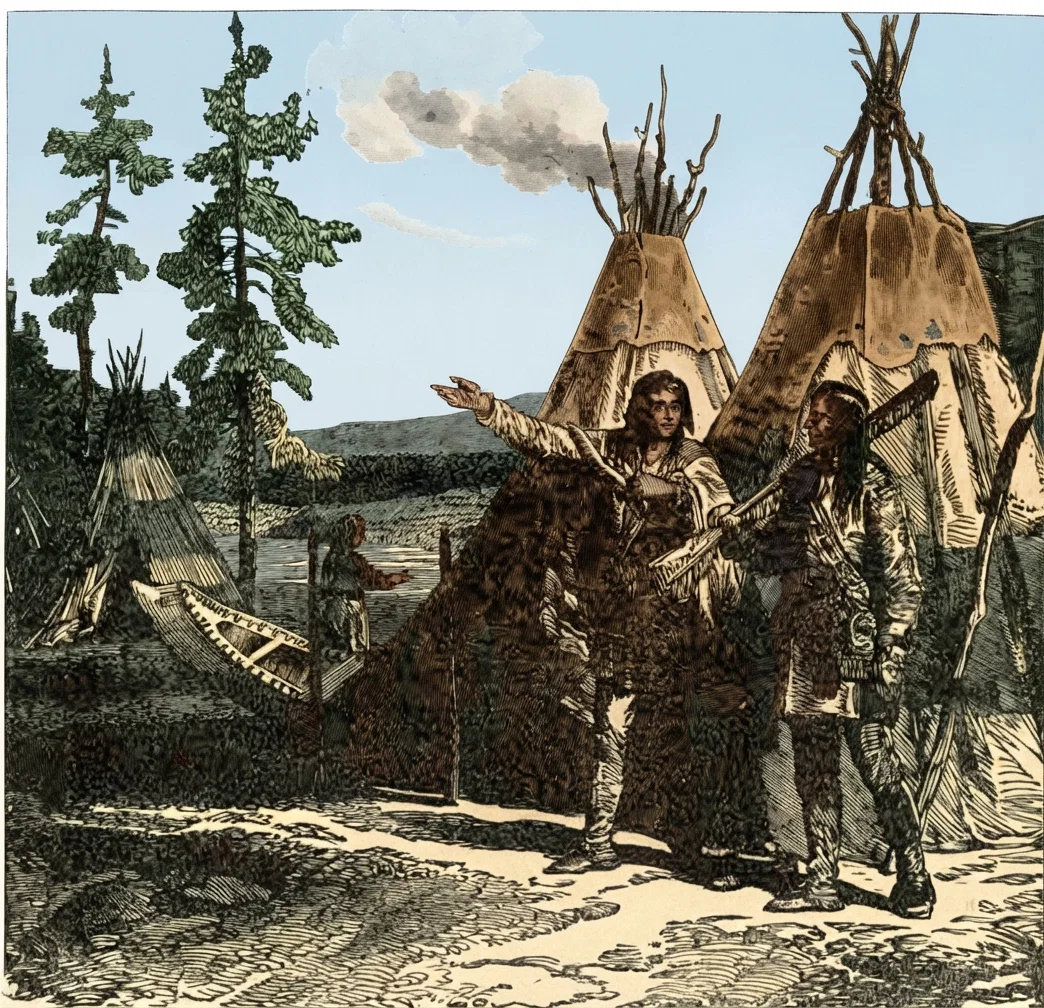
THE Gospel is the power of God. Imagine a missionary going without it! Let me give some facts to illustrate the power of the Gospel among the heathen:—
Thirty-four years ago I left England for the great northwest, going by way of New York, and then up through Minnesota into the great lone land, with its mighty forests and its miserable savages. A few months ago I was called to revisit some of the scenes of my early ministry. I looked at an old Indian with gray hair and wrinkled face, but with the light of God's peace upon his countenance, and his hand upon his Bible, that he loved so dearly. I asked the old man why the "big praying Book," as they call it, was so dear to him. The old man answered: "Big night, all dark, no light. Do not know where to put my feet. Dark night, dark above, very dark. Within, big dark night. This Book was like the sun rising. It showed me where to put my feet. Its words were sweet. Everything that I have got is between the covers of this big praying Book; everything I have is within the Book, and so I keep it near me." Will you please tell me what other book I could put into the hands of that Dakota Indian that could give him the comfort and the hope of this blessed Bible?
Much of our work is among the Ojibway and Kree Indians. When I first went to them I had a great big box of books. They said they did not want the books, that they would only bring them trouble. They could not eat the books, and they would make trouble with their wives and conjurers. Most of these people were polygamous and under the power of the witch doctors, and they knew the Bible would break up all these things, and it has. The very physical appearance of the country has been transformed. Peaceful, happy homes and smiling fields and gardens take the place of the once dreary wilderness. And woman, O, how she has been elevated! Under heathenism the Indian woman has to take a back seat everywhere. She paddles the canoe, while the man11sits in a comfortable blanket in the middle of the boat. When they come to a portage, the woman carries the boat. When the time for eating comes, she gets out the fish and cooks it, and then the man sits down and eats it, and if there is anything left she gets it. But when the Gospel comes woman takes her true place.
There was an old Indian who gave me much trouble. He had five wives and he used to beat them cruelly. There was one older than the rest that he disliked most of all, and he had beaten her until she was quite mutilated from his blows. One morning he called them into his wigwam and told them that they were all free, that the big Book had shown him that he was bad. He told them he was sorry and now in a few days he was going to get the praying water put on him (baptism), and then he was going to get married to one of them. And, sure enough, the day he was baptized he married the old, mutilated, despised wife, and set the others free. What power but the Gospel of Christ could ever have made a selfish human heart to act like that?
On another occasion it was necessary to take the missionary from a station and send him far into the interior to a neglected field. I went to the station and called the Christian Indians together and made the proposition to them. I said:
"Now, I have a big question, a very big question, to ask you; open your ears wide. I want you to lend me your missionary for six months, that I may send him to the people far away, who know not God and never heard a word about this Book. Do let me have him, and I will promise you that I will let you have him back in six months. Now, what will you do when he is away, about your sermons and meetings?" I waited awhile, and then an old Christian Indian arose and said the white man was very foolish. He said:—
"Now, don't you know that the white man can not take away God's Book? You sermon-making men, you are full of words, you never stop talking, but this Book is God's Book, and there is a boy here that can eat this Book (he meant read it), and so I will have him read it to me the day after the praying day (Monday), and then I will go to the Big Chief in heaven and ask him to make me understand it, and I will think about it all the week until the praying day, and then the Big Chief will go with me, and we will talk to the people all that he has told me."
So the arrangement was made, and the missionary left for the distant station. Two months later I visited the station that had been bereaved of its pastor. They asked me to preach, but I said, "No, I will listen." And the old man said, "Yes, that is very wise, it is a much bigger thing to listen than to preach," and so he began to talk. He said:—
"There were two boys that the big Book tells about. One was foolish and the other was very foolish. One went away and left his father, and did very bad; but the other one that staid home was more foolish, because he grumbled when he ought to have been glad when his brother gave up his foolishness and came back to his father."
I wonder if seminaries can produce as good preaching as that. Ah! it is the God back of the Book that triumphs. How this work brings us in touch with God! Beloved, it is not sitting here and singing that makes us happy, but it is to go out and make others happy with his love. You must go out and see its triumphs among the heathen.
Let us describe a visit to what we call our baby mission. After a long journey we reached the place about one o'clock in the morning. Our host, Mr John Rattlesnake, got up, made a fire, and gave us some fish to eat. We told him what we came for. We came with a big message that filled our hearts—God loved them and wanted them to know him. So in the morning John went out and beat his frying-pan with a stick, as the church bell, and the people came and we had some hymns. Then we talked to them from the Bible, and then I said:—
"Now let us stop talking and let God talk. Are there any of you that want anything from God? If so, let him stand up and say so." Then an old woman stood up and said: "I do not know anything about God, but your words are good. I want you to tell God who I am, and that I would like him to help me and give me power to keep his words, for I do not know how." Then another woman got up and said: "I want you to tell God about me. I have two boys; I am afraid they will walk crooked. I want him to make them good." And then we prayed. Some of them were converted and our hearts were so happy. That night we did not go to bed at all, but just talked and prayed all night.
Next day we went over to see some Indians that had not been there. And there was a poor boy lying on a wretched thing called a bed. He had been a year and a half there. I sat down and talked to him and asked him if he ever got anything from God. He said, "Many things." I asked him if he ever thanked God for those things, and he said, "No, I did not know where he was."
"Would you like to thank God?" And then, do you believe it, that poor, emaciated creature crawled off his bed and stood up and stretched up his right hand to heaven, and said:—
"O Big Chief in heaven, I got your things and I never said a word to thank you. I took them and used them. I am so sorry now and thank you. If you will give me more things, I will always thank you. I liked the things, but I would like to know yourself more than the things."
Ah, friends, that poor heathen boy will be nearer to Christ in heaven than some with finer prayer-books and more cultured prayers!
In one station we have 1,200 Indians, and there is not a single heathen on the place. When an old Ojibway Indian becomes a Christian, he is out and out for God.—The Christian and Missionary Alliance.