For Free Speech

6%

Pacific Press Publishing Association · Mountain View, California · Apr 23, 1912

FromSigns of the Times, Vol. 39, No. 17.

Read the full edition

For Free Speech

THE first amendment to the Constitution of the United States reads thus:
Congress shall make no law respecting the establishment of religion, or prohibiting the free exercise thereof, or abridging the freedom of speech or of the press; or the right of the people peaceably to assemble, and to petition the Government for a redress of grievances.
From the Constitution of the State of California, Article I, section 9, we take the following:
Every citizen may freely speak, write, and publish his sentiments on all subjects, being responsible for the abuse of that right; and no law shall be passed to restrain or abridge the liberty of speech or of the press.
Section 10 declares:
The people shall have the right freely to assemble together to consult for the common good, to instruct their representatives, and to petition the legislature for redress of grievances.
Surely it would seem, in the light of these utterances, that there should be no local laws enacted to restrict freedom of speech; but San Diego, for some reason, has felt it necessary to place restriction upon free speech and upon the right of the people to assemble. In brief, the story is as follows:
On December 8 last, a petition was filed with the common council of San Diego, asking for the prohibition of street speaking "within a district seven blocks square," in the heart of the city, including forty-nine blocks. This petition was signed by eighty-five persons, who called themselves property owners. A counter petition opposing the petition of the first named, signed by 250 persons, was filed with the council. On December 13 the council invited arguments on the matter of street speaking. One person appeared on behalf of the property owners, an attorney. The signers of the counter petition were well represented, by delegates from labor-unions, Industrial Workers of the World, Single Tax League, Salvation Army, and other religious bodies, and some individual citizens, who for two hours pleaded for the continuance of a twenty-year-old custom. The arguments of all were directly and specifically against the prohibition of free speech. Nothing was done by the council until January 8, when an ordinance was passed, made also an "emergency ordinance," for the "immediate preservation of the public peace, health, and safety," taking effect at once, making it "unlawful for any person to address any assemblage, meeting, or gathering of persons, or hold or conduct any public meeting, or make or deliver any public speech, lecture, or discourse, or sing any song or songs, or take part in any public debate or discussion, in or upon any public street or alley within that certain district in the city of San Diego which is bounded as follows: on the north by the north side of C Street, on the east by the east side of 6th Street, on the south by the south side of F Street, and on the west by the west side of 4th Street." And this district was named by the council in the same ordinance the "central congested district" of said city. The fine to be visited upon those who transgressed the ordinance was from $25 to $100, or imprisonment in the city jail not exceeding thirty days, or both fine and imprisonment.
It was adopted, as before stated, January 8. And yet, tho enacted as an "emergency ordinance," no effort was made by the police department to enforce it until one month after, the night of February 8. On that night, thirty-eight men and three women were arrested, charged with criminal conspiracy, bail fixed at $750 cash or $1,500 in bonds for each person. The extreme penalty for this offense is one year in the county jail and a fine of $1,000. February 9, fourteen more persons were arrested; February 10, fourteen more were arrested for the same offense; and on February 11, twelve persons were arrested. And the arrests went on. Sometimes those arrested were treated brutally, badly beaten, clubbed, and kicked, and in one instance taken miles away from the city in an auto, beaten, and threatened with death if he returned. And he a citizen of San Diego! The reports state that the county jail of Santa Ana was filled with them. Thirty-six were thrust into a room in jail, 16 x 16 feet, with but two small windows half open for ventilation. One man fainted, and after much persuasion was allowed to be taken out into the open air, and the door was immediately closed. In one instance several men had to be taken out of a cell to allow those who were in there to lie down on the steel floor.
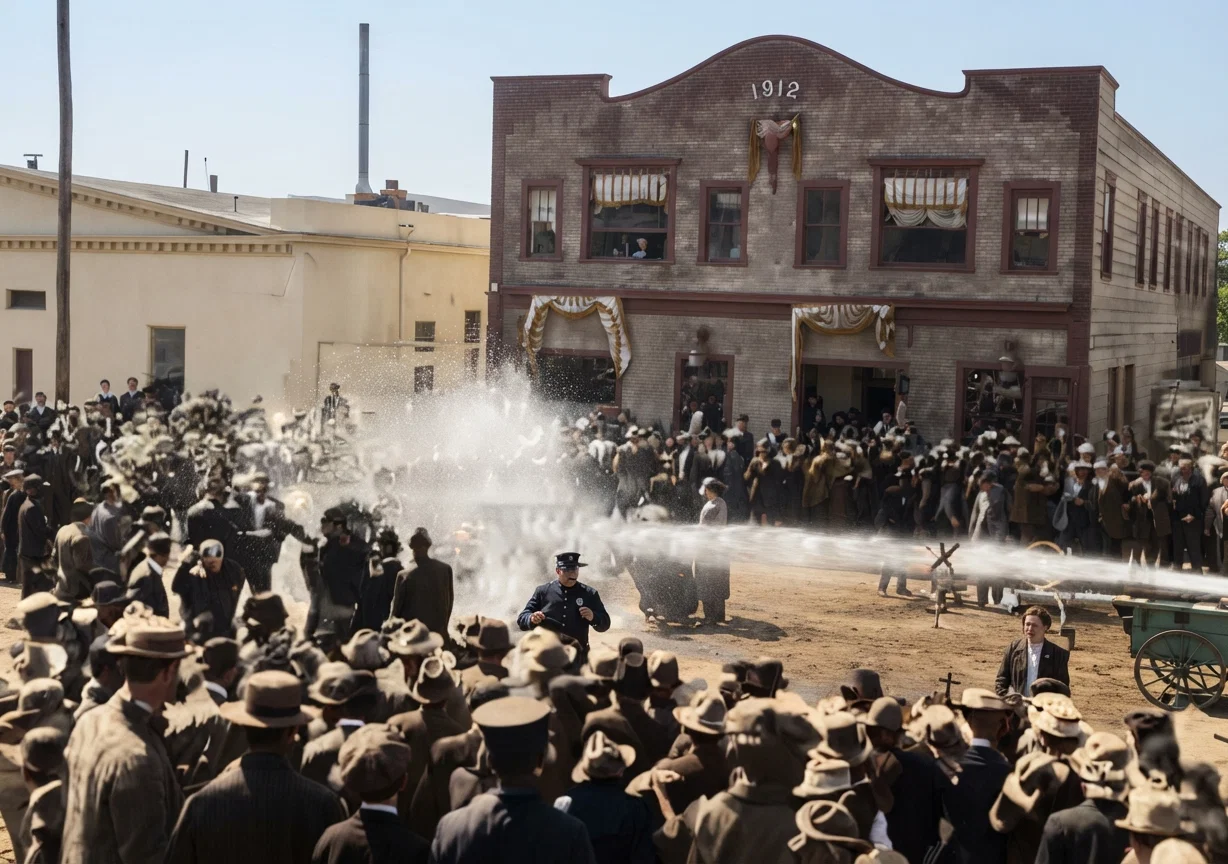
This is from a photograph of San Diego's attitude toward free speech. The lady just above the cross is Mrs. Wightman speaking.
As one newspaper has stated it, these men were not robbers, nor murderers, nor did they exceed the speed limit with automobiles; they were not sneak-thieves; they were not denizens of the red light district, which is said to be running full blast; they were not vagrants. Reputable witnesses, who were in San Diego at the time, told us that they did not use foul, abusive, vulgar, or profane language. The only crime they committed was the disobeying of an unlawful ordinance, or simply doing what had been done at the same place for years. As one writer has remarked, the corner where this speaking was done was not a congested corner. It was such a corner as speakers desire, a quiet place where people can listen without being interrupted by constant traffic or automobiles.
Finding that beating by policemen's clubs, kicking, jailing, did not stop the matter, the fire department was called out, and the hose turned on the crowd. Two women,—Mrs. Wightman, who we understand was not in the restricted district, but on the other side of the street, and a Mrs. Emerson,—were both thrown to the pavement by the force of the water, and thoroly drenched to the skin. Accounts tell us of a woman's being struck in the breast, and knocked down, and kicked after she was down, the policeman saying with an oath that she was not the first woman he had kicked. In a parade to protest against it, there were representatives of the Socialist Party, American Federation of Miners, various labor-unions, Industrial Workers of the World, Single Taxers, and Daughters of the American Revolution, as well as those who belong to no organization.
Surely it would seem that Americans would cry out against this wherever they are, to whatever party or organization they may belong. If a government, or city, or people are pursuing a course that will not stand the light of open discussion and free speech, it ought to perish. If conditions are what they ought to be, all the utterances that are made by agitators will not affect the good sense of the majority.
Not many months ago we were in England. One Sunday afternoon we went over to the Nelson monument, in the very heart of London. On the four sides of the great structure there is rostrum and room for four large audiences with speakers. Some of these speakers were tremendously radical in their utterances. Frequently the police themselves were abused; but outside of those vast throngs, policemen were in attendance keeping order and quiet, so that the speakers could be heard; and when it was over the crowd dispersed to meditate upon the things that had been said, and the policemen stayed on duty. No uprising; no disturbances; nothing to mar the peace.
San Diego is losing by the course that she is taking. She could well call to mind at this juncture the effort that has been made by the cities of Missoula, Montana; Spokane, Washington; Fresno, California; Kansas City, Missouri; Aberdeen, Washington. Entirely apart from policy, such ordinances are unconstitutional and wrong. And yet we wondered, as we listened to the earnest, strong, and yet very temperate protests made by labor-unionists and Socialists in Los Angeles against the action of the San Diego council, whether these men would allow the liberty which they are asking for themselves, to non-unionists, or "scabs," as they are pleased to call them. Would they allow ardent non-unionists to come before union headquarters and speak as freely as they desire to speak, always and everywherethat is proper? That is the real test of our love of free speech, not for ourselves, but the other man, who may be opposed to us. We wish that it were so; that these labor men who are so ardently pleading for free speech in San Diego, would plead for it just as heartily for non-unionists, for "scabs," for strike-breakers. The principle demands the one as truly as the other, and the "Signs of the Times" believes in free speech for all. If there is criminal libel, the transgressor is responsible to the law; but apart from this, let constitutional rights be maintained.
NOTE.—We were informed by one who had closely observed the matters from the beginning, that the real cause of this effort to suppress free speech had a religious basis. Socialists and Roman Catholics are deadly enemies. Socialism has been conducting a successful propaganda in San Diego, seemingly winning not a few Catholics; and when a Catholic becomes a good Socialist, he becomes a bad Catholic, and the uprising against them was instigated by sympathizers with the church. This surmise may be correct, or not. It has nothing to do with the real merits of the question. The Constitution of the United States declares both for free speech and the right to assemble, and that no law shall be made suppressing the one or preventing the other. We are not in this expressing sympathy with the Socialistic propaganda, or with the principles and methods of the I. W. W., or labor-unions.
These must stand on their own merits, but we do stand for free speech for all.