THE islands and groups of islands of Polynesia have long been the home of a people of dark brown skins and stalwart forms. These people lived on in ignorance of the existence of other men, until the early explorers chanced to sight the mountain-tops of unknown land, and, drawing nearer, in wonder beheld their brethren whom centuries of time and vast distance had separated from the rest of mankind. As the Lord had said, "This Gospel of the kingdom shall be preached in all the world for a witness unto all nations," evidently a divine hand was guiding the explorer, and bringing to light the nations that sat in darkness, that some from every "kindred, nation, tongue, and people" might be ready to meet their soon-coming King in peace.
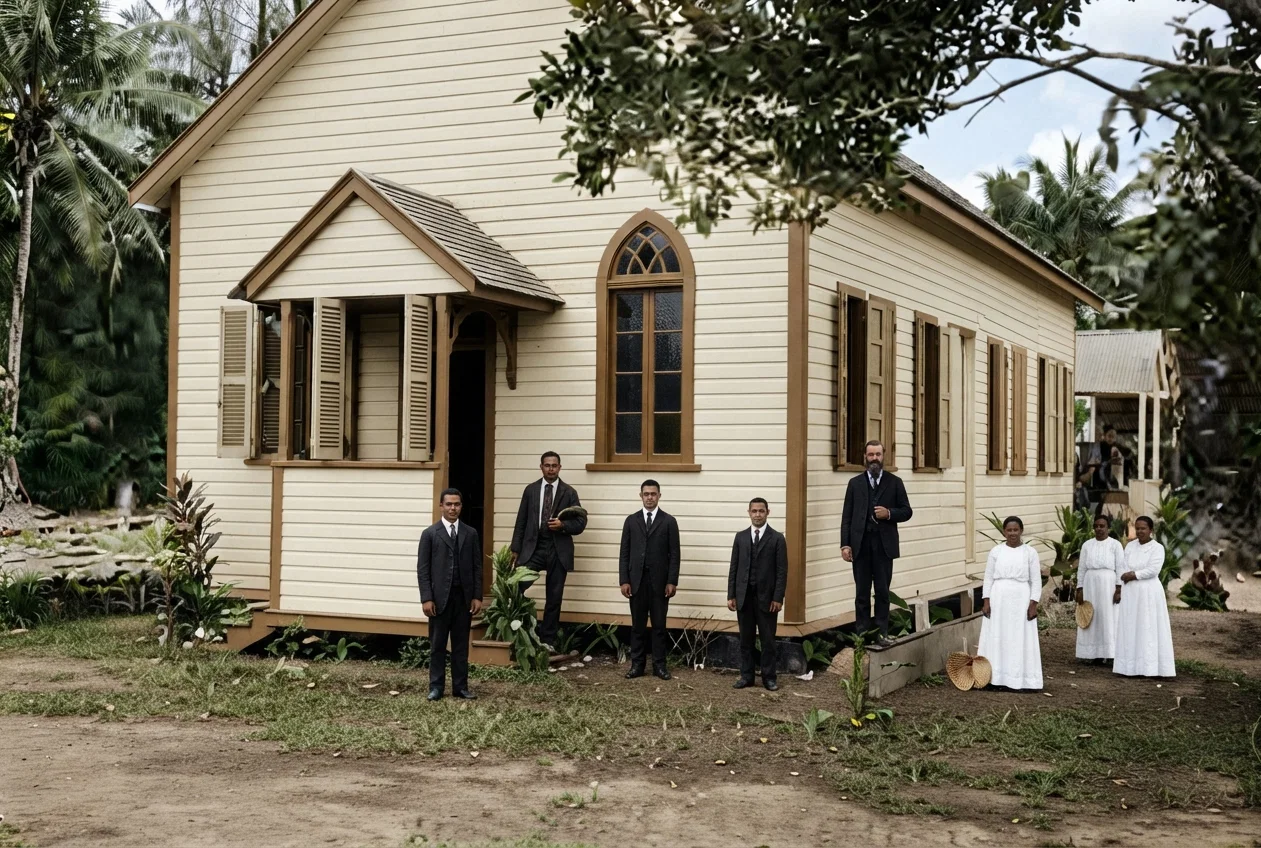
Seventh-day Adventist Church of Arue, Tahiti. Showing Elder A. J. Read and Native Deacons and their wives in front.
The Society Islands, the most important part of the French possessions in Polynesia, comprise Tahiti, Moorea, Raiatea and Tahaa, Huahine, Boroboro, Matea, Maupiti, and Tubuai Manu, besides several smaller islands. These islands are mountainous, and are inhabited by a race of people who in tastes and appearance are brothers and sisters. When discovered, these people were one of the finest races physically on the face of the globe, and, tho since much debased through the effects of rum and kindred evils, there is still a good deal of vigor manifested in the brawny frames and muscular appearance of many of the natives. They much resemble in language, physique, and habits the natives of New Zealand and of the other Polynesian groups.
As there are no finer islands of their size anywhere within the tropics than the Society group, it is not surprising that all the fruits and food-bearing trees that grow within the torrid zone should be found here. The products which are considered especially paying to the producer are coffee, copra, and the vanilla bean. Cotton has in the past been raised to quite an extent for exportation. A considerable quantity of oranges are shipped monthly to New Zealand. The orange trees receive no care whatever, but yield abundantly. Most of the land lies idle from year to year, or raises only weeds and trees.
In early days the Society Islands were ruled by native chieftains, who spent much of their time in planning campaigns and executing crusades against rival factions. At one time the warriors of Raiatea, under their daring leaders, brought beneath their sway the natives of surrounding islands. Their conquests extended as far as Tahiti, which lay 130 miles to the east.
During the years of early mission work, and up to the year 1844, the principal foreign influence in the group was British, and most of the foreign residents were from England. Through difficulties in which the native government became implicated with French priests, the islands came under foreign rule. "The Society Islands, together with the Marquesas, Tuamotu, Gambier, Tubuai, the island of Rapa, the Wallis or Wea, and Howe Islands, form what is called the French Establishment in Oceania, under the control of a Commandant-General, who resides in Tahiti. Tahiti was taken possession of in 1844, and the various other islands were gradually encroached upon by the French, until in 1880 they became French possessions."—Encyclopedia of Missions.
The present population of all these islands of the French possessions, and those of the Austral group, which are under the protection of the flag, is about 28,000, as shown by the government year book.
It was in the year 1797 that the London Missionary Society entered upon active operations in Polynesia, and despatched its first mission ship, the Duff, with a company of workers, to the island field. Several of these located in Tahiti. After nineteen years of trials and hardships, great results were manifested. In 1839 the following testimony as to the condition of society in Tahiti was borne by the captain of a whaler:
A Glimpse at Tahiti.—Population about 10,000.
"This is the most civilized place I have been in in the South Seas. It is governed by a dignified young lady of about twenty-five years of age. They have a good code of laws, and no liquors are allowed to be landed upon the island."
Five years later there was a change in the administration of affairs, concerning which the Encyclopedia of Missions bears the following testimony: "With the institution of the French Protectorate, the flood-gates of iniquity were opened. The people were corrupted by the influence of the rumsellers and other foreigners. The London Missionary Society mission was embarrassed and broken up, and withdrew from Tahiti and Moorea in 1852."
Whatever these people may or may not have been in the past, we know them to be needy of the bread of life to-day. Centuries of heathenism have bound many a poor native with evil habits as with chains of iron, that the power of the Gospel alone can break. The many pages of literature that our press on the island of Tahiti has turned out have found interested inquirers after truth, and thus our few laborers are given an abundance of work. Our brethren are endeavoring to instil right habits into the youth by taking several under their personal watchcare within their family circle. Any one who has ever tried the experiment knows that this line of work, along with other duties, requires eternal vigilance, and gives little time for rest or recreation. How our brethren are going to reach the 28,000 people who are scattered over a hundred or more islands, is puzzling to contemplate, unless they have more help. All of the above-mentioned islanders, speak the same language, and most of those who have reached years of maturity have learned to read.
The climate of these islands over which France exercises jurisdiction is healthful, tho of course debilitating to persons of weak constitutions and unaccustomed to the tropics. The malarial conditions of the New Hebrides and Santa Cruz Islands are not encountered here. Elephantiasis is the most common ailment met with aside from alcoholism.