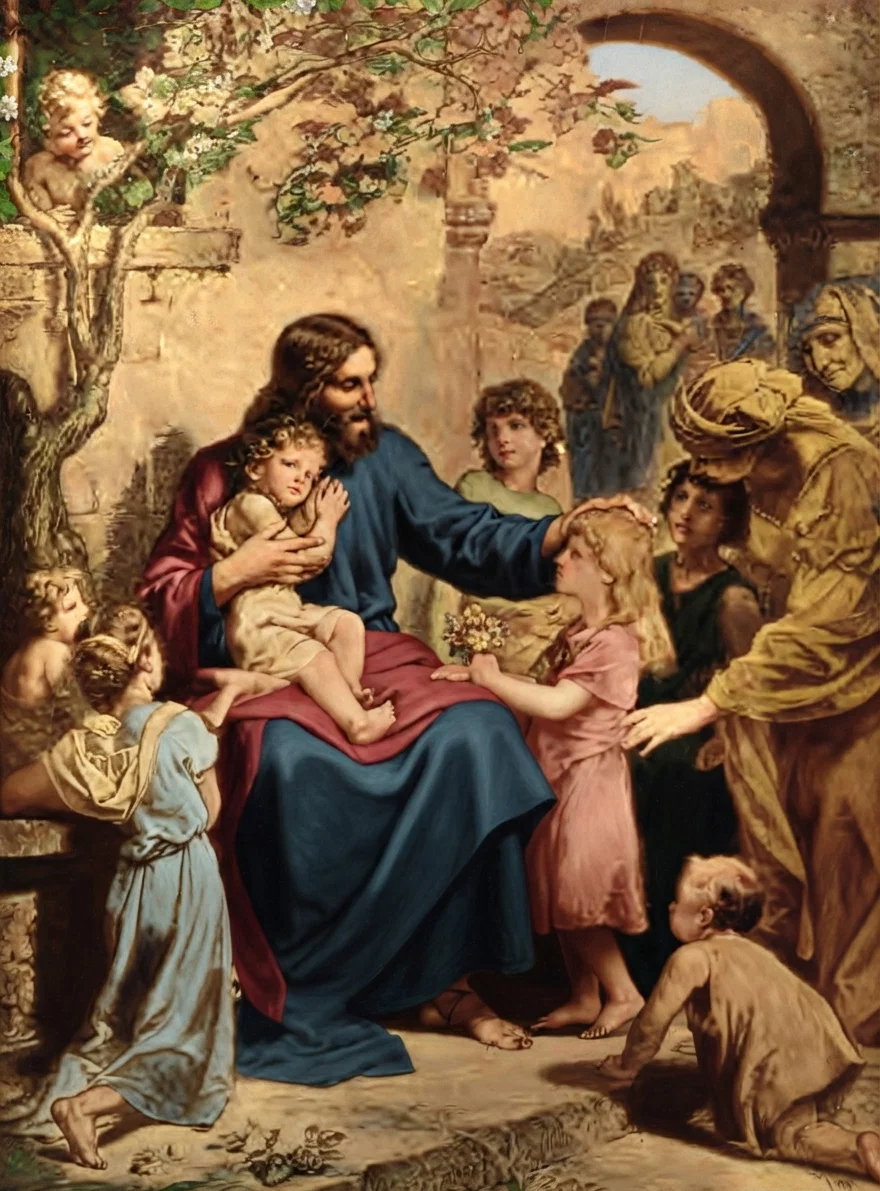
WHAT! the kingdom of God made up of such as these! Yes, that is just what the Master says—"of such." But little children are unlearned; they do not know anything about theology, or the sciences, or the traditions of the elders. Ah! that is just the point; and they know that they do not know anything; therefore they feel their dependence upon their parents for knowledge, and are continually asking for information. They believe what is taught them. Little children do not assume to know more than their parents or teachers.
Millions of people will be lost because they know too much, have too much of the world's wisdom. They would be teachers rather than to be taught the simple things that God would have them learn. But "where is the wise? where is the scribe? where is the disputer of this world? hath not God made foolish the wisdom of this world? For after that in the wisdom of God the world by wisdom knew not God, it pleased God by the foolishness of preaching to save them that believe." 1 Cor. 1:20, 21. There it is; we are saved by our faith in the Word of God, and not by our wisdom; and the little child is the personification of confidence in the words of its parents.
The worldly-wise men are so full of their own wisdom that they are above the Word. They think they know more about the universe than He who created it. They know more about science than the Author of science. Having learned from the wisdom of men, they think they know more than they who have learned from the wisdom of God, as given in His Word. The chief priests and Pharisees sought to quiet the convictions of certain officers with the query, "Have any of the rulers or of the Pharisees believed on Him?" and with a sneer at the ignorant masses—"this people who knoweth not the law are cursed." John 7:48, 49.
Moses was brought up in the royal household of Egypt, and was "learned in all the wisdom of the Egyptians." He was "mighty in word and in deed." His Israelite mother had been allowed to care for him in the earlier years of his life, and the seeds of truth then were watered by the Spirit of God to the extent that Moses knew that he was to lead the people of God out of Egyptian bondage. So at the age of forty years he "refused to be called the son of Pharaoh's daughter," he declined the heirship to the throne, "choosing rather to suffer affliction with the people of God, than to enjoy the pleasures of sin for a season." Heb. 11:24, 25.
But his first attempt to carry out his mission as a deliverer was essayed in his own wisdom and strength. Of course it was a failure, and the great statesman and general was soon fleeing from the country to save his life. Yet the Lord had a care for him, for he was a chosen vessel, and brought him to a place where he secured a situation as a shepherd. He was providentially kept in this industrial school forty years, until he had learned meekness, had learned that of himself he could do nothing (Ex. 4:10), had come to the point where he could be led as a little child. When he had learned to be "very meek, above all the men which were upon the face of the earth" (Num. 12:3), he was qualified as a typical deliverer, a leader of the people of God through the wilderness—himself being led by the counsel of God.
Jesus said, Suffer little children, and forbid them not, to come unto Me; for of such is the kingdom of heaven.
The apostle Paul was a learned man; he had attained high rank among the Jewish people. He says, "I advanced in the Jews' religion beyond many of mine own age among my countrymen, being more exceedingly zealous for the traditions of my fathers." Gal. 1:14, R.V. But after his conversion to Christ he "determined not to know anything, . . . save Jesus Christ, and Him crucified." 1 Cor. 2:2.
Nicodemus was one of the high councillors among the Jews, and must necessarily have been a learned and influential man. He, like other Jews, deemed his people the natural kingdom of God. But when he came to Jesus, the "Teacher sent from God," he was at once informed that he "must be born again;" that is, he must begin life over again, become as a little child. When one is born he knows nothing to begin with.
Everything has to be learned. So when he is born of the Spirit (John 3:5), he begins a new life; "old things are passed away; behold, all things are become new" (2 Cor. 5:17). When we are "born of water" we are "buried with Him [Christ] by baptism into death; that like as Christ was raised up from the dead by the glory of the Father, even so we also should walk in newness of life." Rom. 6:4.
The expression quoted as the caption of this article was called out on this wise: "They2brought young children to Him, that He should touch them; and His disciples rebuked those that brought them. But when Jesus saw it, He was much displeased, and said unto them, Suffer the little children to come unto Me, and forbid them not; for of such is the kingdom of God. Verily I say unto you, Whosoever shall not receive the kingdom of God as a little child, he shall not enter therein. And He took them up in His arms, put His hands upon them, and blessed them." Mark 10:13-16.
This language is very emphatic. Note particularly the positive statement, "Whosoever shall not receive the kingdom of God as a little child, he shall not enter therein." How does a little child "receive" any good thing?—He takes his food with absolute confidence, nothing doubting. As he comes to notice what is going on around him, and learns from whom he gets his food, he begins to look to the mother or nurse for the needed supply. He expects them to feed him. In a little while he learns to ask in his childish way for what he wants. And he asks expecting to get what he asks for. Father or mother doesn't turn him away because he is not educated and can not speak fluently or correctly. If he be properly trained, he will "receive" his food, clothing, and other necessaries with gratitude; he will promptly say, "Thank you," every time any good gift comes his way. He will not think his father, mother, or other benefactor is under obligation to him for receiving the good things proffered. Again, if properly trained, the child will be obedient, especially "little children." They believe implicitly what father, mother, nurse, or teacher tells them. Thus they "receive" instruction, as well as other good gifts, with confidence, appreciation, and love.
But the natural man does not receive the good things which God gives him in that way. "The natural man receiveth not the things of the Spirit of God; for they are foolishness unto him; neither can he know them, because they are spiritually discerned." 1 Cor. 2:14. This is why he "must be born again," why he must become a "new creature," why he must be born of the Spirit, and become a spiritual little child, so that he may live a spiritual life and receive a spiritual education. Thus he can receive the kingdom of God here and now, and enter into His glory at the coming of the King in glory. See Matt. 25:31-34.
And the little child is obedient to his parents. Not so the natural man to his heavenly Father. "The carnal mind is enmity against God; for it is not subject to the law of God, neither indeed can be. So then they that are in the flesh can not please God." Rom. 8:7, 8. Here, then, is emphasis on the fact that the natural man "must be born again," and "become as a little child," in order to enter the kingdom of God; for he can not enter that kingdom without pleasing God. "By faith Enoch was translated that he should not see death," because "before his translation he had this testimony, that he pleased God." Heb. 11:5.
There are many lessons for us to learn from the little children, insomuch as God has sent us to them to be taught, and has given them to be our exemplars in the manner of receiving without question that which God has provided for us at so great a sacrifice. "Have ye never read, Out of the mouth of babes and sucklings Thou hast perfected praise?" Matt. 21:16.