WHILE Christian help work is an integral part of our faith, and institutions are springing up in many large cities, we would like to present in the columns of the SIGNS OF THE TIMES a short statement of what is being done in this line in the city of Philadelphia.
One year ago, under the auspices of the church here, a building at 931 Spring Garden Street was rented, and work begun. The winter was far advanced when this home was opened, with E. A. Merrell, our pastor, as superintendent, and the brethren and sisters in the church as his supporters. In the four months that this home continued, there were furnished, at about cost, to homeless men, 14,000 meals and 8,000 lodgings, with bath and other privileges free.
Meetings were held each evening, with an average attendance of sixty men, with good results; and afternoon meetings for women and children were conducted weekly, in which was given instruction in cooking, domestic economy, and hygiene, for women; and for the children, morals, deportment, and physical culture. Food and clothing were distributed to poor families in the neighborhood of the mission. When the spring came, the location not being near enough to the quarter of the city where poverty and distress are most prevalent, and the building not well adapted for our needs, the mission was closed, with the expectation that the work would be resumed when cold weather should come. About sixty dollars was left over from this first venture, and was deposited for use in the reorganization.
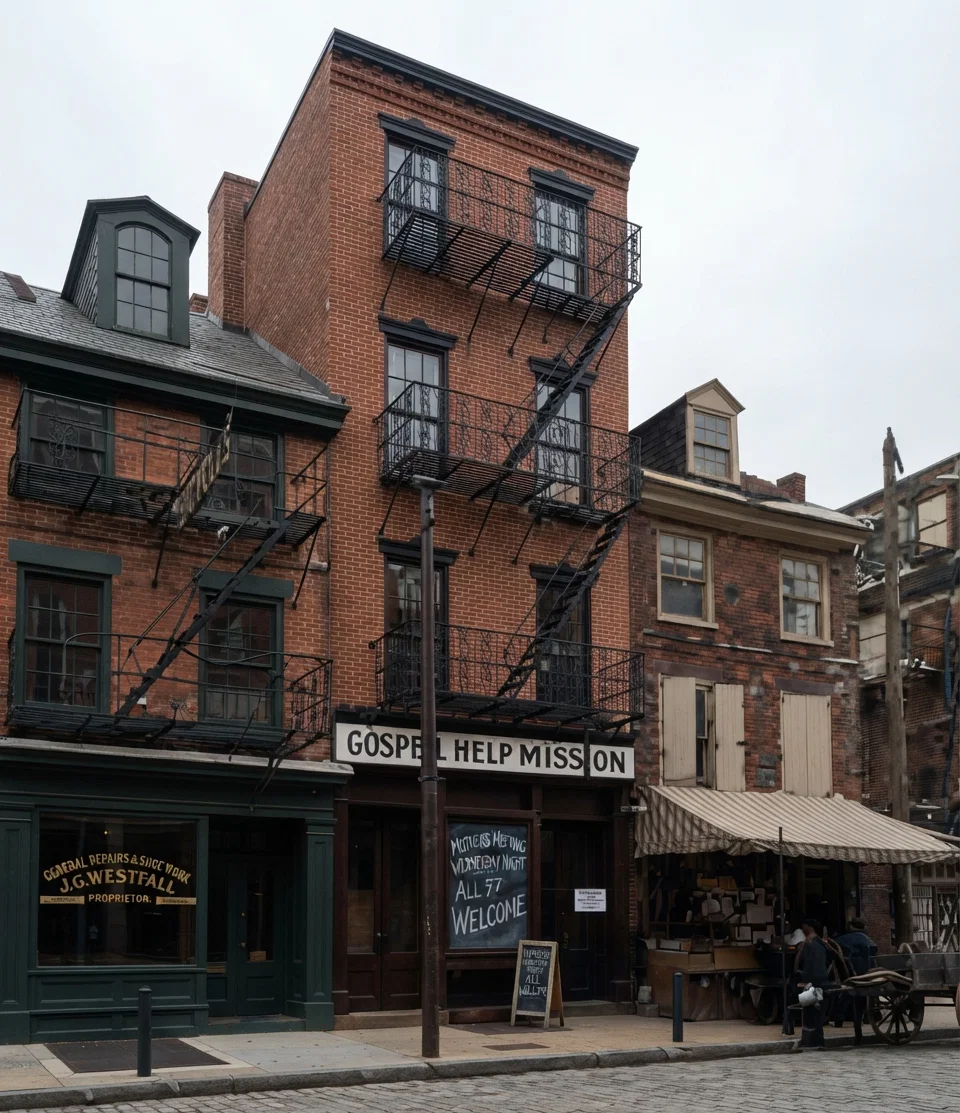
Early in the fall of 1898, those who compose the present board of control counseled together on reopening the mission, with the result that the commodious four-story building shown in the cut, located at 210 North Second Street, was leased, and the trustees of the estate to which it belongs put it in excellent condition for the use we were to make of it.
Gospel Help Mission, Philadelphia, Pa.
The first floor, in which the meeting hall is located as one of the rooms, is ninety-seven feet long; the second and third floors are seventy-seven feet long; and the fourth floor, fifty feet long. To the untiring efforts of the superintendent, by the help of God, is due much of the success of the enterprise that is apparent to-day.
The board of control is composed of the following persons: W. H. Edwards, president; Dr. W. L. Winner, secretary; Pastor E. A. Merrell, treasurer and superintendent; O. B. Hatton, and A. E. Tabor; all of Philadelphia. The secretary of the board has held himself personally responsible to the estate for the rent, and has in many ways conducted to the integrity of the work.
Almost from the start, the mission has been nearly self-supporting. It is true that a small debt was accrued to properly equip the building, complete the necessary amount of plumbing demanded by the city for the number we wished to accommodate, and arrange the cooking and bath departments. The present income pays all the costs for rent, food, fuel, et cetera, except the wages to two helpers. The small debt mentioned has been cut down two-thirds, and will be wholly wiped out, we trust, before the winter is gone.
We are now furnishing five hundred meals a day, and sheltering eighty men nightly, on the average. We have followed hygiene strictly in the dietary, and if it does not give satisfaction there is no complaint. We are circulating moderately in town an announcement stating the object of our work, also a card having the cut of the mission building on one side, and on the other side the bill of fare and name and number of the mission, hours of meeting, etc.
The cost of living at this modest hotel is: 2 rolls, 1 cent; oatmeal, 1 cent; cereal coffee, 1 cent; bowl of bean soup, 1 cent; bowl of pea soup, 1 cent; bowl of stew, and rolls, 5 cents; night shelter, cereal coffee, and rolls, 5 cents; lodging (good bed), cereal coffee, and rolls, 10 cents.
The "shelter" is in a large room on the second floor, well warmed by furnace heat, where the men may sit up, or lie on the floor, and be saved from the stifling atmosphere of the police station, or from freezing on the streets. The meetings are an interesting feature of our mission work. The hall is generally filled, and utmost and polite attention is given to the word spoken. When a call is made for sinners and backsliders to manifest a desire for prayers in their behalf, from five to fifteen arise. While hymns are sung, workers go to these and secure seats by their side, by politely requesting the one nearest to the man to take another seat, and the name and past experience are learned, and how deep is his desire for a better life. If possible, he is induced to kneel right there, and is prayed for and urged to pray for himself, which some do. These men are kept sight of, and soon work is secured, tho they may have been hunting it for six months.
We were much encouraged recently by the visits, labors for a few days each, and words of approval, from the pioneer workers in these lines—Brethren W. S. Sadler and Thomas Mackay, of Chicago, who had been assisting the mission in Brooklyn, N. Y., and came over in different weeks to help us. They expressed themselves to the board as much gratified to see the mission so far advanced in its work in so short a time. Workers from different missions in the city have visited our place, and say that there is nothing in this city—so full of charitable and humanitarian efforts, under many names and guises—exactly like ours, and commend the method.
We are also encouraged at the interest shown by some of the business people of the city, in their words and assistance. The secretary of the board, a few days ago, received ten dollars to aid the mission; and one of the largest grocers in town sent to the writer a10supply of tapioca, oatmeal, and other grains, with a pleasant note, asking that the things be accepted for the use of the mission. Others have given money, fuel, clothing, and bedding, for all of which the board feel grateful. The more we get by donations, the more meals we can dispense to those who haven't even the penny or the nickel.
It is a work for the salvation of the soul, as well as of the temporal man. In Philadelphia, as probably in all cities, the man who partakes of the hospitality of our mission for nothing, or for a nominal sum, feels some degree of gratitude to those who extend it, as he knows, not for gain, but for love of him. It does not take him long to decide that it is not man who is moving in this work, but Christ. Knots of men may be seen in the reading-room canvassing the subject and arguing that we must be Christians to establish such a place for outcasts like themselves. To God belongs the glory.
Brother W. F. Swartz has charge of the house, under the direction of the superintendent, and leads the nightly services in the absence of other help. Brother J. G. Hanna assists Brother Swartz and spends some time in the city holding cottage meetings. These two brethren are paid by the Pennsylvania Conference and the Medical Missionary and Benevolent Association. There are others who are helpers in various ways. The expenses of these last named have to be met by our board.
The members of the church take hold energetically to keep up the interest, by playing the organ, singing, and visiting in the neighborhood of the mission, and collecting and distributing clothing.
We feel satisfied that the Lord was with us in opening the mission, and we believe some souls will be found in the kingdom through the instrumentality of the Gospel Help Mission of 210 North Second Street, Philadelphia.
If any wish to donate money, food supplies, or bedding, the board will receive it with gratitude, and dispense it for the Master.
We would be deeply grateful if we could have a sufficient income to keep the mission open all the year. It has cost too much time and labor to fit it up to close the work in the spring, and then have to go over the work again next fall, and perhaps not secure so favorable a place as the house we now have. If money could be donated for the purchase of a dozen more double-decked iron bedsteads, and other bed appointments, also to pay the wages not otherwise provided for as mentioned, it would greatly assist in continuing the mission through the summer months.
All offerings should be sent to the treasurer, E. A. Merrell, 1724 North Fifteenth Street, Philadelphia.