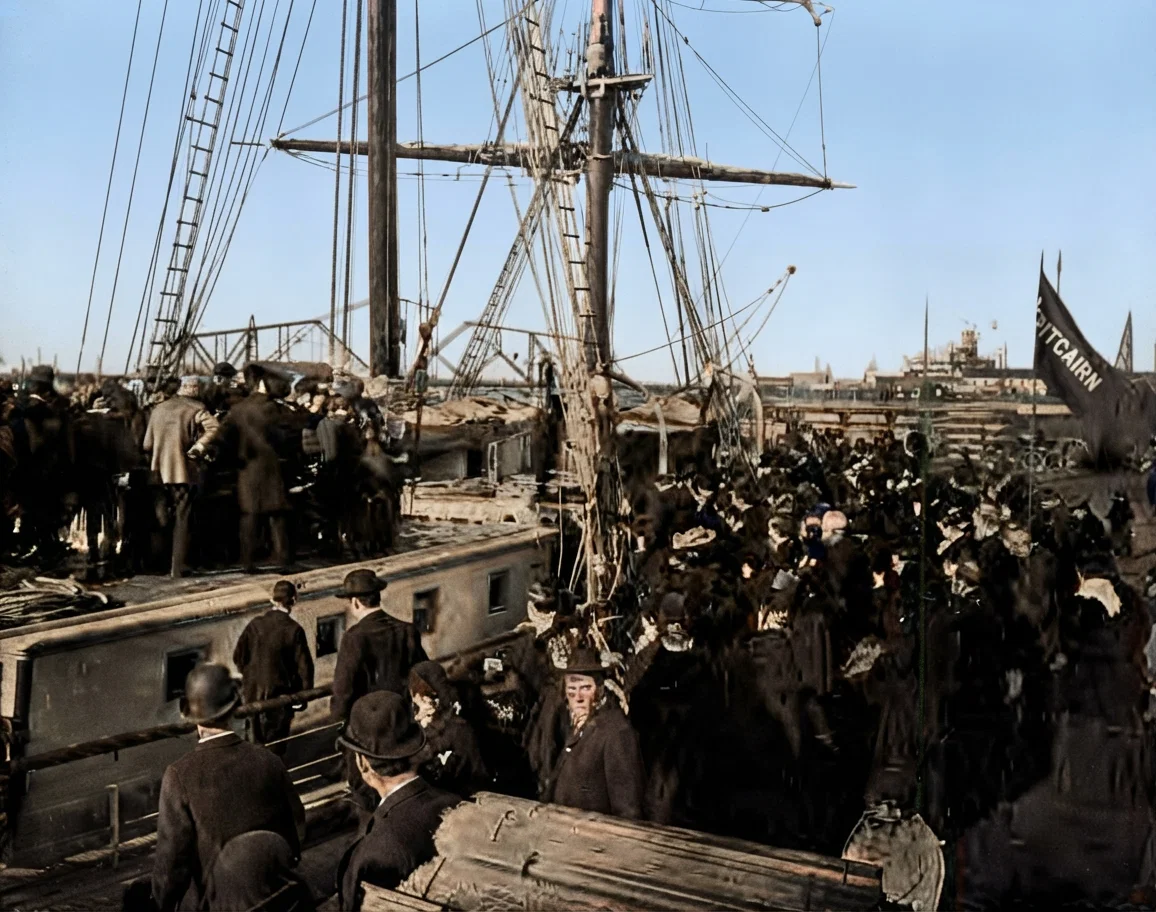
YES, our good missionary ship Pitcairn has entered upon its sixth cruise to the islands of Polynesia. It is probably now in the region where flying fish and tropic birds go dashing by and the north star hangs low in the horizon. It may be that our brethren have, ere this, sighted the southern cross and passed the doldrums.
As the ship is headed south no land will be sighted until 25° south latitude, where lies the island of Pitcairn, some thirty days' sail from San Francisco.
As our earth revolves upon its axis toward the east, the unstable elements of wind and water naturally rush across the equatorial region of the Pacific toward the shores of Asia. In order to take advantage of these currents, the course of our missionary ship is directed westward through the tropics.
The people of Pitcairn Island are always on the alert to note the approach of passing vessels, and as the season of the year has now arrived when they would naturally begin to look for the Pitcairn, they are no doubt doubly watchful. The eyes of the islanders and seafaring men become somewhat telescopic, so they are generally able to see much farther than landsmen.
While waiting upon Pitcairn Island for the return of our vessel, we one day heard a distant yell, which was soon caught up by others until it echoed and re-echoed over the length and breadth of the little island. Some one had sighted a sail. Immediately there was a general hurrying to and fro, men gathering oranges, bananas, pineapples, and melons, while others hastily made ready to launch the whale-boats to go and meet the coming vessel. One with a glass from the hilltop reports that it is the Pitcairn, and there is great rejoicing.
We can quite imagine ourselves once more seeing the islanders gathering in the old thatched chapel to hear the good news from America. The onward progress of the message that we love, the need of a deeper Christian experience, and the reception of the Holy Ghost, are all topics of live interest to these people.
FAREWELL SERVICE ON THE PITCAIRN JUST BEFORE SHE LEFT THE WHARF.
As the Pitcairn sails away from the place after which our good vessel was named toward the Society Islands, the course will be to the northwest, where lie a large number of small coral islands known as the Tuamotu Archipelago. A rugged reef of coral, enriched by drift and sand, with a fringe of coconut trees, is all that goes to make up many of these low islands. While there are some fourscore places in this group where the little trading schooners call for copra and pearl shells, it would not be wise for the Pitcairn to stop at any of them, so she bears on her course to Tahiti, the port of entry and headquarters of the French possessions of Polynesia.
We have one brother in the low archipelago just passed, Alex Drollet, who is conversant with French, English, and Tahitian, and is in a position to do much good.
Our vessel is regarded with a friendly feeling generally by the natives, and its movements are carefully noted. The semaphore upon the heights back of Papeete, Tahiti, will not long have signaled a brigantine outside the harbor before it will be noised abroad among the natives far and near that the "pahi Pitania" (ship Pitcairn) has come again.
Should the Pitcairn not return, the conclusion would gain ground among the natives that this religion was dying out. Its coming has a wonderful influence to strengthen the confidence of those who are weak in the faith, as well as to encourage those long in the way. The Pitcairn is the only missionary ship which visits the French possessions of Polynesia. The London Missionary Society has abandoned that portion of the South Pacific.
Our work among the Society Islands has been largely confined to Tahiti and Raiatea. None of our workers have yet located upon the fine islands of Moorea, Tahaa, Huahine, or Boroboro.
Tahiti and Raiatea both have commodious harbors, while Pitcairn, Rurutu, Rimitara, and Rarotonga are deficient in this respect. Whole navies might drop anchor within Raiatea's barren reef.
Six hundred miles west of the French possessions the rugged heights of Rarotonga present a pleasing picture to the visitor. Our brethren who are there laboring year after year will no doubt do their share of rejoicing upon sighting the welcome sail of the Pitcairn.
Rarotonga is the principal island of the Cook group, Aitutaki, Mangaia, and Atiu being smaller, but still important islands. Upon none of these have we workers except on Rarotonga.
After visiting Samoa, where war and unrest fill the hearts of the native people, our brethren will hasten on to Tongatabu, which is the principal island of the Tongan group. Here the king of Tonga has his palace and the proudest of Polynesian tribes conduct a very elaborate system of government.
The Tongans are a fine-looking people, who make singing their specialty, and farm a little at odd intervals.
Beyond Tonga lies Fiji, with its population of over 100,000. Suva, Fiji, is the greatest business center of the South Sea Islands. Steamers come and go frequently. The large population is scattered over a great many islands, so that Fiji comprises about as much in population, business, and territory as all the other groups mentioned combined. It is a great missionary field. Large numbers of natives from the Solomon group and other cannibal isles to the west have been brought to Fiji on the labor vessels. These men are now scattered among the Fijians. It seems to us that an excellent opportunity is thereby given the missionary of reaching the wild natives of the western groups by beginning with those now in Fiji, where the climate is more healthful and environments less trying than in the Solomon or New Hebrides groups. There are also large numbers of East Indians in Fiji.
We will not go farther with the ship at this writing. E. C. CHAPMAN.
Egypt.—The obstacles in the line of work in Egypt are many, but let me mention these three: The learning of the Arabic language is difficult because of its many guttural sounds. The prevailing religion is Moslem, and it is hard to fight against, because it is a mixture of truth and error. Another difficulty is the position given to woman. She is liable to be divorced at any time, and divorce hangs over her head like the sword of Damocles.—Rev. W. M. Nichol.10