CAUSES are sure to bring their results. To say this is merely to state one of the commonplace things of nature.
There are soon to be some results in this nation, and for that matter throughout the world, as the direct outgrowth of the great amassing of wealth in the hands of a few individuals, and the wanton extravagance and unwise display of those who are so wealthy.
An instance was chronicled in the despatches a few days ago. Mr. Edward E. Stotesbury, partner of J. P. Morgan, was married. His bride's trousseau was said to be the most costly and fine of anything that had ever appeared amid the fashionable circles of Washington, D. C. She had "eighty gorgeous Parisian gowns, sixty equally gorgeous domestic gowns, a hat to match each costume, and trunk after trunk of wonderful lingerie." And the despatches say further that these were only a part of the prominent articles in this most wonderful and costly bridal outfit; for there was a full quart of gems of the rarest kind. There were pearls, diamonds, rubies, and emeralds bestowed upon the bride by her groom-elect and his millionaire friends. "A conservative estimate" places the value of these jewels alone at $1,500,000.
One of the gifts that attracted much attention was the necklace of two hundred diamonds bestowed upon the bride-elect by Mr. J. P. Morgan himself. From this necklace "depends an enormous pear-shaped stone of rarest water," "stated to be even larger than the famous Hope diamond."
The papers told all about this remarkable affair. Columns were given up to it. It was one of the greatest of "society events." Thousands, yes, even millions of the common people doubtless read these reports. And a great many of these selfsame common people do not have even the actual necessities of life, much less its luxuries. If the men and women who are thus wantonly, extravagantly, and recklessly flaunting their expenditures in the face of the poor could only hear the voices that are commenting upon this squandering of means; if they could be enabled to hear the vast multitude who are saying, "I wish I had some of this means to buy food and clothing for my hungry and well-nigh naked children;" in a word, if all these suppressed murmurs of discontent could be combined into one vast chorus and poured into the ears of the ones who are waving their senseless expenditure in the face of the populace, it would cause their hearts to stand still with terror.
It is needless to say that the poorer people are not taking note of these things. If you will mingle among those in the common walks of life and listen to the topics of their conversation, you will find that they are both reading and taking careful note of what is occurring. As an instance that will serve to illustrate this fact, the writer was listening a short time ago to the conversation of a group of section men. They were commenting on the woman who several months ago hired a special train to hasten her aged dog across the continent to some noted dog doctor in New York to see if the old animal could not have his already long sojourn upon earth prolonged for a few days more. Common sense would have directed that a humane officer give the old canine chloroform or some other anesthetic and put him out of the way as easily as possible and bury him in the manner that any truly sane person would bury a mere dog. But the woman who owned the old dog in question took with her a corps of "trained nurses," and spent $50,000 in getting him as quickly as possible to the doctor in New York. If the owner of the dog could have excused herself from her cares and sorrow long enough to hear what these men said, she might have found something that would take her mind to more practical things in life.
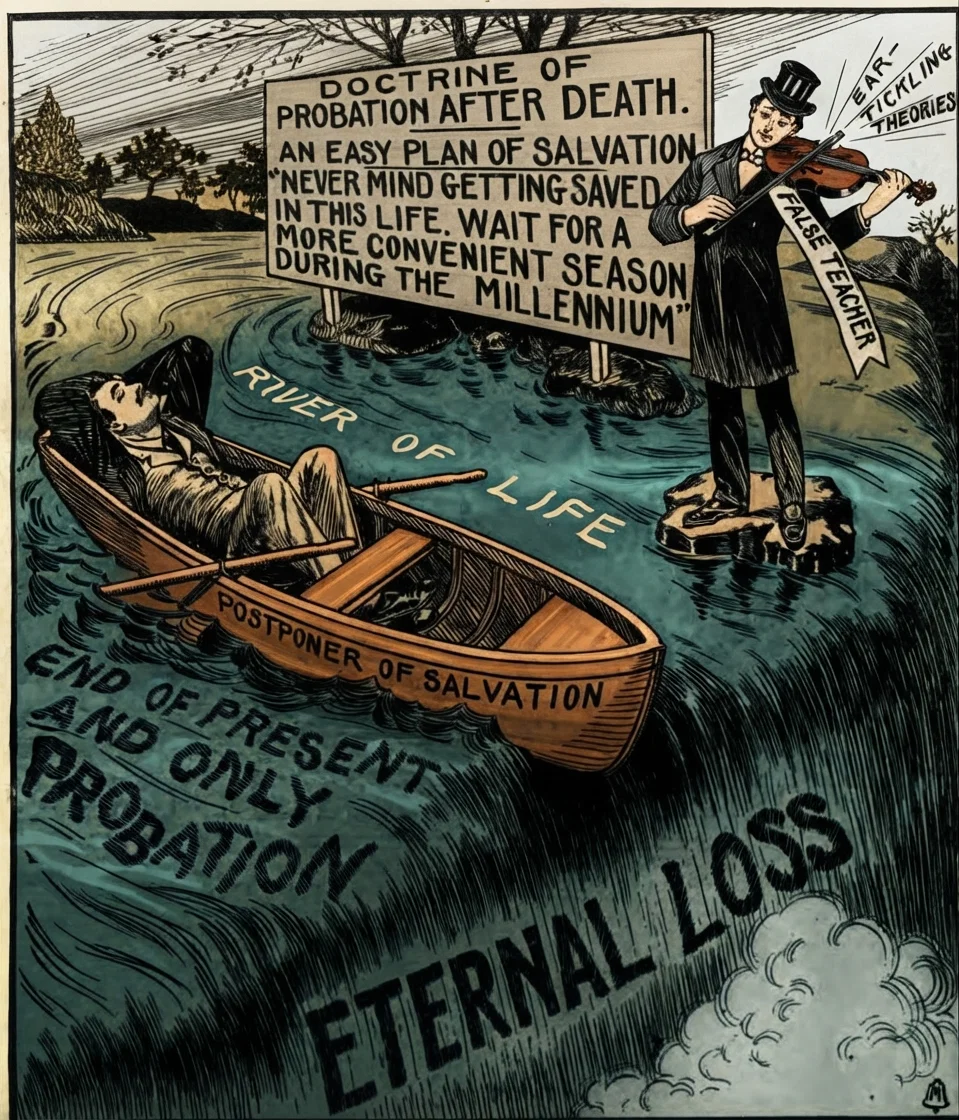
The music drowns the roar of the cataract. "Behold, now is the accepted time; behold, now is the day of salvation." 2 Cor. 6:2.
The men who work hard from seven in the morning until six at night for a dollar and a quarter to two dollars a day are not pleased that there are conditions in the country to permit a few people to spend vast fortunes in a single day without feeling it at all. They spend on the mere whims and vanities of life sums that would provide homes for a vast community of the common people. The common men and women are thinking of these things, and the struggle between capital and labor is doomed to be more and more fierce, until society will all be broken up into the chaos of anarchy and violence. We have the cause before us, and the effect can not help but follow.
We are made the more sure of this because of the following graphic and prophetic words:
"Come now, ye rich, weep and howl for your miseries that are coming upon you. Your riches are corrupted, and your garments are moth-eaten. Your gold and your silver are rusted; and their rust shall be for a testimony against you, and shall eat your flesh as fire. Ye have laid up your treasure in the last days. Behold, the hire of the laborers who mowed your fields, which is of you kept back by fraud, crieth out: and the cries of them that reaped have entered into the ears of the Lord of Sabaoth. Ye have lived delicately on the earth, and taken your pleasure; ye have nourished your hearts in a day of slaughter. Ye have condemned, ye have killed the righteous one; he doth not resist you."
"Be patient therefore, brethren, until the coming of the Lord. Behold, the husbandman waiteth for the precious fruit of the earth, being patient over it, until it receive the early and latter rain. Be ye also patient; establish your hearts: for the coming of the Lord is at hand. Murmur not, brethren, one against another, that ye be not judged: behold, the Judge standeth before the doors. Take, brethren, for an example of suffering and of patience, the prophets who spake in the name of the Lord."
James 5:1-10.
A little study of the foregoing scripture will lead one to see that it utters a prophecy as well as states some great principles. Its startling warning is for the rich who have laid up their treasure "in the last days," and who have kept back the hire of the laborer, and who have not failed to nourish their own hearts even tho in a day of slaughter. And because of these conditions the rich are bidden to "weep and howl" for the miseries that are coming upon them—miseries that they are bringing upon themselves by their own conduct.
There are developing three distinct classes. There are the very rich who are oppressing the poor, and the poor who are fighting them by every means that they can invent. And then there is a third class who are students of the prophetic word, who are not a party to the strife on either side. The foregoing quotation calls this latter class the "brethren" who are patiently waiting amid all this strife for "the coming of the Lord." Those who thus confide their cases to the Master will have no terrors in that day. Now is the time for us to decide where we will then stand. T.