OREGON and California are among the states that have the new plan of the initiative, referendum, and recall. And in both of these states there is much agitation by those who favor Sunday laws. They are seeking to have laws placed before the people of both these states to be voted upon at the elections this fall.
Then in addition to these plans for state-wide laws, they are now beginning to get counties to initiate laws, so that if the law fails to carry in the state as a whole, it may have the chance to carry in numerous counties.
Sunday laws may appear very harmless. But Sunday laws are religious laws, no matter how much the attempt may be made to cover up the fact. And there are always enough bigots in any community to start persecutions when they have the law on their side. It is perfectly easy for us to see the bigotries and the persecutions of the past. But one of the curious things about humanity is that it will engage in doing the very thing it condemns in the past. When attention is called to it, the reply is, 'O, that thing back there was wrong, but this is different.'
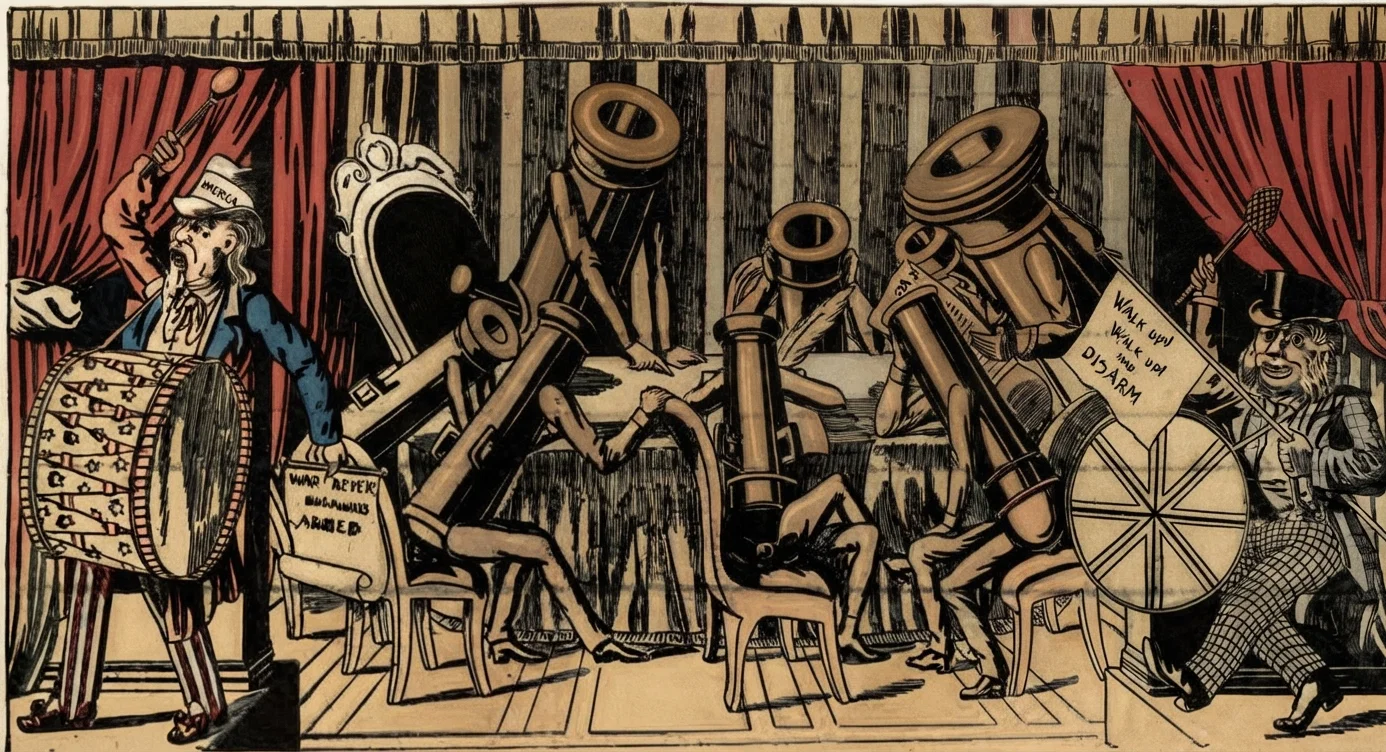
The talk in favor of peace while the world goes on preparing for war is a favorite topic for the cartoonist. The above is one of the very many suggestive sketches that are published almost daily.
So far as we know, the first county in California to invoke the initiative for a Sunday law is Colusa. That county has already sent in her petition entitled a 'Weekly Rest-Day Act.' The proposed law seeks to do away with liquor selling, all unnecessary work, and sports, on Sunday. 'Some of the exceptions listed are operation of railroad-trains, loading and unloading perishable goods and freight, running street-cars, telephones and telegraph, the operation of hotels and restaurants, lodging-houses, and such places as are necessary for health, such as drug stores.'
According to this proposed law, then, certain work may be all right on one day of the week, but the same thing is a crime if done on another day; certain sports are a crime on one day of the week, but are all right on all other days of the same week. If the day on which the thing is done is that which puts the criminal coloring matter into the deed, and furthermore, if that day is the one that is commonly regarded as the Sabbath day, it ought to be easy to see that the law is a religious one. It is the religious character of the day that makes the demand for the law, and not the desire to help some poor laboring man, as the advocates of the measure would fondly have us believe. If the desire, as they express it, is to help free the laboring man from the constant grind of seven days of toil, why prevent him from having games and sports on that day? If the law is purely a secular one, and only designed to give freedom from toil, why does it prohibit play? The thing is sufficiently transparent. Men ought to be able readily to see through it.
Then above all things, why exempt the street-car lines and the railroads? The corporations that conduct these lines of business are said to be among the most exacting. It is claimed that they are among the very worst to demand ceaseless toil. Why exempt the very worst offenders? If the law is all right in itself, Why not make it general? That would at least remove from it the appearance of class legislation, and it has been universally conceded that class legislation is wrong.