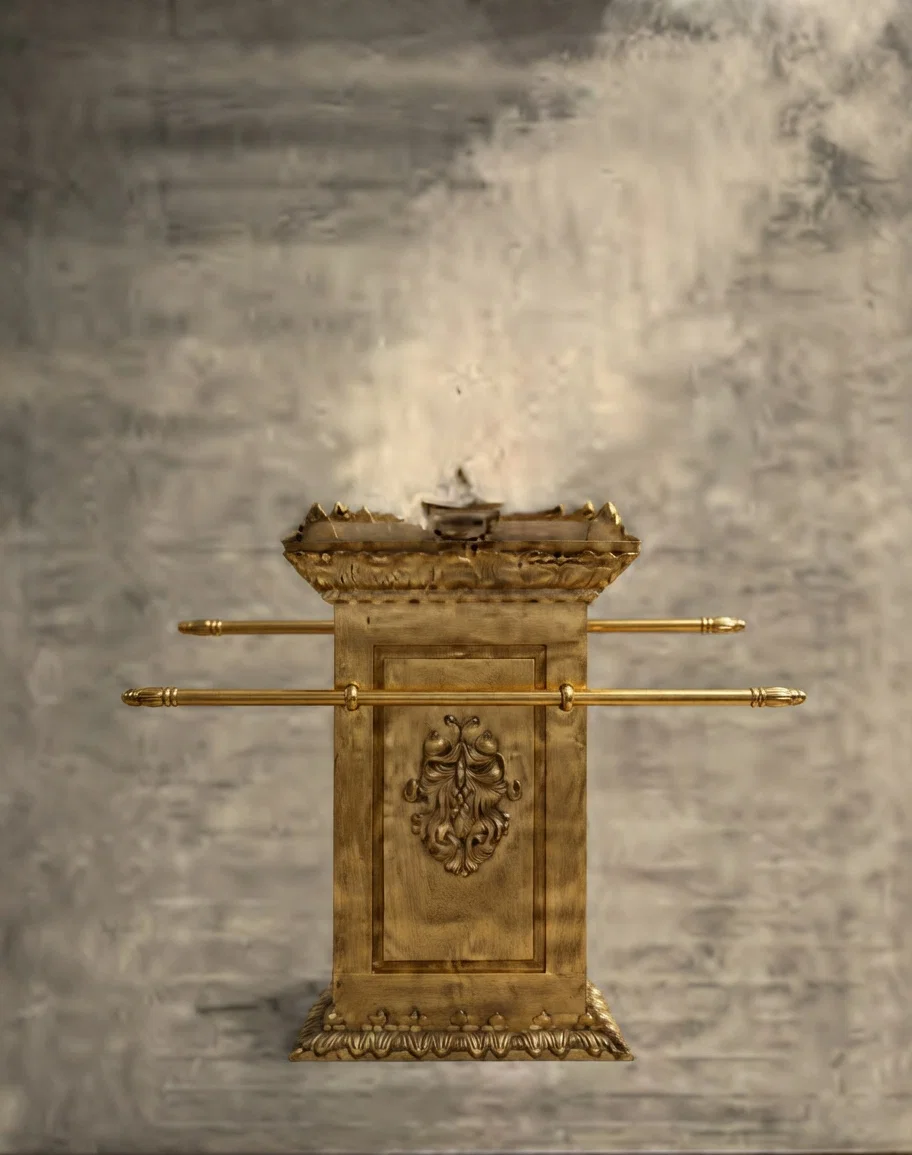
HE golden altar, or altar of incense, was before the veil in the first apartment of the sanctuary. It was a cubit square, and two cubits high, with horns upon each corner. The altar was made of the shittim or acacia wood, and all overlaid with pure gold. Around the top was a beautiful crown of gold; and beneath the crown, rings and staves, all overlaid with pure gold, for carrying the altar.
Within the crown of gold which encircled the top of the altar, holy fire was kept constantly burning (Ex. 30:8), from which ascended the fragrant smoke of the incense. The perfume of the incense pervaded the entire sanctuary, and was carried by the breeze far beyond the precincts of the court.
The incense, composed of equal weight of four fragrant gums and resins, was made by divine direction. It was very sacred; and the individual making any like it, even for perfume, was cut off from among the people. Ex. 30:34-38.
Incense was kept constantly burning upon the golden altar, and was renewed every morning and evening by the high priest. The high priest alone was to perform the sacred duty of putting incense before the Lord on the golden altar. Ex. 30:7, 8. The altar and the fragrant incense in the earthly sanctuary were but a shadow of heavenly things, an example of the work our great High Priest is performing for us. Heb. 8:5. Our minds should often dwell upon the work of Christ in the heavenly sanctuary. Heb. 3:1. Moses, when directed to build the sanctuary, was "caused to see" the heavenly model of which he was to make a "shadow." Ex. 25:40, margin. John the beloved disciple was permitted several times in vision to behold the Saviour officiating in the heavenly sanctuary. He saw a heavenly being standing at the glorious golden altar in the heavenly sanctuary. He beheld the incense offered upon that wondrous altar. How it must have thrilled his soul, when he saw that precious incense added to the poor, faltering prayers of the struggling saints here on the earth! He saw those prayers, after the incense was added, ascend up before God, and they were accepted because they were made fragrant with the incense. Rev. 8:3, 4, margin. "We know not what we should pray for as we ought: but the Spirit itself maketh intercession for us with groanings which can not be uttered. And He that searcheth the hearts knoweth what is the mind of the Spirit, because He maketh intercession for the saints according to the will of God." Rom. 8:26, 27.
But even the Spirit could not present the prayers of sinful mortals before a pure and holy God without adding the fragrant incense. When Jesus was preparing His disciples for His separation in person from them, He assured them that "whatsoever ye shall ask the Father in My name, He will give it you." John 16:23. The strength of a name is the character of the individual that bears the name. The name of the precious Redeemer is honored, and every petition presented in that name is granted in the courts of heaven, because Jesus lived a sinless life. He "knew no sin." The prince of this world had nothing in Jesus. John 14:30. He had nothing in Him, for He was pure and holy, without one stain of sin. It is Christ's righteousness that makes our prayers accepted before the Father. John saw the smoke of the incense, with the prayers of the saints, ascend up before God. Our prayers, made fragrant by the righteousness of Christ our Saviour, are presented by the Holy Spirit before the Father. To John in vision it appeared like a cloud of smoke bearing the prayers and fragrant incense up before the throne of the Infinite One. The weakest saint that knows how to press his petitions to the throne of grace "in the name of Jesus" the Sinless One, has all the treasures of heaven at his command. Having the richest multimillionaire of earth sign his checks at earthly banks would in no way compare with the privilege of the Christian.
The Altar of Incense
The name of Jesus is often added to prayers in a meaningless way. Many prayers are spoken for a mere form of worship, and go no higher than the head of the one that offers them; but every prayer of faith reaches the ear of the God of the universe. David understood what was typified by the incense, and prayed, "Let my prayer be set forth before Thee as incense; and the lifting up of my hands as the evening sacrifice." Ps. 141:2.
There was no other part of the daily ministration that brought the priest as directly into the presence of God, as the offering of incense; so there is no part of our religious service that brings us as close to the Master as when we pour out our souls before Him in earnest prayer. Anciently, as in the antitype, the prayer of faith entered the "holy dwelling-place" of God in heaven. 2 Chron. 30:27.
A lamb was burned upon the brazen altar in the court each morning and evening at the time the incense was renewed upon the altar. The golden altar was an "altar of continual intercession," representing the prayers of God's people coming up before Him continually; while the brazen altar was an "altar of continual atonement," representing the putting away and destruction of sin, the only thing that separates from God and prevents any prayers from being answered. The morning and evening lamb was offered as a whole burnt offering for the entire congregation, showing their desire to put away sin and consecrate themselves to the Lord so that their prayers could ascend from off the altar with the fragrant incense. In ancient Israel, the people living near the temple gathered at that hour. Often "the whole multitude of the people were praying without at the time of incense." Luke 1:10, 11. The habit of morning and evening prayer in the homes came from this typical worship. The faithful Israelite who was far from the temple would pray with his face toward the temple where the incense was ascending each morning and evening. Josephus says the incense was offered as the sun was setting in the evening, and in the morning as it was rising. This service was ordered by the Lord as an "example and shadow of heavenly things." Heb. 8:5.
The type was beautiful, but the antitype far surpasses the type. In the heavenly sanctuary, there is an inexhaustible supply of Christ's righteousness. In the type, the incense was always ascending, typifying that any time, day or night, a struggling soul cries out for help or gives thanks and praise for help received, his prayers are heard. In the morning, as the duties and burdens of the day seem more than human strength can bear, the burdened soul can remember that in the type a fresh supply of incense was always placed on the altar each morning, and from out of the antitypical heavenly sanctuary help will come for the day to the one that claims divine help in the name of Jesus. In the evening, as we review the work of the day, and find it marred by sin, there is blessed comfort, as we kneel confessing our sins, to know that in heaven the fragrant incense of Christ's righteousness will be added to our prayers; and as in the type the cloud of incense shielded the priest (Lev. 16:13), so Christ's righteousness will cover the mistakes of the day, and the Father looking upon us will behold the spotless robe of Christ's righteousness. If we realized more fully the privilege of prayer, we would often say with the prophet, "I will greatly rejoice in the Lord; . . . for He hath clothed me with the garments of salvation. He hath covered me with the robe of righteousness." Isa. 61:10.
Not all prayers that are accepted before God are answered immediately, as it would not always be best for us; but every prayer to which the fragrance of Christ's righteousness has been added, is lodged on heaven's altar, and in God's good time will be answered. John saw those officiating before the throne of God, holding in their hands "vials full of incense," which he said were "prayers of saints." Rev. 5:8, margin. These prayers had been accepted, for the added incense was so fragrant that John said the vials were full of incense.
In the typical work, the one that attempted to use the fragrant perfume of the incense for his own selfish use was cut off from among the people of God. There was8(Continued on page 9)
The Altar of Incense
(Continued from page 7) to be no imitation of the incense. No fire was to be used for burning the incense except that taken from the altar before the Lord. Nadab and Abihu, while under the influence of strong drink, offered "strange fire" before the Lord, and were slain. Lev. 10:1-10. Their fate is an object-lesson of all who fail to appreciate the perfect righteousness of Christ, and appear before the Lord clothed in the filthy rags of their own righteousness. Isa. 64:6. When the plague was smiting the hosts of Israel, Aaron the high priest put incense on the censer and ran among the people, and God stayed the plague. Num. 16:46, 47. The incense was only burned on the golden altar and in the censer of the priests. Levites were not allowed to burn the sacred incense. Num. 16:3-35. The priests, who performed the work which typified Christ's work in an especial sense, were the only ones who could burn incense before the Lord.
The horns of the golden altar were often touched with the blood of the sin-offering, thus typifying that it was Christ's death that made it possible for our prayers to be answered and for us to be clothed in His righteousness. The fragrance of the incense was not confined to the sanctuary, but carried in the air to the surrounding neighborhood. In like manner, when one is clothed with Christ's righteousness, others will detect it. An influence will go out from them which those who come in contact with them will recognize and by its fragrance detect its heavenly origin.