The Balkan Situation

6%

Pacific Press Publishing Association · Mountain View, California · Nov 26, 1912

FromSigns of the Times, Vol. 39, No. 46.

Read the full edition

The Balkan Situation

It is still uncertain, but we may briefly summarize, as follows:
1. The uncertainty of reports. Many of these have been rumors, corrected afterward. This is especially true regarding the outcome of the struggle. Our readers may take with considerable allowance all the prophecies of the dividing up of Turkey and the results of the war. These will all doubtless be determined by a general European conference. There will be many demands now, but these demands must be harmonized, and there will of necessity have to be compromises and concessions.
2. Uncertainty of maps. The one printed by us last week was not accurate. Even such works as the Century Dictionary give us a map more than thirty years old, with all of Bulgaria north of the Balkans, and Rumelia a province by itself, when in 1881 Rumelia revolted from the Turk and joined Bulgaria. Rand & McNally's latest we believe are correct, and so also is the Standard Dictionary and atlas. Still, about this we need not worry; the map of Europe will soon be remade with new boundaries.
3. There has been cruelty unspeakable, without any question, and notoriously on the part of the Turks, and yet there is no doubt much sympathy for the Young Turks and their attempt to establish a stable government. Many feel that they have not had a fair chance, during the last four years, to do what they wished to do; and one noted journal remarks that the Turks have been somewhat indulgent to missionaries, as long as they do not attempt to pervert Mohammedans; but the Orthodox Church, to which the invading Slavs belong, is not so tolerant. That is, there is even more intolerance in Russia under the Orthodox Church at the present time, than in Turkey, if the missionary will let politics alone.
Of course there are the massacres ascribed to the Turk; and yet there are those well-informed who tell us that they have quite as often been perpetrated by Kurds, Albanians, Greeks, and Bulgars, and the Turk as an individual is not so much different from other men, after all. As the English "Spectator" remarks, "the Turk makes a good peasant, but a bad prince."
With his disposition he is no match for the tremendous dash and power with which Bulgaria has hurled against him. He has cut a very poor figure in this struggle, and is also at a great disadvantage in fighting with modern weapons. He is inefficient, not cowardly; and as to cruelty, the "Spectator" remarks that one can not tell whether he would behave like a fiend or a friend to a vanquished enemy. And the Springfield "Republican" remarks: "It is not necessary for Americans to give their unreserved sympathy to either side. It is not a holy war; it is a crisis and an age-long struggle, in which religion has a part, but also racial, economic, and political rivalry. We need not assume that all the right is on one side, and all the wrong on the other." It is really two great civilizations which can not, in the nature of the case, exist together, striving for the mastery.
4. The conflict would long since have ceased if the "powers" had not been divided. Knowing this division, the Balkan allies struck at the right time. One of the real features of the division has been Austria. Austria is Roman Catholic. The Slavs, of which the Balkan States are largely composed, are Greek Catholics; and Austria does not want a strong Slav state on her southeastern frontier. It is for this reason that she has done all in her power to keep Turkey just where she is, and the Balkan States weak. She has fomented jealousy and rivalry during the past for this purpose. While united in alliance with Italy, she still holds some territory that is Italian in population, and which under certain provocation would rebel. On her eastern and southern borders she has the Slav population, so that she really is surrounded in a way by hostile zones, and it is her purpose to keep the Balkan States as weak as possible.
5. The demands of the allies are not wholly known. There have been all sorts of rumors. Doubtless, as has been stated, the allies have not wanted to drive the Turk out of Europe, but they have certainly had the purpose of confining her to a very small territory. It has been stated repeatedly that she would be left with what is called the "Golden Horn," the little peninsula on which Constantinople is located. That would give Bulgaria and Servia each an outlet on the Aegean Sea, and Servia one also on the Adriatic Sea. It would give the northern part of Albania to Montenegro, the central part to Servia, and some of the southern part, perhaps, or at least some of the Greek populated territory, including Saloniki, to Greece. Another rumor is that the Balkan allies would be willing to organize two states out of Turkey,—Albania in the west, and the Slav state in the East, giving them autonomous government, but united in the federation, with one emperor over the federation, but each state having its own government. This the powers would hardly allow. It has been rumored that Servia had already taken possession of Durazzo on the Adriatic. This Italy and Austria forbid. They hold that the Adriatic Sea should be controlled by them, and it has been positively stated in news despatches that an ultimatum has been laid before Servia by both Italy and Austria. This, however, is denied.
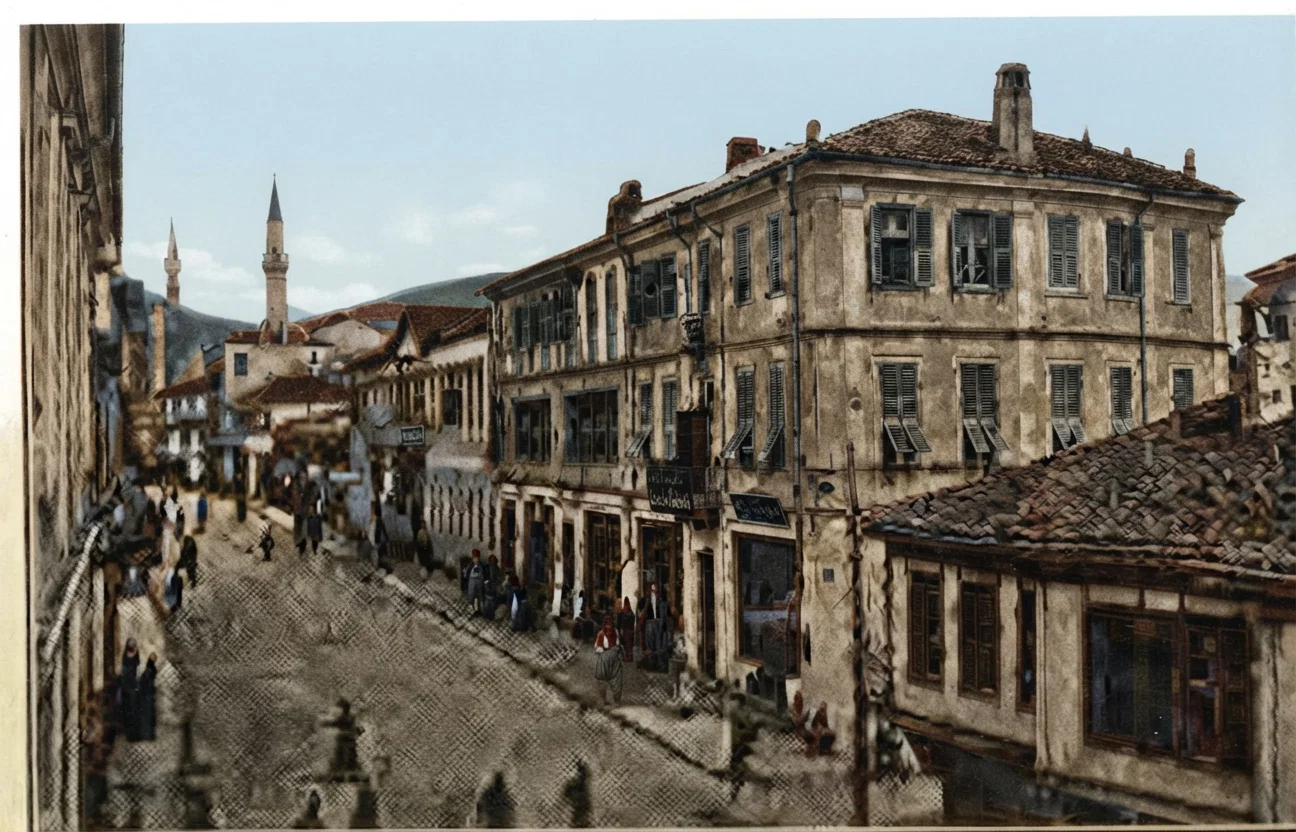
A street scene in Monastir, where heavy fighting is going on
Another rumor is that Saloniki will be made an international port, held by no one power. There are a half dozen ideal divisions suggested. Statesmen, newspaper correspondents, journalists, and editors have drawn ideal boundary-lines of the Balkan territory galore, but it is well to wait.
6. The powers will doubtless bring enough pressure to bear upon Austria to wait until the war is over. Then a European conference will be held, all the past conferences set aside, and a new division will be made with the Balkan allies as parties to the conference. That seems to be the most reasonable rumor in the air at the present time.
7. The present situation. The Turk is willing now to surrender everything but Constantinople and Macedonia, and she has bowed to the state which formerly has been subject to her, Bulgaria, and pleads for an armistice until peace conditions can be arranged. It was thought yesterday that this would be granted; but at this writing, November 17, it is not.
The allies demand the surrender of the Tchatalja army, the evacuation of Adrianople, Scutari, Monastir, and Janina, the surrender of all conquered territory, a war indemnity, and the internationalizing of Constantinople. This at present the Turks refuse to grant with the Bulgarian army within twelve miles of Constantinople, the subjection and capture of which is but a question of hours if the Turk remains obdurate.
Another foe as potent as the Bulgarians is within the Turkish camp, and that is cholera. There were 400 deaths from the disease in one army camp at Tchatalja in one day, November 14. There are nearly 3,000 cases within the Turkish lines, it is stated, and mutiny is feared among the troops. The number of sick and wounded in Constantinople is placed at 15,000. Turkey's condition is pitiable; unless the powers intervene—and it seems too late now—she will agree to any terms whatsoever.
It is well in the human uncertainty for us to wait fuller developments. We believe this, however,—that after this war, there will be greater freedom in the giving of God's last message to the world. That is what we saw in the war between Russia and Japan, and that followed, altho Russia has withdrawn much of that freedom which she permitted. And so in this present conflict there would be greater freedom in the preaching of the gospel. Let our readers be glad of this, and thank God.