Studies in Daniel

3%

Pacific Press Publishing Association · Mountain View, California · Nov 28, 1911

FromSigns of the Times, Vol. 38, No. 47.

Read the full edition

Studies in Daniel

III—Babylon and Her King
ONE of the first great cities of antiquity was Babylon, founded by Nimrod, the great "lawless warrior" of the family of Ham. The origin of its name was the sin of its founders. Rebelling against God, rejecting His law of beneficence in the peopling of the earth, they sought their own glory, and to perpetuate their own name. They declared that they would escape future deluges, concentrate their efforts, and become themselves the arbiters of men's destiny. They said, as recorded in sacred story, "Go to, let US build US a city and a tower, whose top may reach unto heaven; and let US make US a NAME, lest we be scattered abroad upon the face of the whole earth." Gen. 11:4. And they proceeded to build with their well-burned brick. Gen. 11:3. Upon some of those very bricks scholars have found the name they gave their city. It was "Bab-il," or "Bab-ilu," the "Gate of God," or the "Gate of Heaven."¹ It was man's attempt to improve upon God's plan; to put man's work in the place of God's free grace and Spirit; to exalt the creature to the throne of the Creator; and they called it, as have the children of Babylon their efforts ever since, "the Gate of God."
But the erecting of other standards, which must be universally and forever false, always leads to confusion. And God, who gives no names without purpose, thus called it "Babel," or "Babylon," meaning "confusion." Gen. 11:7-9. Perverse men named the city what they hoped it would be. God named the rebellious efforts of man just what they truly are. From that effort of man, from that false principle, has sprung every false system of religion, and every perversion of the true religion, which has cursed the nations and the world, and put to death millions of the children of God. "Babylon hath . . . made all the earth drunken: the nations have drunken of her wine; therefore the nations are mad." Jer. 51:7.
"In populousness and antiquity, Assyria was far exceeded by the southern kingdom of Babylonia. HERE WERE THE CENTER AND STARTING POINT OF THE CIVILIZATION which afterward spread through Western Asia."² "The earliest religious, scientific, and artistic traditions of our present civilization were cradled in Babylon."³
Babylonian perversion of the true, the exaltation of the human to the divine, did not originate in man. It was taught him by the true "king of Babylon,"—"Lucifer," the fallen angel. Isa. 14:4, 12-14. Here are his thoughts, purposes, and principles: "How art thou fallen from heaven, O day-star, son of the morning! how art thou cut down to the ground, that didst lay low the nations! And thou saidst in thy heart, I WILL ascend into HEAVEN, I WILL exalt MY throne above the stars [mighty angels] of God; and I WILL sit upon the mount of congregation [as one reigning], in the uttermost parts of the north; I WILL ascend above the heights of the clouds [of angels]; I WILL make myself LIKE the MOST HIGH." Self-exaltation is the spirit of Babylon. At its least it is the perversion of the truth; at its greatest it is open, active rebellion against God; in all it is confusion,
and its ultimate destruction. And God has given us the origin, history, and end of ancient Babylon, that we may discern the character and see the end of modern Babylon. The former is a prophecy of the latter.
For a time He who ruled over nations suffered the Babylon of Nimrod to remain. As long as God could get glory, even from her perverseness, she was a dominant city of earth. When He could no longer use her, she fell, and Assyria, with the capital city of Nineveh, became the ruling power of the Orient. And yet from the days of Hammurabi (Amraphel, Gen. 14:1), "the city of Babylon, which he had made great, so continued. Its supremacy there was none to question." "No capital in the world has ever been the center of so much power, wealth, and culture for a period so vast."
At the time of our lesson in Daniel 1, a change had again taken place. Babylon, no longer Hamitic, but decidedly Shemitic, had, under a king (Nabopolassar), appointed B.C. 626 by the Assyrian emperor, arisen from its ancient ruins and former vassalage to proud Nineveh. Babylon was again in the ascendency.⁵
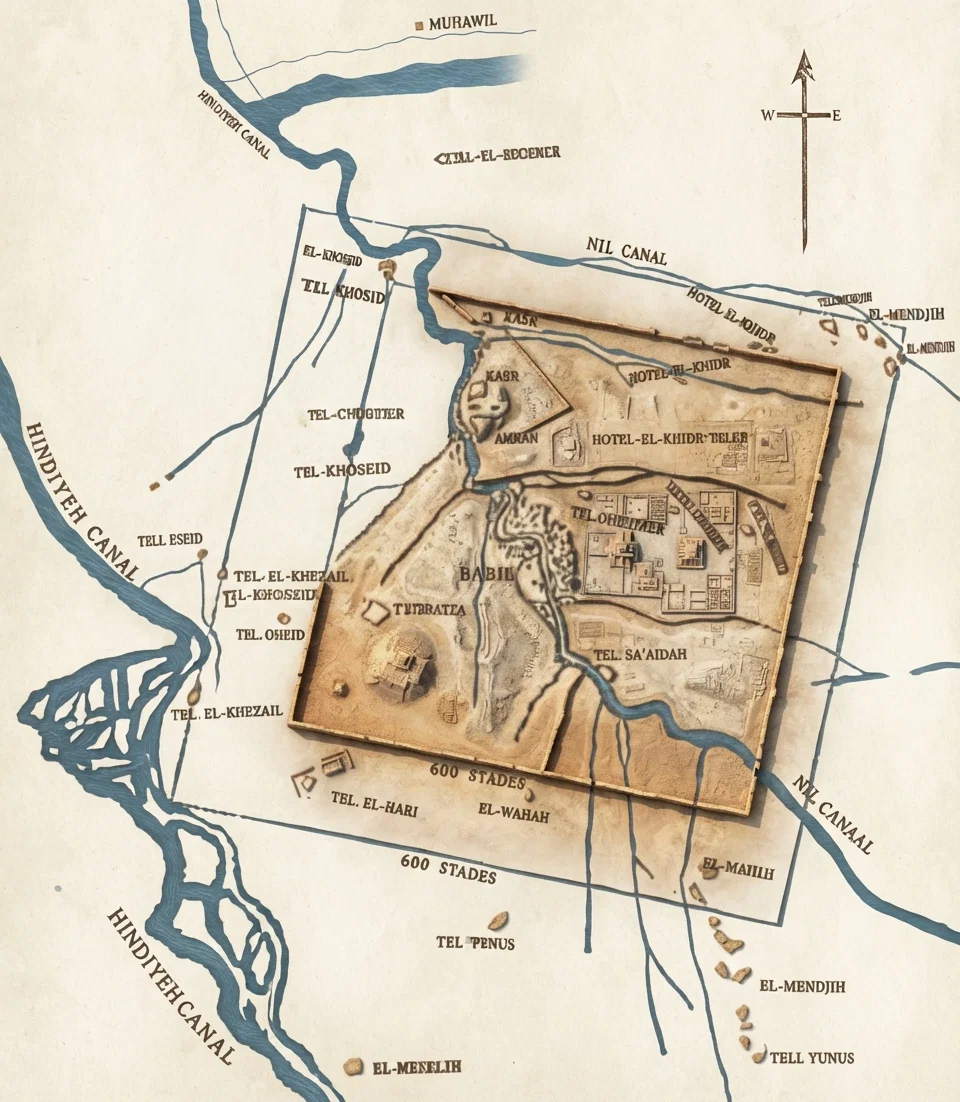
A map of the site of ancient Babylon and its environs
Assyria had yielded to the united and superior power of Media, Egypt, and Babylonia, her former dependencies, and Nineveh fell, as God had predicted. See Nahum, chapters 2 and 3. The kings of Babylon and Media had strengthened their mutual interests by marriage between the royal families. Egypt soon bowed her back to defeat. Proud and wealthy Tyre was humbled in the dust. Edom and Moab and Philistia had all passed under the rod of the mighty conqueror, Nebuchadnezzar, who in B.C. 607 was associated with his father, Nabopolassar, as joint ruler over the empire.
Babylon was just beginning to crown herself with her greater glory. Ancient public buildings and heathen temples were repairing, and new ones were projected on a much larger scale. Nebuchadnezzar, the son of Nabopolassar, was king. His wife was Amyitis, daughter of Cyaxares, king of the Medes.
Nebuchadnezzar was Babylon's greatest king. He seemed to possess neither the vanity nor the cruelty of some of the ancient Assyrian monarchs. He was progressive and enlightened. The very city in which he ruled had for
centuries been the seat of ancient learning. Even the kings of Assyria, who ruled over Babylon from Nineveh, acknowledged the traditional Babylonian greatness. Shalmaneser tells us, in his history of his expeditions, of his arrival in Babylon: "He entered also into Babylon, the bond of heaven to earth, the seat of life." The original name still held good among the heathen—"the Gate of God." Nebuchadnezzar's religious zeal was shown in repairing the ancient tower of Babel, which had fallen into decay. He himself tells this in one of his inscriptions, which have come down to us in one of the stone volumes.
He gathered around him as counselors those considered the wisest among the nations, and thus added luster to the glory of his reign. Education was fostered under royal patronage; astronomy flourished; universities great and ancient were maintained. Four classes of wise men are named in Daniel,—magicians, astrologers, ("enchanters," R.V.), sorcerers, and Chaldeans.
The astrologers were priests of the star worshipers, and pretended to foretell future events by the stars.
The sorcerers seem to be identical with soothsayers. They assumed to foretell the future by the examination of the entrails of animals, such a belief still prevailing among not a few in Christendom, who predict the winter's severity or mildness by the "melt," or spleen, of the swine.
The magicians, or magi, were a priestly class, highly educated, occupying a position of great influence between the ruler and the people. The originator of their religion was Zoroaster. They performed religious ceremonies, wore a peculiar dress, lived apart by themselves, and constituted a complete hierarchy. They were deeply versed, according to their times, in philosophy, the sciences, and especially in astronomy. They at times accompanied the king as his advisers, even in war. Jer. 39:3, 13. While there were doubtless many impostors among them, and the name through this class, in after-ages, assumed a low significance, there were also among them devout and wise men, who were doubtless worshipers of the true God. From this class came the wise men (magi) to see our Lord. Matt. 2:1. They were learned, influential, and wealthy, and Daniel was by the king placed at their head. Dan. 2:48.
The Chaldeans were the educated class, evidently including in their courses of instruction all the learning of the realm.
The promising royal youths of Judah, of good form and feature, and of royal bearing, were selected by the king as future servants, officers, and ministers of the government in Babylon. That they might be fitted for these responsibilities, the king placed them in his universities for a three-year course of special training. Here is the Bible account:
In the third year of the reign of Jehoiakim king of Judah came Nebuchadnezzar king of Babylon unto Jerusalem, and besieged it. And the Lord gave Jehoiakim king of Judah into his hand, with part of the vessels of the house of God; and he carried them into the land of Shinar to the house of his god: and he brought the vessels into the treasure-house of his god. And the king spake unto Ashpenaz the master of his eunuchs, that he should bring in certain of the children of Israel, even of the seed royal and of the nobles; youths in whom was no blemish, but well-favored, and skilful in all wisdom, and endued with knowledge, and understanding science, and such as had ability to stand in the king's palace; and that he should teach them the learning and the tongue of the Chaldeans. And the king appointed for them a daily portion of the king's dainties, and of the wine which he drank, and that they should be nourished three years; thatat the end thereof they should stand before the king. Now among these were, of the children of Judah, Daniel, Hananiah, Mishael, and Azariah. And the prince of the eunuchs gave names unto them: unto Daniel he gave the name of Belteshazzar; and to Hananiah, of Shadrach; and to Mishael, of Meshach; and to Azariah, of Abednego. Dan. 1:1-7, A.R.V.

Notes

1. THE THIRD YEAR OF JEHOIAKIM.—From Jer. 25:1 we learn that the first year of Nebuchadnezzar was the fourth year of Jehoiakim. Nebuchadnezzar, as the active force in the field, is spoken of as king two years before the death of his father Nabopolassar. His sole reign, therefore, after the death of Nabopolassar, began in the fourth year of Jehoiakim, as stated by Jeremiah. This captivity was in B.C. 606, the beginning of the seventy years' captivity of the Jews.
2. PART OF THE VESSELS.—Not all were taken by Nebuchadnezzar at this time. Jerusalem was taken twice subsequently to this by Nebuchadnezzar, B.C. 599 and 588, at which the last of the treasures were taken. See the last chapter of 2 Chronicles.
3. HOUSE OF HIS GOD.—These vessels were carried to Babylon (Shinar, Gen. 10:10; 11:2-9), were considered holy, and placed in the temple of his chief god, probably Bel-Merodach, the patron god of Babylon, to whom Nebuchadnezzar's inscriptions were addressed. This temple, says the king, "is the great temple of heaven and earth, the dwelling of Merodach, the master of the gods. I have restored its sanctuary, the place of repose of the deity, plating it with pure gold. I stored up inside silver and gold and precious stones, . . . and placed there the TREASURE-HOUSE of my kingdom," the very words which Daniel uses. At the base of the pyramid of this temple was a sanctuary of another noted deity, Nebo, the name of which enters into that of Nebuchadnezzar. This sad captivity of Judah came as the result of their repeated transgressions.
4. PRINCES.—Daniel and his fellows were evidently of the royal family, as indicated by Isaiah to Hezekiah a century and a half before. See Isa. 39:3-8. Nebuchadnezzar's judgment is shown in the character of the young men chosen, physically perfect and handsome, skilled in wisdom, endued with knowledge, understanding science, and having ability. That there were to be found such youths in Judah, speaks well of the schools of the prophets, founded by Samuel, and the advanced education given therein, notwithstanding Israel's apostasy.
5. THREE YEARS.—The university course, the advanced training which the king proposed to give to fit them for positions of usefulness in his government. They were to feed upon the king's dainties, the meats and wine of Babylon. Of this later.
6. NAMES.—From names which connected them with the true God they were to pass in their experience to names connecting them with the gods of Babylon or to the king. Daniel ("God is my Judge") was named Belteshazzar ("prince whom Bel favors"); Hananiah ("graciously given of Jehovah," a mother's thanksgiving) became Shadrach (rejoicing in the way, or little friend of the king); Mishael ("who is that which God is," a devoted mother's prayer) was changed to Meshach ("guest of the king"); Azariah ("helped of Jehovah," a prayer and prophecy) became Abednego ("servant of splendor, worshiper of the sun"). But they did not forget their God nor their people.
Of the ability of their instructors, the education Nebuchadnezzar proposed to give these youths, its real worth as compared with divine instruction, and the result of the trial between the two systems, we will consider in following articles.