EDITORIAL

8%

Pacific Press Publishing Association · Mountain View, California · Aug 13, 1912

FromSigns of the Times, Vol. 39, No. 31.

Read the full edition

EDITORIAL

The Child Jesus

THERE is but one sentence in all the Gospels which refers directly to the child life of Jesus. Together Matthew and Luke tell of His birth, of the worship of the humble shepherds, the circumcision of the Boy at eight days of age, His presentation in the temple, the prophecies of the aged Simeon and Anna, the adoration of the
Magi, the flight into Egypt, and the return to Nazareth of Galilee to the home of Joseph. Then comes the one pregnant sentence regarding His childhood days, "And the Child grew, and waxed strong, filled with wisdom: and the grace of God was upon Him." Luke 2: 40.
THE place where our Lord spent His childhood and youth was most favorable. He was born of the Jews, a preeminently religious people, possessed of the books of God's revelation, and with a wealth of tradition of His dealings with them providentially. His early life was not spent in Jerusalem nor in Judea, dominated as this section of Palestine was with a hollow, su-
perstitious, hypocritical, narrow pharisaism, and set over against that was the wickedness and immorality of the Romans. The parents of Jesus were simple, hard-working people in an ordinary Galilean village, where the best type of Judaism prevailed. The Holy Scriptures had taken stronger hold of the simpler, freer Galileans, and the traditions of the rabbis and doctors had less power with the people.
THE education afforded the children of the time was excellent. It began in the home, and was supplemented by the Levites in the synagog schools. It is generally agreed that the Holy Scriptures were made the basis of education up to the age of ten years. The education was therefore deeply religious. The sacred books were faithfully taught according to the instruction given in Deuteronomy 6, and the teachings and revelations committed to that people faithfully carried out. Jesus probably learned these at His mother's knee, who in faithfulness met the task which God had imposed upon her. This education included the whole Old Testament canon. Whether or not He attended the synagog schools the Scriptures do not tell us; but He learned in His study of the Scriptures, in all probability, the Hebrew, the Greek of the Septuagint, and the language of common conversation among the Jews, the Aramaic.
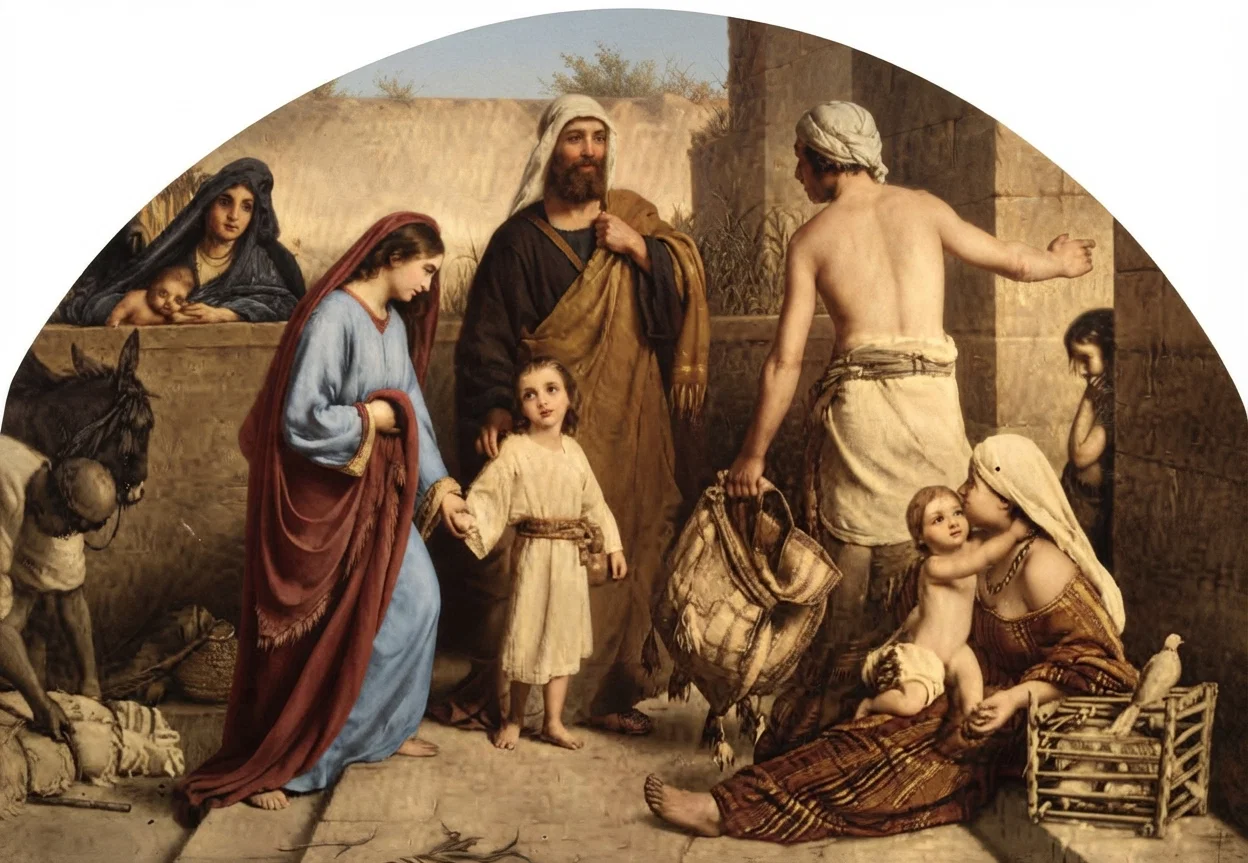
HOME LIFE AT NAZARETH
W. C. T. Dobson
HOME LIFE AT NAZARETH W. C. T. Dobson
THE education of Jesus did not include the barren, speculative philosophies of India, Greece, Egypt, or Rome. Doubtless these philosophies may have good things, but the good things were perverted by the false. It has been truly remarked that in morals and religion Judaism was to be the teacher,
not the taught. The education of the world's Teacher in His childhood was therefore drawn from the revelations of God's will through the Old Testament. He learned of Adam in his paradise home, of the fall of man, of the Deluge, of the confusion of tongues at the tower of Babel, of the call of Abraham, of the bondage in Egypt. In His childish receptivity He saw the great deliverance, witnessed the great Red Sea and the Jordan open, stood before the cloud-enswathed mountain, and amidst the reverberations of thunder, the flashes of lightning, and the roar of furnace heard the Ten Words of the great Decalogue. He saw the wonderful organization and order of Israel'scamp, and in the midst of that camp the pillar of cloud by day and pillar of fire by night, leading God's host to victory.
THEN, too, the Boy learned from nature. It has been said that the very configuration of Palestine was ordered of God, that it might be used in the greater enforcement of His revealed truth. From the snowy heights of Hermon to the Dead Sea there were lessons. Mountain and valley, tree and flower, from the cedar of Lebanon to the lily of the valley, had been enshrined in Hebrew literature and had been made teachers in religious things. Through them all God spoke to the heart of the receptive Child.
ANOTHER great fact in His education was a trade. Jewish children were not trained to a life of idleness, shiftlessness, worthlessness. The Jews possessed the splendid custom of teaching each one a trade. What a blessing it would have been if the peoples who know the Bible had followed the custom! Whether the future man ever uses the trade in after-life or not, its acquirement has taught him the use of hand and eye, the proper proportion of part and whole, the discipline of restraint and labor, the strength and manliness to overcome difficulties, to deny self for duty, and to make even weariness a delight and accomplishment. And we may be sure, as the Child wrought at the little tasks given His untrained fingers, or walked with His mother in the clear starlight of Galilee, or sat at the frugal meal, He was taught diligently by precept and example the great truth of God's law as inculcated by Moses, the man of God. In this way the Child Jesus grew and waxed strong, filled with wisdom, or, literally, becoming filled with wisdom as He grew, and the grace of God was upon Him. A demonstration of this we have in the later record of His boyhood and young manhood.
BUT what a lesson is here for parents! What mighty opportunities for God go unimproved, what trifles take them from the most important education of their children, the moral and religious! They are willing that the child mind shall be filled with folly indescribable, building into the fiber of its character gross perversions of great moral truth, and utterly wrong conceptions of the object of life, and the fruitage is seen in the multiplying hosts of perverted boyhood and young manhood of our schools and cities of to-day. The training of the child begins on the part of the parents before he is born, and especially with the mother, and should be begun with the child from the moment of its birth. In the injunction, "Train up a child in the way he should go," the word "train" means to narrow, to confine, to dedicate to that way. The Hebrew word is rendered "dedicate" in Deut. 20: 5. If it was important that a man dedicate to a holy family use for God his house, how infinitely more important it is that parents should dedicate their child to God, and do all in their God-given powers to hold him to that way! We do not mean by this as to trade, pursuit, profession, but as to moral purpose and character, and let that character glorify God and manifest their devotion in whatever honored vocation of life he may choose. Parents and teachers may study with infinite profit the education taught by the Book and demonstrated in the life of the Child Jesus. W.