Isaiah the Prophet, Nearly Two Hundred Years Before the Birth of Cyrus, Foretold What His Work Would Be—Fiendish Efforts to Destroy the Baby Persian Prince—The Triumph of the Prophetic Word
By GEORGE W. REASER
A RECOGNIZED historian who lived in the early part of the next century following the reign of Cyrus the Great, relates a thrilling and impressive incident that bears the stamp of the miraculous in the preservation of the life of the one who was destined and foretold by Providence to be the reigning king of Persia at the exact time when the decree for the return of the Jews to Jerusalem must be issued. The incident, much condensed, runs as follows:
The grandfather of Cyrus, Astyages by name, had given his eldest daughter, Mandane, in marriage to a Persian prince named "Cambyses, whom he found descended of a good family, and of a peaceful disposition." Astyages was the king of the Medes, and the Persians were at that time in subjection to the Medes. The "higher" horn of Daniel's prophecy, representing the ascendancy of the Persians over the Medes, had not yet arisen. The special reason for forming this marital alliance with a Persian rather than a Mede was a dream, which left the impression on the mind of Astyages that the offspring of his daughter would be his rival for the kingdom.
THE KING REMINDED OF HIS DREAM
Mandane's first child, whom she named Cyrus, was born at the palace of her father. On seeing the infant, the king's dream flashed into his mind, and he became wickedly jealous lest the child with the royal blood of both the Medes and the Persians in his veins would, on reaching manhood, wrest the kingdom from him. To avert the possibility of losing his kingdom, he "sent for Harpagus, a kinsman of his, the most faithful of all the Medes, and the manager of all his affairs, and said to him: 'Harpagus, on no account fail to do the business I now charge you with. . . . Take the child that Mandane has given birth to, carry him to your house, and kill him.'" Harpagus received the child, but dreading the task imposed by the king, and being influenced by his wife, summoned his herdsman, who lived in the mountains not far distant, and charged him, under penalty, to cause the death of the child by exposing it to the elements.
On his return home with the infant Cyrus, the herdsman found that his own new-born babe had died. The child had not been interred, nor was the fact of its decease known to the neighbors. Under such circumstances, how natural it was that the herdsman's wife should plead that the living child be given her to nourish and rear, and that her own child, already beyond the possibility of suffering pain, after due exposure in the mountains, be taken to Harpagus, clad in the apparel in which Cyrus was sent to her home! Her husband yielded to her entreaties, with the hope that the substitution would not be detected.
All went well until Cyrus, reared by Cyno, the herdsman's wife, had attained the age of ten years, when a neighborhood difficulty which was finally appealed to the king, resulted in the discovery that his command to Harpagus had not been executed, and that the boy Cyrus still survived.
In punishment of Harpagus, Astyages put the former's son to death in a most horrible manner.
THE BOY-PRINCE CYRUS WAS SPARED
Then, considering what he should do to Cyrus, he summoned the Magi. Their answer was favorable to sparing the boy's life, to which the king replied, "I too, O Magi, am very much of the same opinion." The Magi then offered the advice to Astyages to send the boy out of his sight to his parents in Persia. When Astyages heard this, he was delighted, and after calling for Cyrus, said to him: "Child, I have been unjust to you, by reason of a vain dream, but you survive by your own destiny. Now go in happiness to Persia, and I will send an escort to attend you. When you arrive there, you will find a father and mother very different from the herdsman Mitradates and his wife."
Harpagus ever after cherished the spirit of revenge deep-hidden in his heart, awaiting opportunity for expression. His first measure was to influence the chief men of his nation secretly against Astyages, on the ground of his tyranny. Then "perceiving that Cyrus was growing to be his avenger, he contracted a friendship with him." Finally deciding that the opportune time had come, with great secrecy he sent a letter to Cyrus.
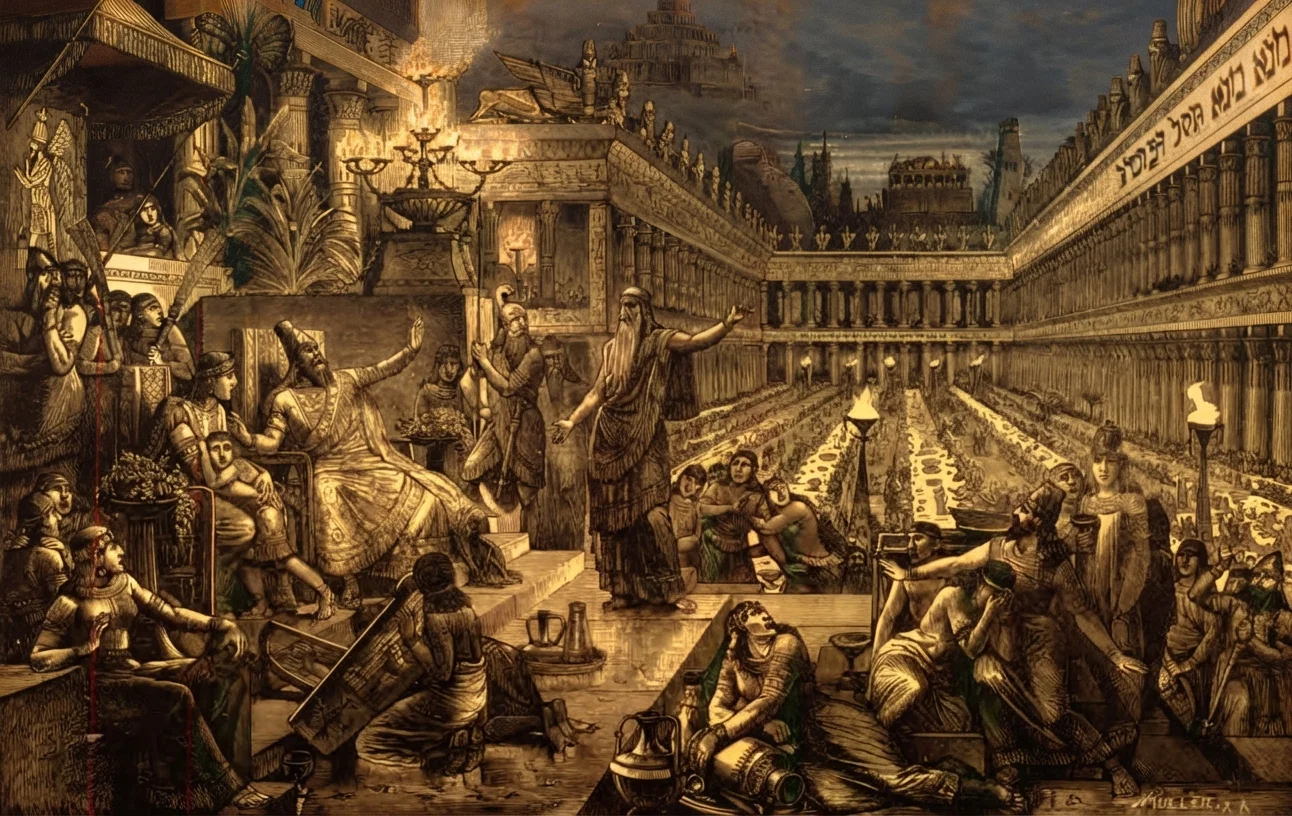
Belshazzar's feast, when "the handwriting on the wall" announced the overthrow of his kingdom, and Cyrus, in harmony with the prophetic Word, came to the throne of world empire.
SEEKING REVENGE
In the introduction of his letter, in which he proposed to co-operate with him in the overthrow of the Medes, Harpagus said: "Son of Cambyses, seeing the gods watch over you (for otherwise you could never have arrived at your present fortune), do you now avenge yourself of your murderer Astyages."
Having assembled his warriors, in his appeal to them to revolt from the rule of the Medes, Cyrus said in part, "Now, therefore, obey me, and be free; for I am persuaded I am born of divine Providence to undertake this work."
Acting upon the suggestion of Harpagus, and with his cooperation, Cyrus subjugated the Medes, and made Astyages a captive for the remainder of his life. Concerning the one whom the king of the Medes attempted to slay in his infancy, the historian says, "Cyrus therefore, having been thus born and educated, came to the throne, . . . and became master of all Asia."20
THEY BELIEVED IT SUPERNATURAL
It should not escape our notice that Astyages, Harpagus, and Cyrus each recognized that a supernatural power had preserved the life of the last named, evidently that he might accomplish a special work. Prophecy foretold the special part that he was to play in the working out of Jehovah's eternal purpose for His people, and both sacred and profane history prove that he fulfilled his Heaven-appointed mission. We might call half a score of historians to the witness-stand, and all would bear the same testimony as to the work of this king.
CYRUS FINALLY CAME TO THE THRONE
Cyrus came to the throne of Babylon in the year 536 B.C. He found God's people in captivity; but the set time had come for their return to their own land, as the seventy years' captivity in Babylon began in B.C. 606, and must terminate in B.C. 536, or the word of the living God would be broken. Immediately a supernatural desire took control of the king to let God's people return to their own land, and the decree was issued.
THE BOLD PREDICTION OF ISAIAH
One hundred seventy-six years before Cyrus became the king of Medo-Persia, the prophet Isaiah had delivered Jehovah's message relative to this monarch in these words: "Thus saith the Lord to His anointed, to Cyrus, whose right hand I have holden, to subdue nations before him; . . . I will go before thee, and make the crooked places straight. . . . I have even called thee by thy name: I have surnamed thee, though thou hast not known Me." And again, "He is My shepherd, and shall perform all My pleasure: even saying to Jerusalem, Thou shalt be built; and to the temple, Thy foundation shall be laid." Isa. 45:1-4; 44:28. Compare with Ezra 1:1-4.
When we consider the fact that the historian who wrote the account of the miraculous preservation of the life of the infant Cyrus, was not in touch with the Jewish people, and that, being a heathen, he could have had no desire to substantiate the prophecy, in fact was doubtless wholly in ignorance of its existence; and again, when we recognize that among the millions of Persians upon the stage of action at that time, the historian's account falls upon the identical individual whom the Lord named in the prophecy, we are driven to the conclusion that in the birth of the child foretold, Satan saw and seized the opportunity to nullify the "testimony of Jesus," "the spirit of prophecy," even as he attempted to defeat the plan of salvation by destroying the infant Saviour. But in each instance, He whose omnipotent hand upholds the universe worked "all things after the counsel of His own will." The word of Jehovah can not be broken. Whoever attempts it, meets with ignominious defeat.