A Romantic Life Story

4%

Pacific Press Publishing Association · Mountain View, California · Feb 17, 1914

FromSigns of the Times, Vol. 41, No. 6.

Read the full edition

A Romantic Life Story

ITS LESSON

By MRS. VEDA DAYTON
WITH the name Rebekah there is associated a beautiful story of romance, love, and domestic happiness, a story of joy and sorrow, faith and unfaith, from which we may draw many a lesson.
First let us get the setting for our story. Nearly forty centuries ago, Abraham was called to separate himself from his kindred in Mesopotamia, and go, a missionary, to the land of Canaan. He went, and there became an old man before the son of divine promise was given him.
This son, Isaac, the heir of the world and the progenitor of Christ, also heir to the large temporal wealth of his father, was, when forty years old, still unmarried. In those days, the experienced, God-fearing parents usually made the choice of life companions for their children, though not against the wishes of the young people. So Abraham, feeling himself growing old and feeble, wished, before he should die, to see his son happily united to one of like faith,—to one who would maintain with him, in that idolatrous land, the pure, lofty worship of the true God. And his mind turned immediately to Mesopotamia, the land of his kindred.
Long years it was since he had left relatives and friends—so long that his name was there only a misty memory. And now, under solemn oath he sent his most trusted servant, Eliezer, on this important mission to the old home—a long, long journey—based on the faith that God would provide a wife for Isaac.
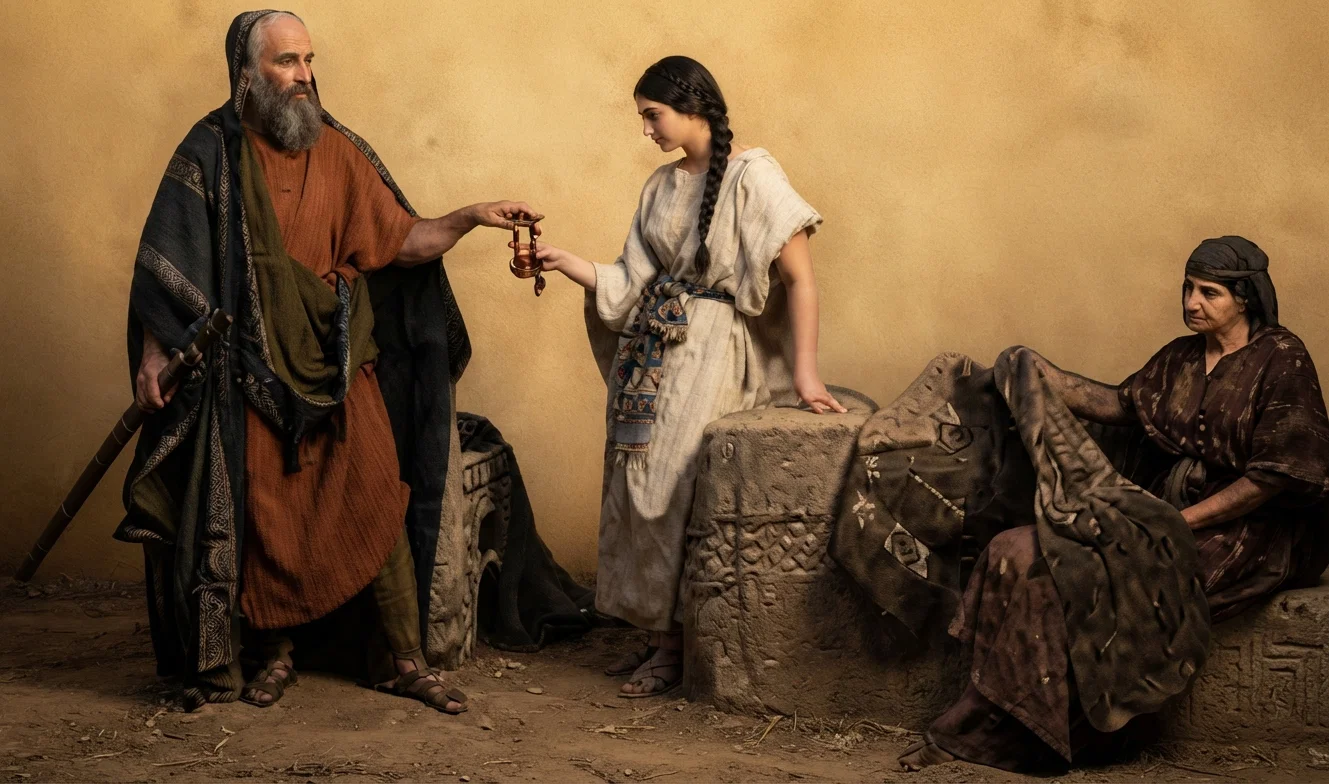
It is the beautiful sunset hour. Eliezer has alighted at the well just outside of Haran, and is praying,—praying that the great God will guide in this most delicate undertaking. His prayer ended, he rises, full of faith, and soon there comes a beautiful maiden to draw water from the well. In answer to a request from him, and showing the gracious courtesy and deference to years which is a part of her character, she not only gives him water to drink, but draws for his camels also,—the very tokens he had prayed might be given as a sign of God's approval.
Joy and thanksgiving fill his heart as he learns that the maiden's father is a nephew of his master Abraham, and he bestows upon her costly ornaments of gold. She hastens home, and tells with excitement the strange tale of the old man, rich and having many camels, who has given her these ornaments, and who wishes lodging in her father's house. Immediately her brother Laban goes out and greets
this servant of his great uncle Abraham with these words: "Come in, thou blessed of the Lord; wherefore standest thou without? for I have prepared the house, and room for the camels."
When provision has been made for his men and camels, Eliezer, faithful messenger that he is, can not rest until his mission is made known. So he tells first of the wonderful blessings and great riches bestowed by God upon Abraham; then of Isaac, the son of faith; and finally he relates the story of his own prayer at the well, and its remarkable answer; and he asks that Rebekah be allowed to go to become the wife of Isaac. Bethuel her father and her brother Laban both see God's hand leading, so dare not refuse, but say, "Behold, Rebekah is before thee, take her, and go, and let her be thy master's son's wife, as the Lord hath spoken." At these words, Eliezer reverently worships God.
His mission fulfilled, he is in haste to return home, and in the morning wishes to set out. Now the marriage custom is that a young woman shall remain at home for nearly a year after her betrothal, and Rebekah's mother and brother plead for her to remain. But Eliezer is unmoved; so Rebekah is called, and contrary to all custom, consents to go at once, for she feels that the call is from God. She realizes that her going means separation from home and relatives for a long time, perhaps forever; but her faith fails not, and she goes forth with gladness.
It is a long journey, and we can imagine what thoughts fill her heart during the weary days of travel. She wonders what the new home and life will be, and what love will be hers. But this is a journey of faith, so she goes with a heart full of trust for the future.
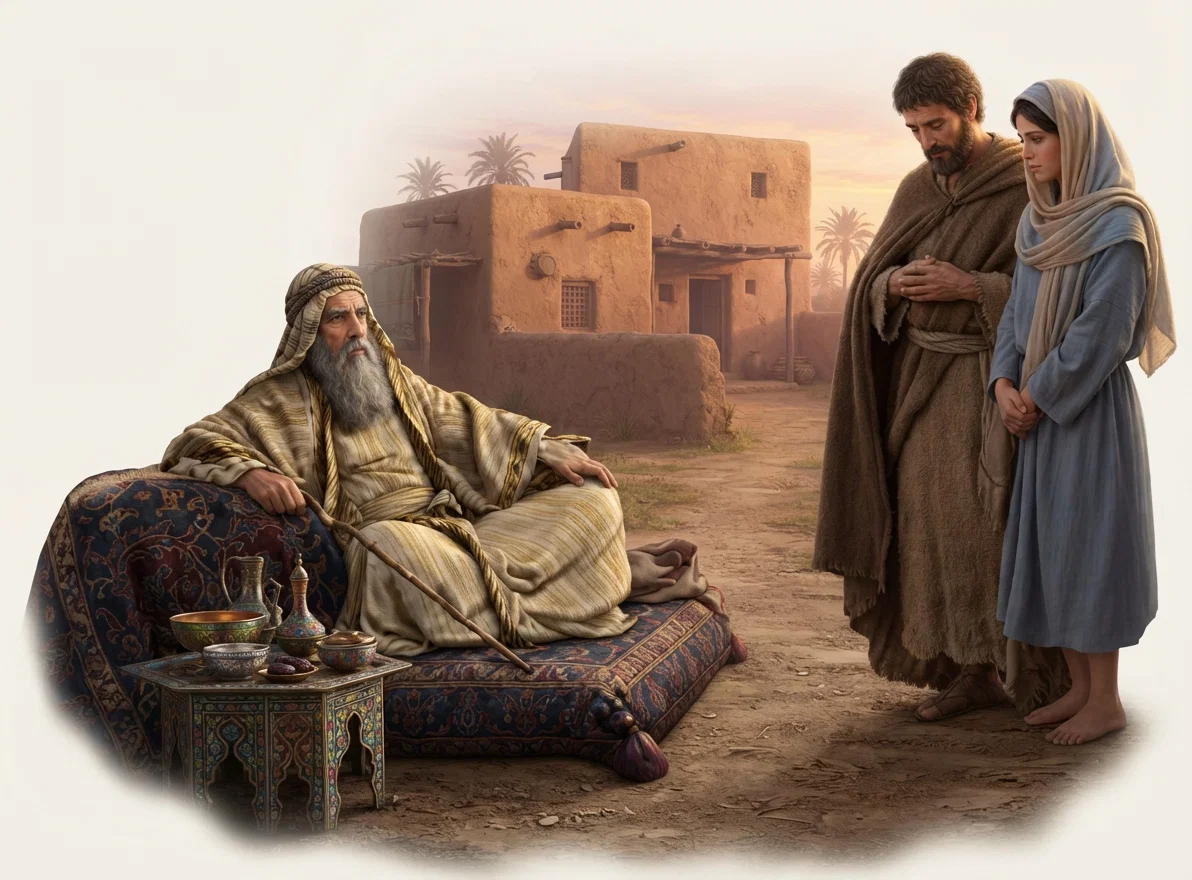
The heart of Isaac is filled with joyful anticipation and longing for the fair one of his dreams—and yet his dreams have never pictured one so fair as she who comes, his bride-to-be. He is out in the fields in the glow of the evening—praying. No doubt he is praying for the safe arrival of the precious caravan wending across the desert, for faith dwells in the heart of Isaac as in the heart of his father Abraham. As he lifts up his eyes, he sees the camels slowly approaching, and his heart thrills. As they draw near, Rebekah sees him, and alights from her camel, yet with maidenly modesty draws her veil over her face.
And the Book says, "And Isaac brought her into his mother Sarah's tent, and took Rebekah, and she became his wife; and he loved her." Those four small words connote much.
Very happy were Isaac and Rebekah, but their joy was not complete. For many years her arms ached for children. Their tent seemed lonely for the music of baby voices. At last, in answer to the earnest prayer of faith, twin sons were given them.
As the years went by, Rebekah's love grew stronger for Jacob, the boy of affectionate, home-loving disposition, while the heart of Isaac turned to Esau. We all know the story of the birthright and blessing, and how Rebekah aided Jacob to deceive his father. Here the chain of faith is broken. In her ardent mother-love, she did not leave it to God to untangle the knotted skein of circumstance, but for the time lost faith and failed.
This circumstance in the life of Rebekah and Jacob always fills one with sadness. Yet how many times we fail in the very same way!
As a consequence of Rebekah's failure, Jacob had to flee from home, and shenever again saw the son of her heart's delight. Poor mother! Her last days must have been filled with sorrow, all because of one rash act, one little time when faith was lost.
At the last hour, no loving son was there to smooth the brow of death. But as the heart clings longest to that most loved, this mother's heart still throbbed with love for the son of her hope, still held the sweet faith that she would look upon his face once more, even as death closed the curtain on the scene of life. So passed out the life of Rebekah the beautiful, and she was laid to rest in the Cave of Machpelah, "the tomb of the faithful."
It is a beautiful story, this of Rebekah, but so sad at the last, all because faith was lost just once. Faith is the tie that binds our hearts to heaven. When once it is severed by our failure—God never fails—sorrow and remorse—yea, and sin—are consequences. Let us not break one link in the golden chain. Let us be faithful.