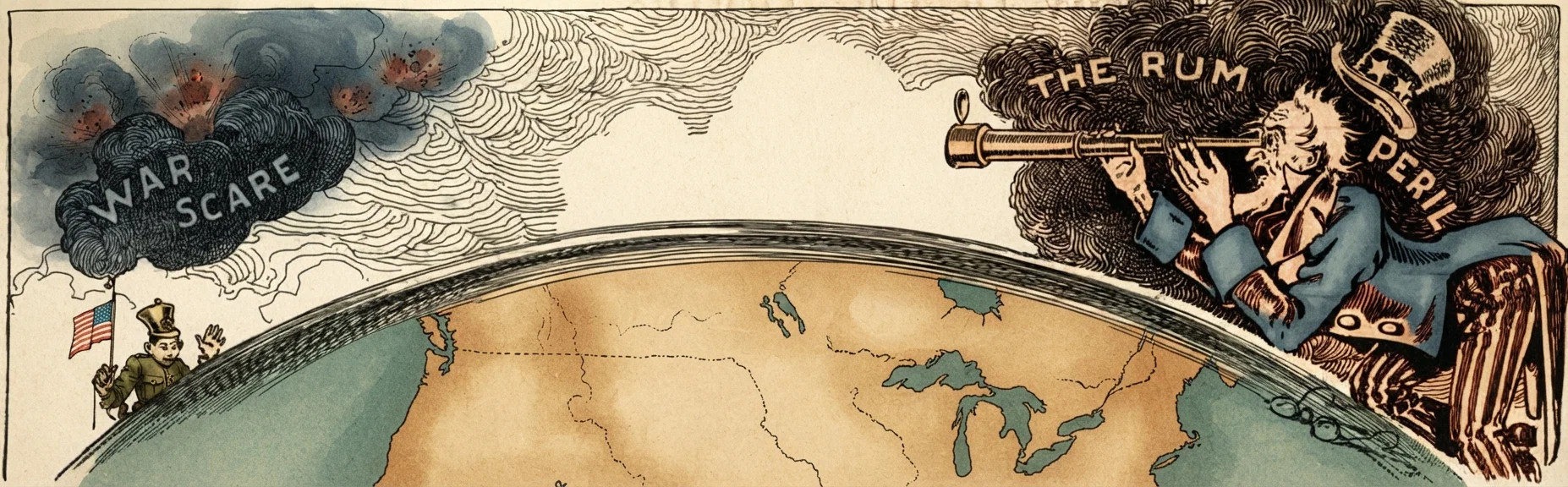
The Great Prohibition Movement. The Mightiest Question before the American People
The Great Prohibition Movement
By Hon. Fred F. Wheeler
The Mightiest Question before the American People
By the HON. FRED F. WHEELER
Chairman of Convention That Inaugurated "Dry" Federation of California
THE proposed amendment to make California "dry," coupled with the Hobson bill introduced in Congress proposing to submit to a vote of the states a similar amendment to the national Constitution, together with similar measures in a dozen other states, is such a radical departure from the governmental partnership heretofore existing between the towns, cities, counties, states, and national government, on the one hand, and the liquor traffic on the other, as necessarily to involve more or less economic loss and business demoralization to many of our citizens. In order to justify such loss, we must be able to show clearly that our proposed action is based on principles fundamentally sound. Let me state some of them very briefly:
The Standard of Judgment
1. The liquor traffic is entitled to be weighed in the same scales and measured by the same standard by which we judge every other business; namely, by its effects upon the peace, happiness, and prosperity of the majority of the people. The preacher, the teacher, the merchant, and the manufacturer, the lawyer, the doctor, and the farmer, the editor, the capitalist, and the railroad man, as well as the gambler, the pickpocket, the thief, and the murderer, are all judged by this standard, and are either approved as a blessing to the community, or condemned as a curse. The liquor traffic therefore can not complain of or object to being judged in exactly the same manner, by the same standard; and we must insist that it shall abide by such a verdict reached by a jury of the citizens qualified to serve on the juries of states or nation.
The Findings of the People
2. The experience and observation of the American people during the fifty years that have elapsed since Abraham Lincoln reluctantly signed the internal revenue bill of 1862 which made the United States government the largest partner in this business, have enabled them to make up their verdict already. They have observed:
(a) That no man has ever made a better father or husband or citizen because of his drinking alcoholic liquors.
(b) That fifty per cent of our extremely poor are brought to that condition because of the drinking habit.
(c) That possibly fifty per cent of our idiotic and insane are in that deplorable condition either directly or indirectly because of the liquor traffic.
(d) That seventy-five per cent of our inmates of jails, prisons, and penitentiaries are products of the liquor traffic.
(e) That every dollar expended for intoxicating liquor is an absolute economic waste. The buyer receives for his money that which is worse than nothing, because it reduces his strength, vitality, and ability to perform any useful labor and to support himself or his family. The amount of money thus spent as the direct cost of the liquor traffic in the nation, based upon the government reports, is not less than $1,752,109,635 annually, and is usually stated in round figures as being two billion dollars. The indirect cost involved in caring for the victims of the traffic, and the loss of labor of the victims, and the interest, and depreciation of the necessary buildings, is probably as much more. If these estimates are approximately correct, then this issue is by all odds the largest financial and economic question now before the American people, and California's share alone of the direct cost can not be less than thirty-five million dollars annually, and the indirect cost as much more.
(f) The above stupendous statement does not include the destruction of manhood or womanhood, the criminals produced, the ruptured homes and the broken hearts, the orphaned children, and the numerous other tragedies that follow in the wake of this business.
(g) Neither does it include the destructive and demoralizing political results of the traffic. For fifty years it has been bulldozing and terrifying officials, from councilman to United States senator, until they have not dared to express their honest convictions. It is the most gigantic and law-defying trust or business combination that exists under the American flag, by the side of which the Standard Oil Company and the steel trust are angels of mercy and benevolence.
We Can Not Let It Alone
That is unthinkable and indefensible. We have tried license and regulation for fifty years, and we have concluded that these methods are not only morally wrong but entirely inadequate, as the per capita consumption of liquor has steadily grown larger notwithstanding an ever-widening area of "dry" territory.
Objections Considered
Let us consider some of the objections that are raised to our proposed amendment:
1. "It is an interference with personal liberty." Of course it is. So is nearly all other legislation. If a man were the only living thing on an island, he could do as he pleased; but the moment a dog came upon that island, his right to do as he pleased would end just where the rights of the dog began.
2. "It is sumptuary legislation." This is a false argument, inasmuch as we are not trying to legislate on what a citizen may eat or drink, but upon what he can manufacture and sell, and the latter comes squarely within the police powers of the state.
3. "It will destroy our grape-growing industry and confiscate much property." There will undoubtedly be some financial loss involved in such a sweeping governmental revolution, but my judgment is that it will only be a fractional part of the amount claimed by our opponents. The raising of wine grapes has not been profitable for several years, as such grapes have only sold for six to ten dollars a ton, as against twenty to thirty dollars for table grapes. Wine grapes may be grafted over into table grapes, or grape juice can be profitably manufactured instead of wine from wine grapes. Many farmers are already digging out their wine grape-vines, because they have been so unprofitable for several years; and this amendment, if adopted, will be a blessing in disguise by accelerating that movement. The land in nearly all cases can be used for other crops, and the buildings generally can be used for other purposes profitably. But whatever the final economic loss may be, the individual, the community, and the state will be the gainer a thousandfold in moral fiber and real riches.
4. "Prohibition does not prohibit." Neither does an ax cut, nor a gun shoot, without a man behind them. For five years Kansas has been giving the nation the most wonderful and the most convincing demonstration that prohibition does prohibit when there is placed behind the law an administration that is in full sympathy with it. The results in Kansas in their increased wealth, sobriety, freedom from crime, increase in educational and religious advantages, are almost unbelievable. No wonder that her newspapers, her state officials, her representatives in Congress, her educators and leaders in the business world, are all so overwhelmingly in favor of prohibition. Her experience can be confirmed in a lesser degree by a thousand other communities whose experience has been similar when the law was faithfully enforced.
In conclusion let me say that if two thirds of the women of California will stand with us at the ballot-box next November, we will adopt the amendment, and this grand commonwealth of the West will be free from this blight and curse forever.