MISSIONS

6%

Pacific Press Publishing Association · Mountain View, California · Aug 19, 1913

FromSigns of the Times, Vol. 40, No. 32.

Read the full edition

MISSIONS

Encouraging Items from the Orient
(From the "Asiatic News-Letter")
BROTHER GEORGE HARLOW writes regarding the work around Pakhoi, as follows:
"On Sunday Brother Bach and I left Pakhoi on wheelbarrows en route for Limhoi, which is about sixty li from Pakhoi. There we found the brethren waiting for us. All were of good courage, and we had several meetings. A church was organized, the second church in that district. I desired to go farther inland; but it was thought best not to attempt the journey at this season, for the plague is raging all through the villages. This, of course, made it unsafe to lodge in the country inns; so we returned to Pakhoi, where a general meeting was held. I was very glad to see the attention that was given to each study. Even at this time, when people are afraid to go out on account of the plague, the meeting-house was full at almost every meeting.
"The plague is raging fearfully in nearly all the towns around Pakhoi; and unless something shall intervene, it seems that the inhabitants will be wiped out, for they die off by hundreds. Every day coffin after coffin passed us, being carried to the burial-place. In some instances children are buried two and three together. All night long the gongs and drums are beaten to frighten away the evil spirits, which the people think are the cause of the disease. While seeing so many dead carried out, and hearing of so many dying, it was a comfort to read Ps. 91:7, and to trust the promise that 'a thousand shall fall at thy side, and ten thousand at thy right hand; but it shall not come nigh thee.' As yet not one of our members has been taken away by the fearful sickness."
Brother Bach, who is laboring in Pakhoi, writes of the plague conditions as follows:
"The work here has been greatly hampered by the plague. To give a description to any one who has not experienced these days of worry and anguish, and seen the ravages of the sickness, is nearly impossible. People one had seen at morning were buried by evening, and one was nearly afraid to ask for a man, lest he were dead already. This spring's plague here has carried off nearly three thousand people, old and young, and that means one out of every ten of the Pakhoi population. The houses are closed by four o'clock in the afternoon, and people did not dare go out. Even in broad daylight some streets were deserted. Of course this state of things made it very easy for robbers to break open the houses at night and rob the people. Two houses just beside our station have been robbed in this way, and the robbed people have no place to ask for help. One fellow was robbed and murdered just behind the law court, and seemingly no one cares. Altho the plague has been so fearful, not one of our church-members has died. One old woman got the plague boils, but recovered. A little girl started with fever, but got better. One of the inquirer women was three days sick, when we were notified by her landlord, and when we sent up to find out, it seemed that her last day had arrived. However, we brought her the next day to the French consulate physician, a very kind man, who stated that it was seemingly too late to do much for her, but he wanted to do all he could. He gave her six injections of anti-plague serum, the next day five, and so on. We had to find a place for her near the sea beach, where she stayed in rain and sunshine. Now she is recovered, and, thanks be to God, not one believer has died."
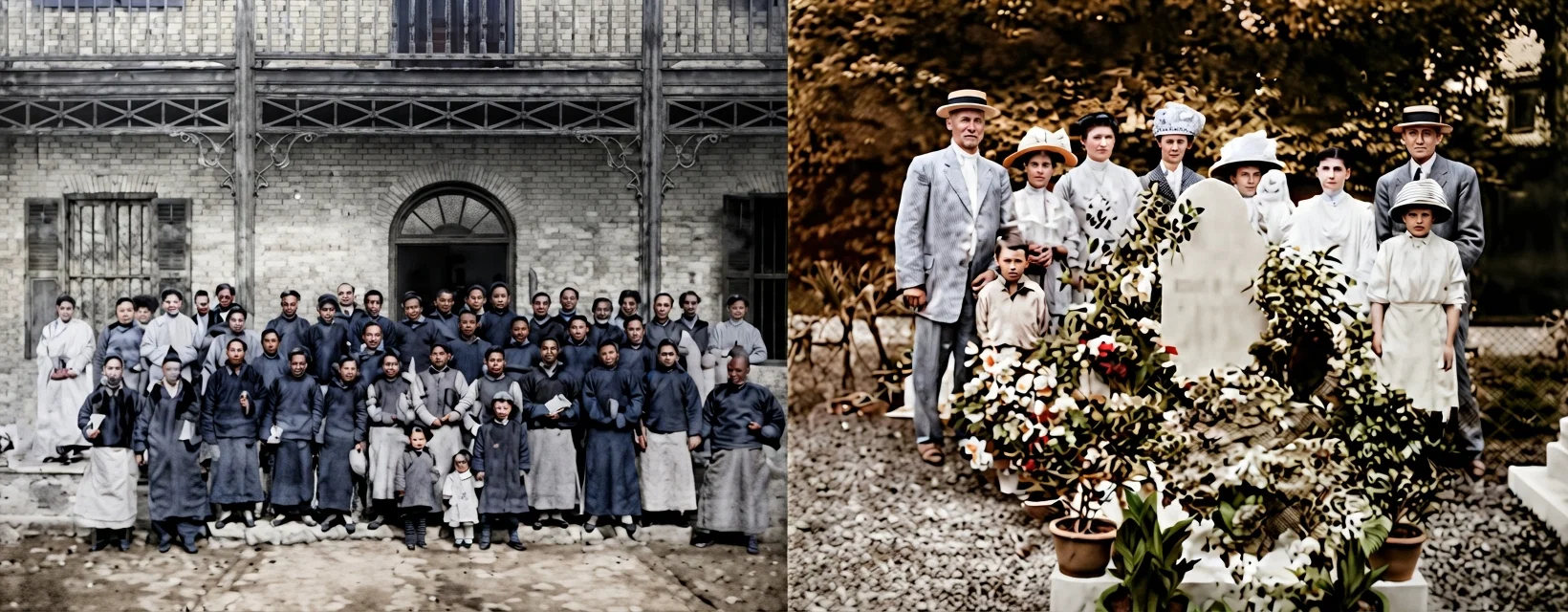
Teachers and students of the S. D. A. Mandarin training-school, Nanking, China; Brethren and sisters decorating the grave of Brother Esta Miller, May 13, 1913, Bubbling Well Cemetery, Shanghai
The following from Elder R. F. Cottrell will touch the hearts of those in the home land who know nothing of the poverty and sufferings which these poor natives are obliged to endure, and we trust will incite many to liberality in helping to better the conditions among these people:
"At this writing I am waiting at the Yen Cheng station for the Hankow train, which is six hours late. On my way from Hankow last week, scenes of poverty and distress were on every hand. At the railway stations there were scores, and often hundreds, of famine refugees; and at such places as Sin Yang Djou and Dju Ma Tien, there could not have been less than a thousand. It seemed to me that their pinched faces would have moved a heart of stone, and my soul in its helplessness yearned to do something for the poor people. I prayed earnestly that the Lord would quickly send copious showers upon these parched plains, and also that the relief work that is being undertaken might quickly become effectual to alleviate this awful distress.
"The following evening, I reached Chow Kia Kow. Altho for the present that city is just outside the real famine belt, there will hardly be a quarter of a wheat crop in that vicinity. Brother Westrup told me that owing to conditions, he did not look for more than about one hundred at the general meeting; nevertheless, the people kept coming until the chapel was crowded, and the attendance was quite as good as it was a year ago. The second day, at the early morning prayer-meeting, we read some of the precious promises of the Word regarding prevailing prayer and its conditions, and then besought the Father of mercies to send rain. The following day came the response in a heavy twenty-four hours' downpour. This answer to prayer made a deep impression on the people; and when the need of the Yen Cheng intermediate school was presented, together with the appropriateness of showing our gratitude by a liberal thank-offering, the people responded with a gift of one hundred fifty-eight dollars, Mexican, in cash and pledges. This will be increased within a few days by money from others who were not present. Where has greater loyalty, thankfulness, or self-sacrifice ever been manifest by advent believers?"
When we consider that these natives receive wages of only four to eight cents a day, and skilled workmen receive only nine cents, we will understand something of what a sacrifice such a large donation means to them. From a letter from another worker we learn that there had been no rain in this district for eight months.
A later letter from Brother Cottrell contains the following:
"A further indication of growth was the Hunan offering to the Mission Board of $225 Mexican, in cash and pledges, making a total for the three provinces of $455 Mexican. Our Sabbath-school offerings for the first quarter of 1913 amounted to $56.76. Those in the home land who are giving for missions may observe that their brethren and sisters on this side of the Pacific are, to the extent of their ability, beginning to share the financial burdens of the work.
"The most of the students who were in the Nanking training-school have returned, and are full of courage and zeal. In planning for the summer's campaign in Hunan, we are sending fourteen evangelists and twenty-nine canvassers into the field. Twelve out-stations are being manned, and earnest pleas have come to us from six other places where there are interested companies. We confidently believe that the Lord is about to do a great work in Central China, and the needs and magnitude of the work bring us often upon our knees to confess our helplessness and to plead for strength and wisdom."