The Prince of Life and the Prince of Darkness in Decisive Combat—A Self-Control Stronger than Hunger or Death—The Power in the Word the Deciding Factor
BY MRS. E. G. WHITE
AND Jesus being full of the Holy Ghost returned from Jordan, and was led by the Spirit into the wilderness.” Luke 4:1. The words of Mark are still more significant. He says: “Immediately the Spirit driveth Him into the wilderness. And He was there in the wilderness forty days, tempted of Satan; and was with the wild beasts.” “And in those days He did eat nothing.”
When Jesus was led into the wilderness to be tempted, He was led by the Spirit of God. He did not invite temptation. He went to the wilderness to be alone, to contemplate His mission and work. By fasting and prayer, He was to brace Himself for the blood-stained path He must travel.
Mighty issues for the world were at stake in the conflict between the Prince of Light and the leader of the kingdom of darkness. After tempting man to sin, Satan claimed the earth as his, and styled himself the prince of this world. Having conformed to his own nature the father and mother of our race, he thought to establish here his empire. He declared that men had chosen him as their sovereign. Through his control of men, he held dominion over the world. Christ had come to disprove Satan’s claim. As the Son of man, Christ would stand loyal to God. Thus it would be shown that Satan had not gained complete control of the human race, and that his claim to the world was false. All who desired deliverance from his power would be set free. The dominion that Adam had lost through sin would be recovered.
Since the announcement to the serpent in Eden, “I will put enmity between thee and the woman, and between thy seed and her seed,” Satan had known that he did not hold absolute sway over the world. At the birth of Jesus, Satan knew that One had come with a divine commission to dispute his dominion. He trembled at the angel’s message attesting the authority of the new-born King. That the Son of God should come to this earth as a man, filled him with amazement and apprehension. He could not fathom the mystery of this great sacrifice. His selfish soul could not understand such love for the deceived race.
SATAN AN INTERESTED OBSERVER
At the Saviour’s baptism, Satan was among the witnesses. He saw the Father’s glory overshadowing His Son. He heard the voice of Jehovah testifying to the divinity of Jesus. Ever since Adam’s sin, the human race had been cut off from direct communion with God. The intercourse between heaven and earth had been through Christ. But now that Jesus had come “in the likeness of sinful flesh,” the Father Himself spoke. He had before communicated with humanity through Christ; now He communicated with humanity in Christ. Satan had hoped that God’s abhorrence of evil would bring an eternal separation between heaven and earth. But now it was manifest that the connection between God and man had been restored.
Satan saw that he must either conquer or be conquered. The issues of the conflict involved too much to be entrusted to his confederate angels. He must personally conduct the warfare. All the energies of apostasy were rallied against the Son of God. Christ was made the mark of every weapon of hell.
With Christ, as with the holy pair in Eden, appetite was the ground of the first great temptation. Just where the ruin began, the work of our redemption must begin. As by the indulgence of appetite Adam fell, so by the denial of appetite Christ must overcome. “And when He had fasted forty days and forty nights, He was afterward an hungered. And when the tempter came to Him, he said, If Thou be the Son of God, command that these stones be made bread. But He answered and said, It is written, Man shall not live by bread alone, but by every word that proceedeth out of the mouth of God.”754
A SELF-CONTROL STRONGER THAN HUNGER OR DEATH
From the time of Adam to that of Christ, self-indulgence had increased the power of the appetites and passions, until they had almost unlimited control. Thus men had become debased and diseased, and of themselves it was impossible for them to overcome. In man’s behalf, Christ conquered by enduring the severest test. For our sake He exercised a self-control stronger than hunger or death. And in this first victory were involved other issues that enter into all our conflicts with the powers of darkness.
When Jesus entered the wilderness, He was shut in by the Father’s glory. Absorbed in communion with God, He was lifted above human weakness. But the glory departed, and He was left to battle with temptation. It was pressing upon Him every moment. His human nature shrank from the conflict that awaited Him. For forty days He fasted and prayed. Weak and emaciated from hunger, worn and haggard with mental agony, “His visage was so marred more than any man, and His form more than the sons of man.” Now was Satan’s opportunity. Now he supposed that he could overcome Christ.
IN THE GUISE OF AN ANGEL
There came to the Saviour, as if in answer to His prayers, one in the guise of an angel from heaven. He claimed to have a commission from God to declare that Christ’s fast was at an end. As God had sent an angel to stay the hand of Abraham from offering Isaac, so, satisfied with Christ’s willingness to enter the blood-stained path, the Father had sent an angel to deliver Him; this was the message brought to Jesus. The Saviour was faint from hunger. He was craving for food, when Satan came suddenly upon Him. Pointing to the stones which strewed the desert, and which had the appearance of loaves, the tempter said, “If Thou be the Son of God, command that these stones be made bread.”
Though he appears as an angel of light, these first words betray his character. “If Thou be the Son of God.” Here is the insinuation of distrust. Should Jesus do what Satan suggests, it would be an acceptance of the doubt. The tempter plans to overthrow Christ by the same means that were so successful with the human race in the beginning. How artfully had Satan approached Eve in Eden: “Yea, hath God said, Ye shall not eat of every tree of the garden?” Thus far the tempter’s words were truth; but in his manner of speaking them, there was a disguised contempt for the words of God. There was a covert negative, a doubt of the divine truthfulness. Satan sought to instil into the mind of Eve the thought that God would not do as He had said; that the withholding of such beautiful fruit was a contradiction of His love and compassion for man. So now the tempter seeks to inspire Christ with his own sentiments. “If Thou be the Son of God.” The words rankle with bitterness in his mind. In the tones of his voice is an expression of utter incredulity. Would God treat His own Son thus? Would He leave Him in the desert with wild beasts, without food, without companions, without comfort? He insinuates that God never meant His Son to be in such a state as this. “If Thou be the Son of God,” show Thy power by relieving Thyself of this pressing hunger. Command that this stone be made bread.
A MAN AMONG MEN, HE DEPENDS UPON THE WORD
The words from heaven, “This is My beloved Son, in whom I am well pleased,” were still sounding in the ears of Satan. But he was determined to make Christ disbelieve this testimony. The word of God was Christ’s assurance of His divine mission. He had come to live as a man among men, and it was the Word that declared His connection with Heaven. It was Satan’s purpose to cause Him to doubt that Word. If Christ’s confidence in God could be shaken, Satan knew that the victory in the whole controversy would be his. He could overcome Jesus. He hoped that under the force of despondency and extreme hunger, Christ would lose faith in His Father, and work a miracle in His own behalf. Had He done this, the whole plan of salvation would have been broken.
Not without a struggle could Jesus listen in silence to the arch-deceiver. But the Son of God was not to prove His divinity to Satan, or to explain the reason of His humiliation. By conceding to the demands of the rebel, nothing for the good of man or the glory of God would be gained. Had Christ complied with the suggestion of the enemy, Satan would still have said, “Show me a sign, that I may believe You to be the Son of God.” Evidence would have been worthless to break the power of rebellion in his heart. And Christ was not to exercise divine power for His own benefit. He had come to bear trial as we must do, leaving us an example of faith and submission. Neither here nor at any subsequent time in His earthly life did He work a miracle in His own behalf. His wonderful works were all for the good of others. Though Jesus recognized Satan from the beginning, He was not provoked to enter into controversy with him. Strengthened with the memory of the voice from heaven, He rested in His Father’s love. He would not parley with temptation.
Jesus met Satan with the words of Scripture. “It is written,” He said. In every temptation, the weapon of His warfare was the word of God. Satan demanded of Christ a miracle as a sign of His divinity. But that which is greater than all miracles, a firm reliance upon a “Thus saith the Lord,” was a sign that could not be controverted.
MET THE ENEMY IN TIME OF SUPREME WEAKNESS
It was in the time of greatest weakness that Christ was assailed by the fiercest temptations. Thus Satan thought to prevail. By this policy, he had gained the victory over men. And he will still work in the same way. Whenever one is encompassed with clouds, perplexed by circumstances, or afflicted by poverty or distress, Satan is at hand to tempt and annoy. He attacks our weak points of character. He seeks to shake our confidence in God, who suffers such a condition of things to exist. We are tempted to distrust God, to question His love. Often the tempter comes to us as he came to Christ, arraying before us our weakness and infirmities. He hopes to discourage the soul, and to break our hold on God. Then he is sure of his prey. If we would meet him as Jesus did, we should escape many a defeat. By parleying with the enemy, we give him an advantage.
Of all the lessons to be learned from our Lord’s first great temptation, none is more important than that bearing upon the control of the appetites and passions. In all ages, temptations appealing to the physical nature have been most effectual in corrupting and degrading mankind. Through intemperance, Satan works to destroy the mental and moral powers that God gave to man as a priceless endowment. Thus it becomes impossible for men to appreciate things of eternal worth. Through sensual indulgence, Satan seeks to blot from the soul every trace of likeness to God.
In our own strength it is impossible for us to deny the clamors of our fallen nature. Through this channel Satan will bring temptation upon us. Christ knew that the enemy would come to every human being, to take advantage of hereditary weakness, and by his false insinuations to ensnare all whose trust is not in God. And by passing over the ground which man must travel, our Lord has prepared the way for us to overcome. It is not His will that we should be placed at a disadvantage in the conflict with Satan. He would not have us intimidated and discouraged by the assaults of the serpent. “Be of good cheer,” He says: “I have overcome the world.”
HIS VICTORY IS OURS
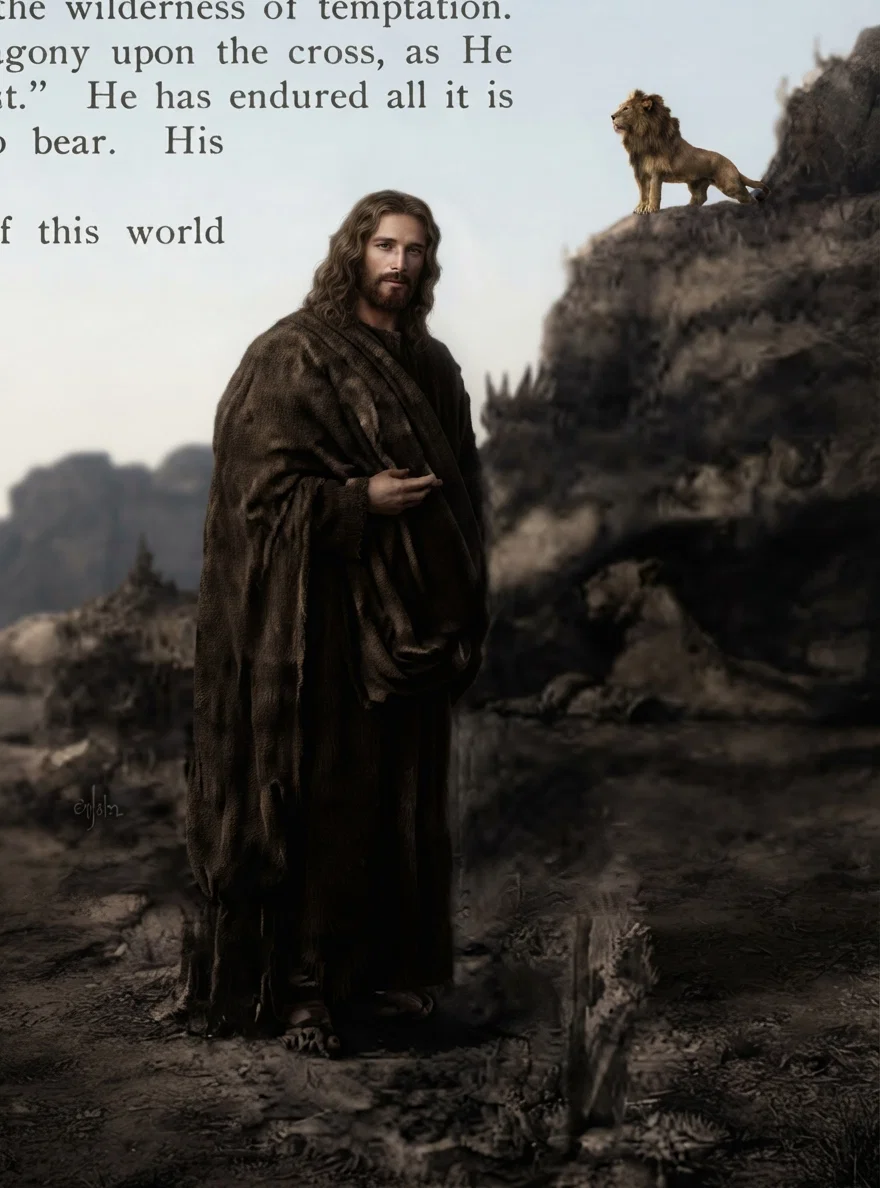
Let him who is struggling against the power of appetite, look to the Saviour in the wilderness of temptation. See Him in His agony upon the cross, as He exclaimed, “I thirst.” He has endured all it is possible for us to bear. His victory is ours.
"And He was with the wild beasts."
“The prince of this world cometh,” said Jesus, “and hath nothing in Me.” There was in Him nothing that responded to Satan’s sophistry. He did not consent to sin. Not even by a thought did He yield to temptation. So it may be with us. Christ’s humanity was united with divinity; He was fitted for the conflict by the indwelling3
His Moral Victory Saves the World
(Continued from page 2)
of the Holy Spirit. And He came to make us partakers of the divine nature. So long as we are united to Him by faith, sin has no more dominion over us. God reaches for the hand of faith in us to direct it to lay fast hold upon the divinity of Christ, that we may attain to perfection of character.
And how this is accomplished, Christ has shown us. By what means did He overcome in the conflict with Satan?—By the word of God. Only by the Word could He resist temptation. “It is written,” He said. And unto us are given “exceeding great and precious promises: that by these ye might be partakers of the divine nature, having escaped the corruption that is in the world through lust.” Every promise in God’s word is ours. “By every word that proceedeth out of the mouth of God” are we to live. When assailed by temptations, look not to circumstances or to the weakness of self, but to the power of the Word. All its strength is yours. “Thy word,” says the psalmist, “have I hid in mine heart, that I might not sin against Thee.” “By the word of Thy lips I have kept me from the paths of the destroyer.”