What the Prophets Saw Concerning the Conflict Between Capital and Labor in These Times — The Great Amassing of Fortunes — The Howling Cries of the Rich Man — Eternal Peace Just Beyond
By PROF. G. W. RINE
IN the preceding article of this series, there was given a mass of irrefutable evidence that a tremendous struggle between capitalist employers on the one hand and the working class on the other is not only inevitable but imminent. That such a struggle is near and unescapable is the uniform conviction on the part of all enlightened publicists and sociologists of the civilized world.
But the one aspect of the conflict which is of paramount interest and moment is the unique fact that the whole movement and its outcome were anticipated and enunciated by both Old Testament and New Testament prophets. Under the inspiration of the divine Spirit, many of the ancient prophets foresaw that the economic strife of our day would constitute one of many latter-day signs of the times. It would be a mark, a distinctive characteristic, of "the last days."
"WEEP AND HOWL," "YE RICH MEN"
Everybody knows that we are living in an age of fabulous wealth — of wealth unprecedented in the history of mankind. Under the quickening power of the Spirit, James was enabled to foresee that a class of men would arise in the last days who would be distinctly "rich men." Observe the opening words of the fifth chapter of his letter: "Go to now, ye rich men, weep and howl for your miseries that shall come upon you." In verse 3 he says explicitly that their treasures were laid up in the last days. He states also, in verse 4, that one of the reasons why they would be able to amass such vast riches is the fact that they would keep back by fraud a part of the hire justly due to "the laborers," whose toil largely created the amassed "treasures."
But the words of James that have special relevancy in this connection are those which show that these latter-day rich men would ultimately "weep and howl" because of the miseries that would come to them. Are not these words an obvious anticipation of the sanguinary contest now impending? They surely mean this or they mean nothing. Now observe that it is in the last days, in the days when "the coming of the Lord draweth nigh," that this struggle between the "rich men" — capitalists — and the "laborers" would take place. See verses 3 and 8. It is at the very time when the "brethren," the true believers, are admonished by the Holy Spirit to be "patient," to "stablish" their hearts, for the express reason that "the coming of the Lord draweth nigh." It is evident, then, that this prophetic revelation of the status of the economic world of to-day was given through the prophet for the express purpose of constituting it a sign to the remnant church of God that her Lord is about to "come again," "in power and great glory," to take to Himself His redeemed people, in order that they may "inherit the kingdom" prepared for them "from the foundation of the world."
"WHO ENLARGETH HIS DESIRE AS HELL"
This momentous fact — a fact fraught with eternal consequences — is set forth even more strikingly, if possible, in the vision given to Habakkuk, and recorded in the second chapter of his prophecy. Habakkuk was divinely commanded to "write the vision, and make it plain upon tables, that he may run that readeth it." How plainly this command shows the prophecy to be an exceptionally significant one — one to be read and pondered and understood! In verse 3 we are told that the vision is "for an appointed time," and "at the end it shall speak [be fulfilled], and not lie." These words show unmistakably that the prophecy will be realized, fulfilled, at "the end"; that is, in the end of time, or as James puts it, "in the last days." See also verse 14.
Of the typical man of our day, when the vision "shall speak," it is said that he "enlargeth his desire as hell," and as death, he "can not be satisfied." How trenchantly these words declare that in these latter days men would be inordinately avaricious, insatiably greedy for gain! The original of "hell" is sheol, the place of the dead, or the grave. Though sheol or the grave receives more than one hundred thousand human victims every day in the year, yet it is never satisfied — it is forever yawning for more. Even so "death" is the black camel that kneels at a hundred thousand doors each day, yet he is never sated, never appeased. What a startling illustration are these similes of the relentless greed which would be characteristic of men in our day! Read verses 1 and 2 of the third chapter of 2 Timothy, and note how Paul foretold the same fact, when he declared that "in the last days" men should be "covetous," or as the American Revised Version expresses it, "lovers of money." So general and malignant is avarice in our day that the Rev. Dr. Washington Gladden calls it "the new idolatry" as the title of a lecture upon the subject.
SYSTEMATICALLY DESPOILED
Now, the prophet Habakkuk goes on to declare that the typical rich man of the last days has brought together workers of all "nations" and "peoples," and has "despoiled" them; that is, has systematically defrauded them by withholding from them wages that in equity and justice belonged to them. The prophet then asks the startling question, "Shall not all these [exploited working men] take up a parable against him, and a taunting proverb against him, and say, Wo to him that increaseth that which is not his?" Again756the prophet, by way of emphasis, asks, "Shall they not rise up suddenly that shall bite thee, and awake that shall vex thee, and thou shalt be for booties unto them?"
No student of sacred literature would deny that the words "bite" and "vex" are specific terms used to express the idea of violent attack in any form. The despoiled workers are represented as violently despoiling their despoilers. By the figure of apostrophe, the prophet continues to address the devotee of Mammon, the capitalist employer of to-day, in these portentous words: "Because thou hast spoiled [despoiled] many nations, all the remnant of the people shall [de] spoil thee." The "remnant" of anything is the last part of it. Hence the remnant of the people can mean only the last people, that is, the people of the last generation.
INSATIABLY GREEDY
The import of this prophecy is as clearly obvious as the noonday sun. It tells us, in words that breathe and burn, that "in the end" men would become insatiably greedy — would become "lovers of money," and, accordingly, would "despoil," defraud their helpless employees, until, driven to frenzied wrath, the workers would turn upon their heartless employers, and by violence despoil them. Recall the words of the apostle James: "Go to now, ye rich men, weep and howl for your miseries that shall come upon you." Note again the stern pronouncement addressed by Habakkuk to the typical money lord of to-day: "Thou shalt be for booties unto them" [the defrauded workers].
WILL CAST THEIR SILVER IN THE STREETS
In the nineteenth verse of the seventh chapter of Ezekiel is found a tellingly significant declaration of the same tenor. The prophet foresees that in the days when the "wrath of the Lord" is about to be revealed from heaven upon a hopelessly godless world, the rich "shall cast their silver in the streets, and their gold shall be removed: their silver and their gold shall not be able to deliver them in the day of the wrath of the Lord: . . . because it is the stumbling-block of their iniquity." This terrible prognostic declaration needs no extended comment. Its meaning is evident. The modern lords of the money tables would continue worshiping at the shrine of Mammon until they make the awful discovery that their treasures have been the stumbling-block, the cause, of their irretrievable sins; they have been the occasion of all their woes; and, finally, their gold and silver have robbed them of eternal life. For, as Jesus taught, we can not serve God and Mammon. Hence, in agony of despair, they hurl their treasures into the streets. In the words of James, they weep and howl because of the miseries that have come upon them. Let us not forget that it is "in the last days" that men, according to the testimony of Paul, shall be lovers of money, "lovers of pleasures more than lovers of God; having a form of godliness, but denying the power thereof."
IT CAN NOT FAIL
The people who know their Bible, and have studied history with a serious purpose, know full well that it would be easier for heaven and earth to pass away than for one jot or tittle of inspired prophecy to fail of fulfilment. We have seen that the divine oracles repeatedly declare that a militant class conflict will be one of the tragic ordeals through which latter-day society is destined to pass. Not that God has decreed that it should be so. He simply, in love to man, foretold that it would be so. And, as we noted in the preceding article, men of foresight and intelligence are everywhere predicting that a world-wide industrial or social war is apparently inevitable.
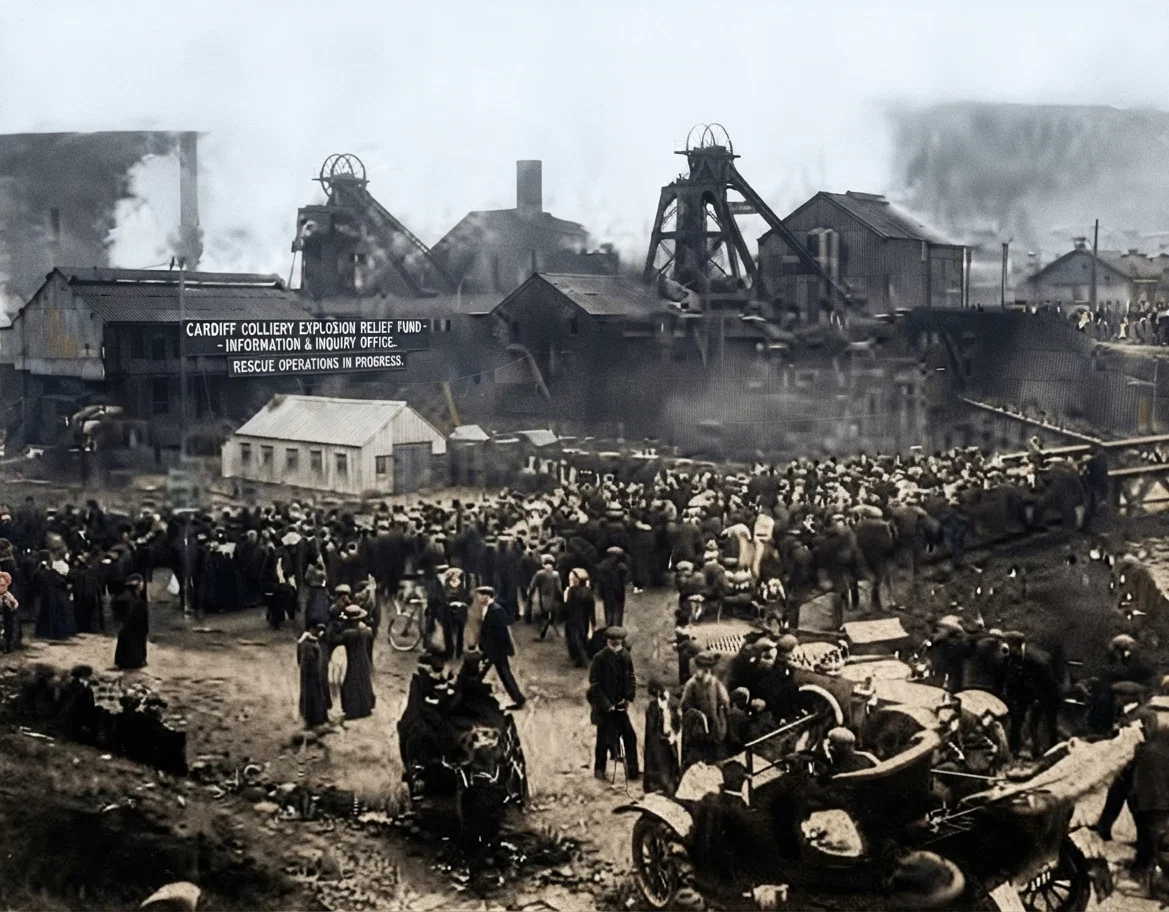
Photo by Paul Thompson CROWD AROUND THE HEAD OF THE MINE AT CARDIFF, WALES, AFTER THE GREAT EXPLOSION, OCTOBER 14
SEEKING TO PARALYZE INDUSTRY
Dr. Strong reminds us that, under the auspices of the Syndicalists, the general strike has been attempted in various countries, with sufficient success "to cause not a little fear on the part of the general public." The whole structure of Russian society was shaken, in 1905, by the "universal strike." All the railways of Russia were tied up for many months, and by reason of sympathetic strikes everywhere, industrial and commercial life came to a standstill. A like attempt was made to paralyze society in France, which was overcome by the military forces, but only after an enormous expenditure of blood and treasure. Early in 1912 the coal strike practically prostrated British industry for the time being. Press despatches said:
"The magnitude of the strike is almost inconceivable. It has affected in a direct way, counting only the miners and other men thrown out of work, with their families, more than four million persons. In other respects it has paralyzed practically the whole life of the nation. Prices of food have gone sky-high, fuel is virtually unattainable, railways have curtailed their services, shipping has been held up, and every branch of industry stopped to a greater or less extent."
INSPIRED BY THE SYNDICALISTS
It should be remembered that these disastrous strikes were all inspired and directed by the Syndicalists. "These attempts," says Dr. Strong, "suggest what tremendous possibilities lie in this sort of 'masterly inactivity.'"
We are reminded that the feasibility of a universal strike is constantly increasing. Industry as now organized is a great school in which working men are daily drilled in concerted action; and as the solidarity of labor progresses, and class antipathy deepens, "the day approaches, when the general strike can disorganize society and inaugurate anarchy." Dr. Strong thinks failure will attend premature effort in this country as in Europe, and the strikers will be the greatest sufferers, which must further embitter the working class against the capitalist class, and increase the score which the strikers will remember against the final day of reckoning.
THEY WOULD OVERTURN SOCIETY
Mr. Bruce Barton reports in the Congregationalist the following statements made by a national I. W. W. organizer:
"We are fighting a war; this is merely a battle. . . . Between battles we make the boss pay the bills. . . . Between capital and labor there is a war; and capital has no rights which labor is bound to respect. We produce everything; we mean to have everything. . . . Of course the owners hate us; of course they'd like to see us hanged. I don't blame them. I'd feel that way if I were a capitalist. It's because they see that we are growing, and realize that our program means their extinction, that they dread us so. . . . Ours is a constant war, and the end of it is the overturn of society and the abolition of the private ownership of wealth."
In these statements are exhibited the spirit, aim, and methods of the Syndicalists. Referring to the same movement, Mr. John Graham Brooks says, "Its tendency is steadily toward anarchy, and it is extremely likely within a few years seriously to plague the Socialist party, as now organized, and it will surely plague the public."
THE DARKEST HOUR JUST BEFORE DAY
Does the picture we have tried to sketch look dark? It is ominous and forbidding. But we must by no means forget the trite saying that the darkest hour comes just before the dawn. Manifold signs of the times conspire to show that the kingdoms of this world have almost run their course. The first petition in our Lord's prayer, "Thy kingdom come. Thy will be done in earth, as it is in heaven," is about to be answered5in fact. When that kingdom comes, it will supplant all the kingdoms of this world. It will be the kingdom of God, and God is love, and where LOVE reigns there can be no class ethics, no class consciousness, no class antipathy, no class war. The law of that kingdom is the law of Christ; and we are expressly taught, by the divine Spirit, that the law of Christ is fulfilled by bearing one another’s burdens.
According to the inviolable testimony of inspired prophecy, as we have seen above, the very fact that we have to-day an industrial warfare is a sign that the return of our Lord in His kingdom is imminent. In that kingdom we shall have socialism, we shall have collectivism, we shall have solidarity—but it will be socialism founded upon divine love, it will be solidarity issuing from the love of God shed abroad in every individual heart. In this way, and in no other, will the great economic problems now vexing society be solved.
But Christ is the “way,” the only way, into that kingdom. Is He your hope, your trust, your life? If He is, then you are one of the elect, and you shall share forever the justice, the peace, the glory and joys of a social state founded eternally in the wisdom and goodness of God.