Their Release from Prison—Their Exile to Foreign Lands—Their Return to Their Valleys and Heroic Defense—Religious Liberty Finally Decreed to Them
By H. H. HALL
THIS is the concluding article on the Waldenses by Mr. Hall. In a very interesting way he has told, in preceding articles, of the descent of this people from the apostolic church. He has told of their doctrines, their great missionary activity, their highly perfected educational system, and the persecutions launched against them with exterminating intent. In the last article, it would seem that their enemies had hopelessly destroyed this devout and courageous little people. The happy outcome is therefore an unexpected and pleasing climax in this article. EDITOR.
AS the silence of death settled down upon the valleys, and the smoke of burning villages died away, there arose a new power to be reckoned with.
"From the recesses of the ravines, from the clefts of the rocks, from the summits of steep peaks, came forth emaciated men, half-naked patriots, outlaws battered by the storm, inured to danger, familiar with fatigue and hunger, who, to escape persecution, had maintained their lives for whole months on the herbs of the mountains and the flesh of the chamois, or even on the savage brood of wolves that wandered about to devour the corpses left unburied. By degrees these rude mountaineers drew together, united, organized themselves, and, having taken an account of their numbers in the Valley of Lucerna, . . . they found themselves in all forty-two men, with a few women and a few children. An almost equal number made their appearance from the Valley of St. Martin."—"Israel of the Alps," volume 1, page 454.
THE CAUSE OF THEIR RELEASE
Made desperate by the knowledge that thousands of their brothers and sisters were languishing in the prisons at the foot of their mountains, and animated, it would seem, by the cry of Milton, "Avenge, O Lord," they threw themselves like thunderbolts upon their persecutors at Villar, La Torre, Lucerna, and St. Segont. They intercepted supply trains, and thus secured food and ammunition. In the darkness of midnight they even fell upon some of the cities of the plains, setting them on fire, and compelling the payment of heavy ransoms. Knowing every foot of the mountain passes, they always returned to their strongholds before dawn and without loss. A terrible fear gripped the hearts of their enemies, and the sound of a gun at night would ofttimes set them in a panic. Perhaps they thought, with Herod of old, "It is John, whom I beheaded: he is risen from the dead." The refugees were offered safe-conducts to such foreign countries as they might elect to go to, but they demanded that their imprisoned associates accompany them. This was finally agreed to, and the doors of the fourteen prisons and fortresses opened one after another, and about three thousand people emerged, and left their native land, in different detachments, for Geneva, Switzerland. We will not dwell upon the terrible march over the mountains in the dead of winter. Suffice it to say that one hundred fifty persons in one company died of cold and fatigue the first day out.
THE BALSILLE
THE VALLEYS LEFT DESOLATE
Well has the historian described the condition of the valleys at that time:
"We now behold these famous valleys, for the first time in their history, empty. The ancient lamp burns no longer. The school of the prophets in the Pra del Torre is razed. No smoke is seen rising from cottage, and no psalm is heard ascending from dwelling or sanctuary. No herdsman leads forth his kine on the mountains, and no troop of worshippers, obedient to the summons of the Sabbath bell, climbs the mountain paths. The vine flings wide her arms, but no skilful hand is nigh to train her boughs and prune her luxuriance. The chestnut-tree rains its fruits, but there is no troop of merry children to gather them, and they lie rotting on the ground. The terraces of the hills, that were wont to overflow with flowers and fruitage, and which presented to the eye a series of hanging gardens, now torn and bleached, shoot in a mass of ruinous rubbish down the slope. Nothing is seen but dismantled forts, and the blackened ruins of churches and hamlets. A dreary silence overspreads the land, and the beasts of the field strangely multiply. A few herdsmen, hidden here and there in forests and holes of the rocks, are now the only inhabitants. Monte Viso, from out the silent vault, looks down with astonishment at the absence of that ancient race over whom, from immemorial time, he had been wont to dart his kindling glories at dawn, and let fall at eve in purple shadows the ample folds of his friendly mantle."—Wylie's "History of the Waldenses," pages 173, 174.
THEIR RETURN AND FINAL STAND
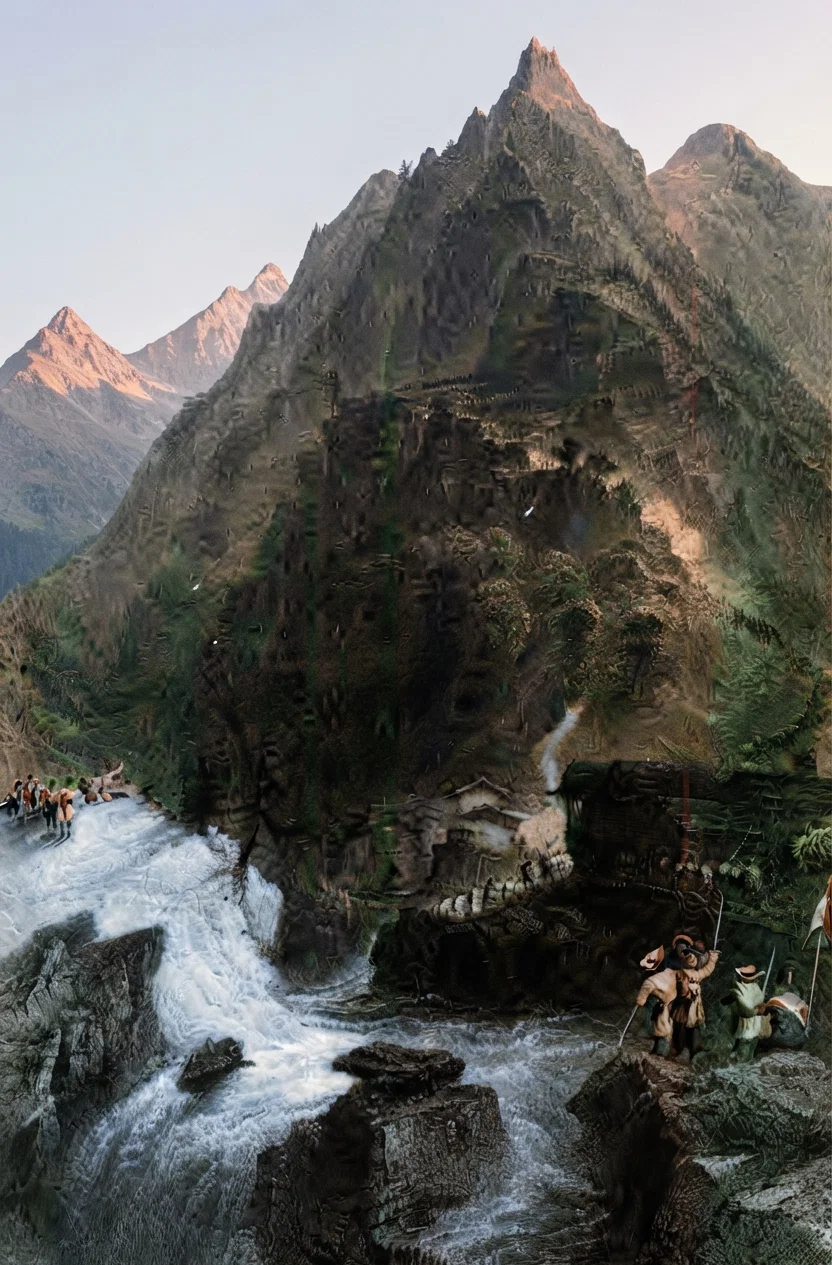
Although most kindly treated by the Swiss, and by several German princes who opened their states to these exiles, they longed for home. Three years later, eight hundred men secretly collected, scaled the mountains that separated them from their own valleys, and began the task of recovering them. Troops were rushed in, winter began, food was covered up with snow, they had to depend upon their enemies for ammunition. Yet they fought on. Finally the remnant, about four hundred, retreated to the Balsille, a terraced mountain which "shoots its gigantic pyramids heavenward, as if proudly conscious of having once been the resting-place of the Vaudois ark." Here the four hundred planned for their final758stand. They added to the natural strength of the citadel by earthen fortifications, into which they fastened trees with their tops downward. Some eighty storerooms were dug. They found that early snows had covered the ungathered corn of the valley, and they harvested and stored it. Thus they spent the winter.
When spring opened, their enemies, twenty-two thousand strong, returned with it, bringing four hundred ropes to hang the last of the hated race. They covered the entire valley and approaches, and began to lay siege. Time after time they were driven back with heavy losses. Finally they mounted cannon on a distant height, and for the first time these mountains, valleys, and peaks echoed with their thunder, while thousands of muskets added to the terror of these refugees. By night their fortifications were in ruins, and the lower portion had been taken. The valley and the mountainsides were lighted up by great camp-fires. Well they knew that no quarter would be given. Destruction seemed certain. The night alone postponed it. And then when all human help had vanished, the hand of God's deliverance was extended.
THE MIST BEGINS TO GATHER
"The mist began to gather on the summits of the mountains around them. They knew the old mantle that was wont to be cast around their fathers in the hour of peril. It crept lower and yet lower on the great mountains. Now it touched the supreme peak of the Balsiglia.
"Will it mock their hopes? Will it only touch, but not cover, their mountain camp? Again it is in motion. Downward roll its white, fleecy billows, and now it hangs in sheltering folds around the war-battered fortress and its handful of heroic defenders. They dared not as yet attempt escape, for still the watch-fires burned brightly in the valley. But it was only for a few minutes longer. The mist kept its downward course, and now all was dark. A Tartarean gloom filled the gorge of San Martino."—Wylie's "History of the Waldenses," page 199.
And then there stood forth a man—for it is by the sword of the Lord and of Gideon, the union of the human and the divine, that the Lord carries on His work—Poulat by name, and he bade them be of good courage, for he knew the paths, and would conduct them to safety.
"Having accurately examined, by the light of the fires, the position of each guard, Captain Poulat . . . offered to conduct them down a ravine full of frightful precipices. Sliding on their backs, and holding on by the bushes, they followed their conductor, who first felt with his hands and feet for spots which could be rested on with safety. They all followed his example, without shoes, alike for sake of silence and security of footing."—"The Glorious Recovery," page 180.
The next morning, the eyes of the invading host scanned the Balsille, but in vain did they look for their quarry. But looking higher, they spied them scaling the distant mountain peaks by cutting foot holes in the snow and ice. Pursuit was in vain. If the
Waldenses did not sing, they certainly appreciated the feelings of that other hunted man who did sing:
"Our soul is escaped as a bird out of the snare of the fowlers:
The snare is broken, and we are escaped."
Their crestfallen enemies returned to Pignerol with wagons filled with wounded, and four hundred unused ropes. Peace was soon declared, the lands of the Waldenses restored, their churches reopened, and their exiled brethren permitted to return.
This really closed their great persecutions, but they were subject to many petty ones until the year 1848. February 17, the following order was signed:
"1. The Vaudois are admitted to the enjoyment of all the civil and political rights of our other subjects, and freely to attend our schools, both within and without the university, and to obtain academic degrees
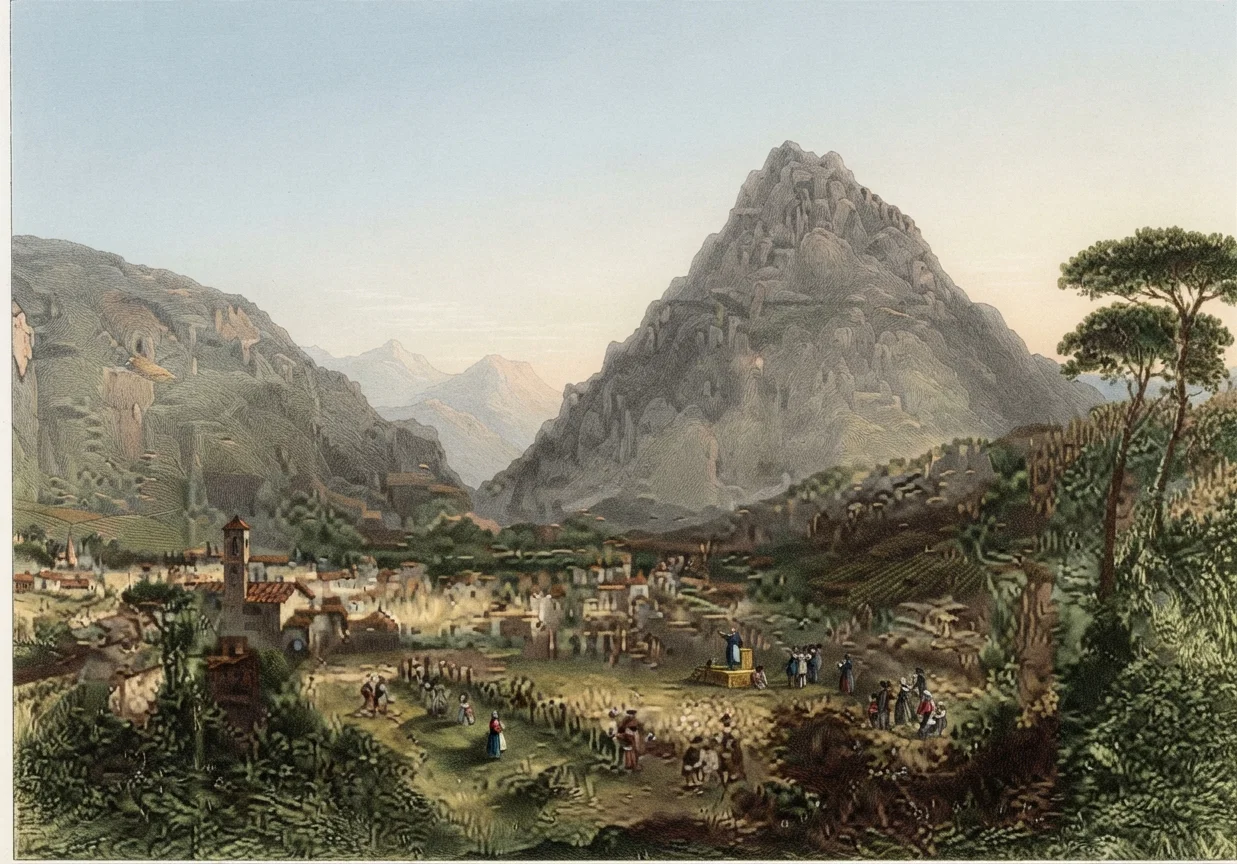
THE TOWN OF BOBI, NEAR WHICH THE RETURNING EXILES HELD THEIR FIRST DIVINE SERVICE
"2. No change, however, is made as to the exercise of their worship and their own schools.
"3. We repeal, by these presents, every law to the contrary, and command the senate and the chamber of accounts to register this decree, enjoining all and sundry to observe it and cause it to be observed, and willing that it be inserted in the collection of acts of the government."—"Israel of the Alps," volume 2, page 390.
This order was received with the utmost enthusiasm, not only by the Vaudois, but by their neighbors as well. Great bonfires were lighted, houses and public buildings were illuminated, processions were formed; and amidst general rejoicing, the men of the valley came into their own. At the time of the annual festival at Turin, the Vaudois delegation was placed at the very head of the procession by the managers, who said, "They have been so long last that it is right that to-day they should be first."
"IT IS ENOUGH"
And well did they deserve that recognition. For more than a thousand years, they had held the torch of truth aloft in their native valleys, and sent out their missionaries throughout Europe. The Reformers had found their light unextinguished in the sixteenth century, the sacred manuscripts still in their possession, their missionary zeal still alive. And even after this they battled on for almost two hundred years, enduring in the meantime some of the most terrible persecutions in their history. Finally God said, "It is enough," and made even their enemies to be at peace with them.
Dear reader, is not the example of this people—their adherence to the Sacred Scripture, and their rejection of tradition, their missionary activities, their system of education, and their patience in the hour of persecution—is not all this worthy of our study and emulation? And shall we not in this our day, when the Bible is spiritualized away by one class, evolutionized away by another, and criticized away by still another, remember that after all it is the only safe guide to the heavenly city? And let this recital of the struggle of the Waldenses impress our minds and hearts anew with the fact that while obedience to that Word may require cross bearing for a time, "the way of the cross leads home." And the promise is that after the cloudy and dark day, "at evening time it shall be light."