Primitive Man

8%

Pacific Press Publishing Association · Mountain View, California · Aug 12, 1913

FromSigns of the Times, Vol. 40, No. 31.

Read the full edition

Primitive Man

By George McCready Price
THERE is only one science that is in a more confused state than archeology, and that is geology, the science upon which all the most fundamental assumptions of archeology are based. It would be beyond our limits and far from our purpose to attempt, in a short article of this kind, to consider in any detailed or systematic way the fundamentals of either of these sciences. We desire to make simply a few remarks about some of the remains of man that have been discovered in various parts of Southwestern Europe. A prominent daily paper recently gave some of the pictures of the animal drawings that have been found on the cave walls of France, Spain, and Italy, and as is usual in such cases, conveyed the distinct impression to its readers that these pictures were carved and painted by primitive men just emerging from the savage state, and that the time when this work was done was two hundred millennium ago.
These drawings are unquestionably very old; the question is, How old? The pyramids of Egypt are old, and so are the clay tablets of Nippur, and the ruins of Stonehenge. The lower gorge of the Niagara is also very old, and so are the boulders and other “drift” materials that have been scattered over Northeastern America and Northwestern Europe; and the Alps are old, and so are the Rocky Mountains. The geologists, in their own peculiar fashion, have arranged all these natural phenomena in alleged chronological order, and claim to know the exact order of sequence in which all the great physical events took place; and the ambition of the archeologists is to locate their discoveries concerning primitive man with reference to these geological changes, so that their archeology may make a good splice on the end of the geological record.
When we look at the slow rate at which rivers are now eroding their channels or spreading out deltas, and when, taking this modern rate as a measuring unit, we attempt to estimate how long it has taken to dig out the gorge of the Colorado, or spread out the deltas of the Nile or the Mississippi, we soon become dismayed at the length of time involved. IF this extremely slow rate of present-day action is to be projected back into the past as an accurate and reliable measure of the rate at which these phenomena took place. For over half a century it has been quietly assumed that this is the correct method, a really scientific method, of measuring the geological changes of the past; and tho this method involved the manifest positive denial that any great world catastrophe such as the Deluge has ever taken place, it is only recently that it has occurred to geologists that it would be much more scientific in point of method to make this rate of the past geological changes the subject of careful and judicial examination, instead of thus prejudging the matter as Lyell and his followers have always done.
A more calm and candid consideration of the whole matter has led some scientists to see that if a careful and scientific investigation of all the facts all over the globe were carried on along this line, we ought to be able to decide very definitely whether or not the tools of nature have always worked at the same rate and in the same manner as at present, and that it is little short of nonsense to assume this uniformitarian doctrine in the face of the thousands of facts from all over the world now known to testify uniformly to the contrary. I have a profound sympathy for any one who stands dazed at the length of time represented by any single one of these geological events when estimated on the basis of the present action of the elements, and apart from that broad view of the whole subject that can take in at one view the sum total of the general geological facts. But some other word than “sympathy” is needed to describe my feeling for the mind that can, in the face of the facts now known to modern geology, project this theory of uniformitarianism back into the dim abysmal past as an infallible guide, and then claim that the results of such a measurement are truly scientific and accurate.
We really know very little of the races of men represented by these drawings. There is no doubt that, even on the Biblical view of the case, the early races of man were left to work out the discovery of the various handicrafts and trades and the multitudinous properties of earth, air, and water, by their own independent efforts. This was one of the sad conditions of the fall. As Pope has expressed it:
“But He who knew what human hearts would prove, How slow to learn the dictates of His love, That, hard by nature and of stubborn will, A life of ease would make them harder still, In pity to the souls His grace designed To rescue from the ruins of mankind, Called for a cloud to darken all their years, And said, ‘Go, spend them in a vale of tears.’”
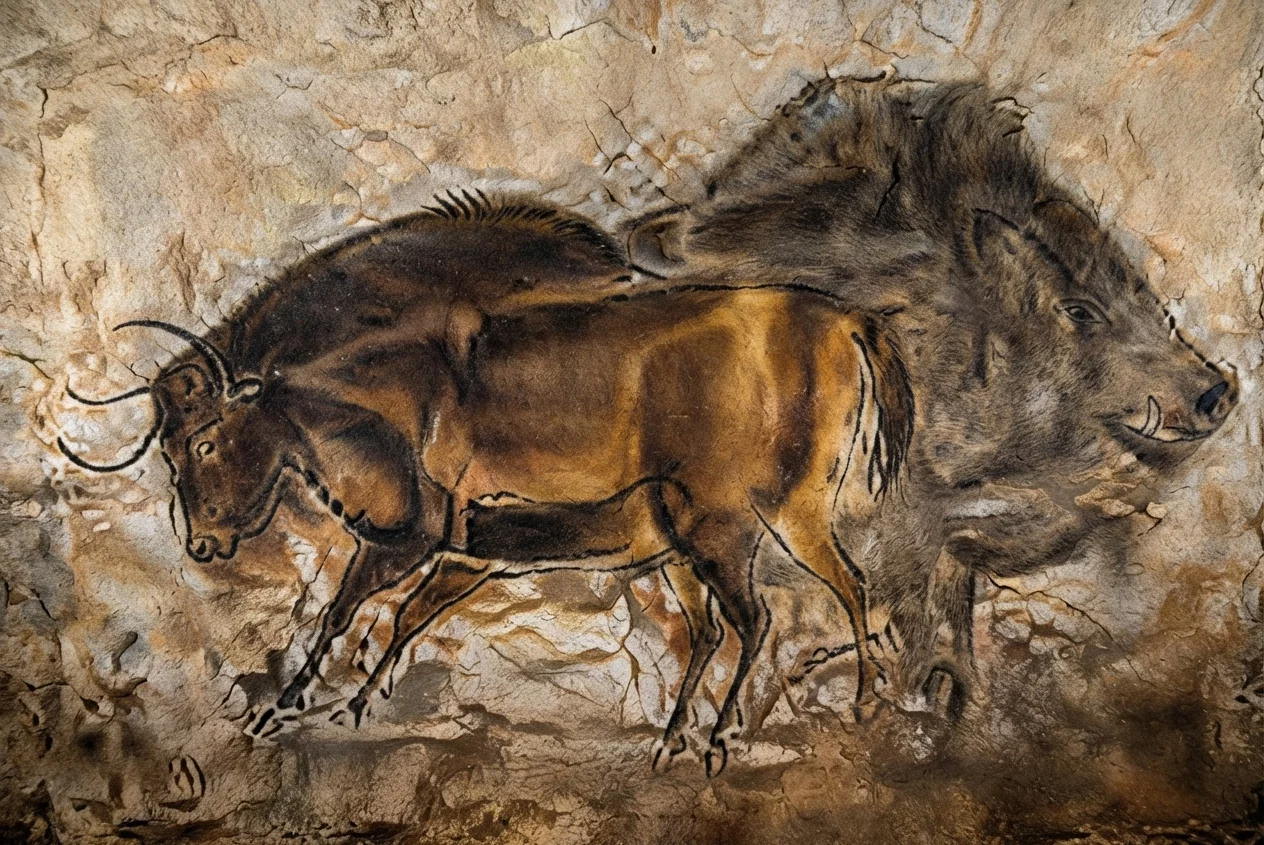
Nearly ten years ago, on the first discovery of these drawings, the present writer published an article in the SIGNS OF THE TIMES calling these drawings “Pictures Older than the Flood.” At present he does not feel so sure that these pictures are really as old as this would indicate; at least it is certain that not all the human remains classed as “palæolithic” are this old, tho some of them may be. As already remarked, the wholesubject is in the greatest confusion, owing to the false and unscientific methods followed in this study at the present time. When every layer in a sand-bank marks off a new “age,” and each peculiarity on a skull or a femur calls for a new Latin name to designate the particular species of the genus homo represented, it would seem that subjective speculations could not well go very much further. Some day we shall probably know more about it. In the meantime, it is impossible to say with certainty whether or not these cave drawings were made before or after other well-known landmarks elsewhere, such as the building of the pyramids in Egypt or the beginnings of civilization in the Euphrates Valley. There is a well-defined boundary line in Europe between the true geological deposits and the “recent,” what Sir Henry Howorth calls the “great dividing line.” But at present it can not be settled which side of this dividing line these men lived. In Biblical language, this dividing line means the Flood; and hence this is equivalent to saying that we can not yet tell whether these men of the caves of France and Spain lived before or after the Flood. And from the present methods of studying the subject, the question never will be settled. But perhaps when clearer facts are discovered, and above all, when more sensible methods are adopted in dealing with the matter, we may hope for better progress.
In the meantime, we need not be alarmed. The Bible is an anvil that has worn out many a hammer. H. L. Hastings used to compare this criticism of the Bible to a rat gnawing a file. It didn’t hurt the file, but it was rather hard on the rat’s teeth.
Loma Linda, California.
Three animals, one on the other,—an ox to the left, a horse over the top of a boar's head at the right