[This is a continuation of developments in the Chinese republic. Our readers will be interested in the light thrown on the opium question.]
ON May 2, at twelve o'clock noon, formal recognition was extended to the republic of China by the United States of America.
Mr. E. T. Williams, American chargé d'affaires, and acting minister to China, accompanied by the entire staff of the American legation, visited the winter palace, Yuan Shih Kai's headquarters, at eleven o'clock in the forenoon.
The president sent a private carriage with a guard of honor to take Mr. Williams to the president's office. The route from the legation quarter through the imperial city to the winter palace was lined with soldiers. As the party entered the gates, the palace band played a tune of welcome.
The party entered boats, and were conveyed across the lake to the buildings which the president uses as offices. Here they were met by a delegation including military and naval officers and the foreign minister. After a few minutes' chat with the foreign minister, Mr. Williams was informed that the president was ready to receive him in an adjoining room. Mr. Williams and the staff entered, bowed to the president, and proceeded immediately to read President Wilson's message, the text of which is given as follows:
President Wilson's Message to China
"The government and people of the United States, having abundantly testified their sympathy with the people of China upon their assumption of the attributes and powers of self-government, deem it opportune at this time, when the representatives in the National Assembly have met to discharge their high duty, setting the seal of full accomplishment upon these aspirations of the Chinese people, that I extend, in the name of my government and of my countrymen, greeting and welcome to the new China which is thus entering into the family of nations. In taking this step, I entertain the confident hope and expectation that in perfecting republican form of government, the Chinese nation will attain the highest degree of development and well-being, and that under the new rule, all the established obligations of China which passed to the provisional government, will in turn pass to be observed by the government established by the Assembly."
After reading this, Mr. Williams spoke as follows:
"Mr. President, having communicated to your excellency the message of the president of the United States giving formal recognition to the Chinese republic, I desire for myself, and on behalf of my countrymen resident in China, to express the satisfaction we all feel in the action taken by the American government. As citizens of a sister republic, we can not be indifferent to anything affecting the success of republican government in China. We shall watch your progress with interest, trusting that the hopes that animated the martyrs of the revolution will find their full fruition in the free institutions now being established. We rejoice with you to-day in the confident belief that this new government, 'broad-based upon the people's will,' by the establishment of lasting peace and equal justice, will minister to the highest happiness of the people, and merit the blessing of Heaven."
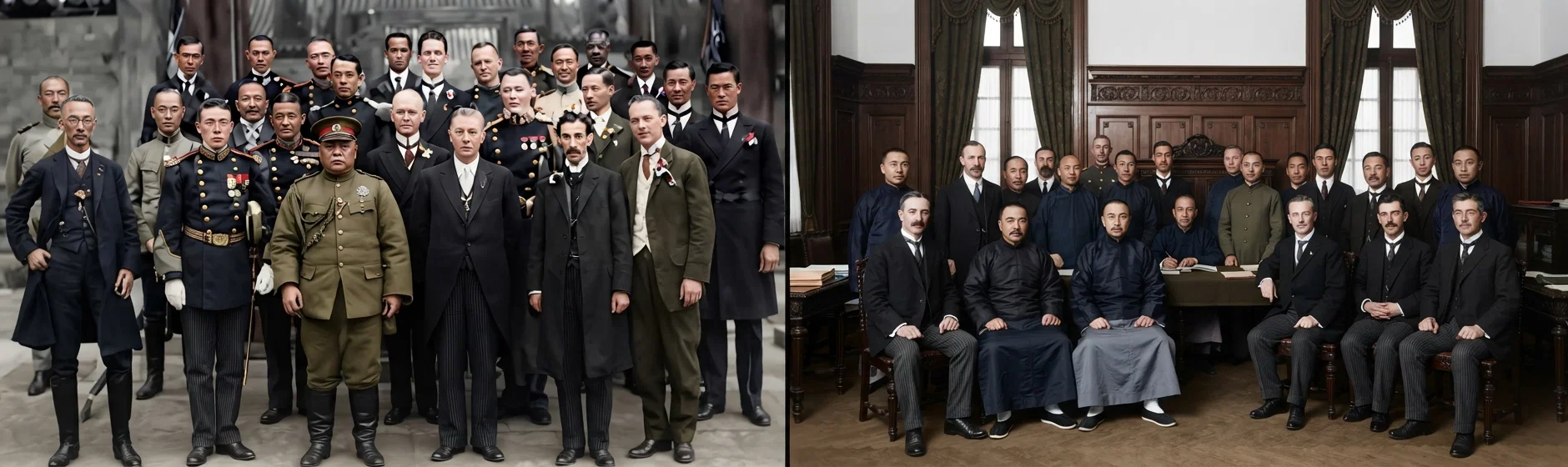
Those who took part in the historical proceedings at the palace of President Yuan Shih Kai, when America accorded recognition to the republic of China, on May 2, 1913. The short, heavy man in front, in military dress, is Yuan Shih Kai. Mr. E. T. Williams, American chargé d'affaires, stands at the president's left. Others are officials and soldiers of the two governments. There is warm friendliness in China now toward America. May it continue. Officials at Shanghai who participated in the ceremony of recognition by America of the Chinese republic. United States Consul-General Wilder and staff represented the United States. On the Chinese side were Tutuh Chen and staff, and Commissioner of Foreign Affairs Ivan Chen and staff. There were also present other prominent officials of the republics United States, France, and China, and other prominent men.
Yuan Shih Kai then responded as follows:
Mr. Chargé d'Affaires, I listened with the profoundest satisfaction to the welcome message from the president of the United States which you have just read, and to the assurances of sympathy which you eloquently extended. On behalf of the government and the people of China, I thank you, and also beg you to transmit our thanks to your president. Tho young in years, the republic of China is founded on principles of liberty and freedom which are already deeply graven on the hearts of the Chinese people. We believe that through the permanent establishment of this form of government, we have found the best means of insuring us what you have been enjoying through the same means for one hundred and forty years; namely, the unalienable rights of life, liberty, and the pursuit, of happiness. It is equally gratifying and significant that the political ideals of two great peoples, tho separated by a broad ocean and living under different skies, are of one and the same kind. I am confident in the hope that this common faith in the soundness of republican government will serve to bring China and the United States into yet closer contact than they are now, and will further strengthen the friendly relations which have invariably existed between them."
The formal proceedings ended, the reception committee escorted the visitors around the palace, after which they took luncheon with President Yuan Shih Kai.
In all the treaty ports and cities in China at which consuls of the United States are located, recognition was extended at precisely the same hour. May 8 was declared a holiday to celebrate the recognition of China by the United States. In Peking, Shanghai, Nanking, and other large cities, great enthusiasm was exhibited. Speeches were made at various places, followed by vociferous cheers for America, and college yells from the students.
There has been growing up, during the last decade, a marked friendship between China and the United States, and a confident belief, on the part of the Chinese people, that America was her "friend indeed," without any sinister motives back of her friendship. The events of the last three years have served to strengthen this feeling, and cement the tie of friendship into a bond of love; and to-day the two largest republics in the world stand with hands clasped across the Pacific, united in aim and object, one great ideal common to both—that of securing to the men and women of their respective countries their God-given rights of life, liberty, and the pursuit of happiness.
America's aid in the time of great distress, famine, and flood, her friendly attitude during the revolution, and recently her withdrawal from the Six-power Loan Syndicate, and lastly her recognition of the new republic at the most opportune time,—these actions, combined with the many words of sympathy expressed by individuals and government representatives, have made a lasting impression on the Chinese, which will never be forgotten, and will live and grow in the minds and hearts of the people, as a surety of pleasant and harmonious relations in the future between the two great Pacific republics.
There is another way in which America has helped China in the past and recently in a special manner, and that is in lending her sympathy and aid in the11
Suppression of the Opium Traffic
For the last seven years, China has carried on an aggressive and determined campaign against opium-smoking, and has endeavored to stop entirely the cultivation of the poppy plant from which the opium is extracted. The old government in 1906 passed laws calling for the gradual decrease of the opium traffic, in all its phases, on a ten per cent a year scale, which would end the business at the end of ten years.
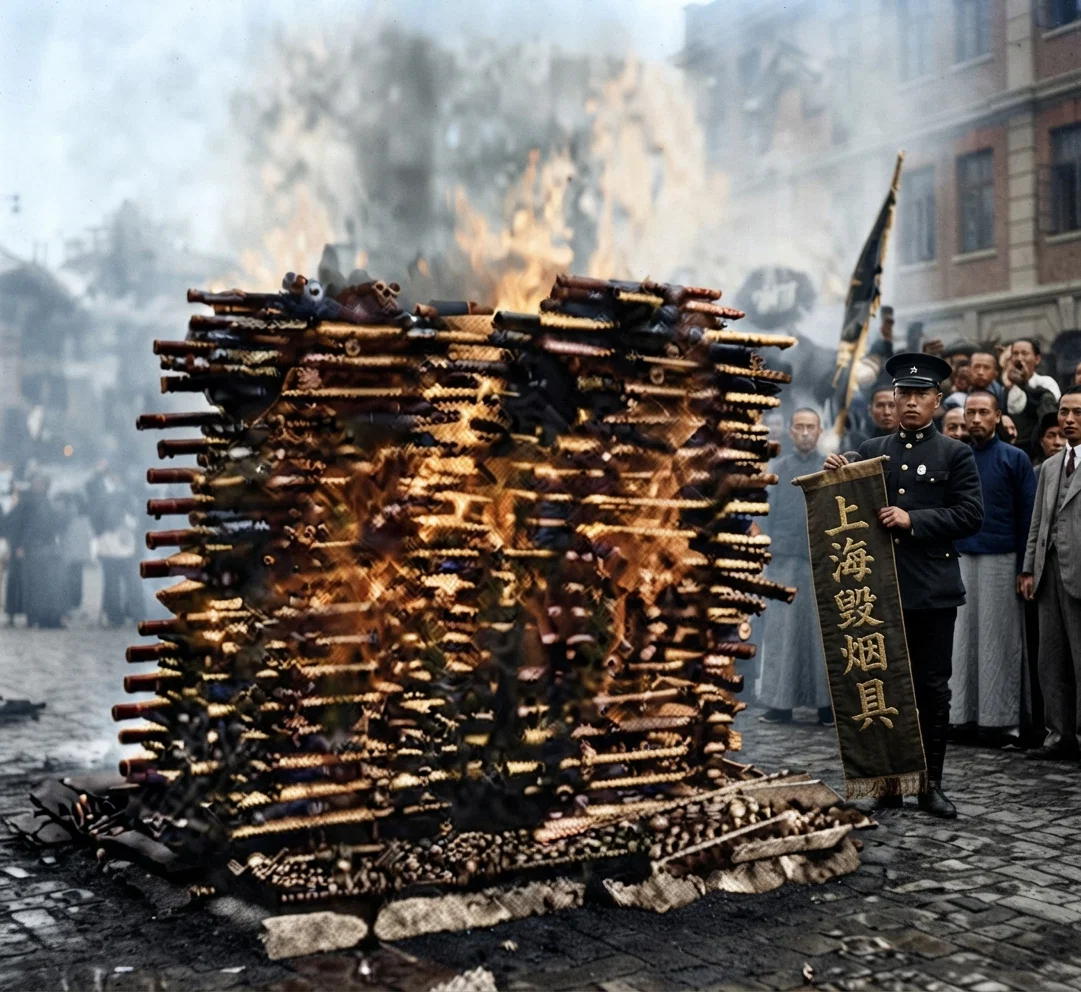
This campaign was carried on in a vigorous manner. Opium dens were closed, the paraphernalia confiscated and burned, farmers who refused to stop planting opium were imprisoned and killed, and officials who smoked, or refused to coöperate in this business of stamping out the opium, were dismissed from office.
It was soon seen, however, that all this good work was of no avail as long as foreign governments were importing opium into China to the amount of ten million pounds a year; so an appeal was sent to England asking her to coöperate in the good work and stop bringing the deadly drug into China. She replied that her treaty with China gave her this privilege and she could not stop on account of the tremendous loss that would result to the merchants who carried on this business. Not a word about the terrible loss of both body and soul of thousands of Chinese who were slaves of the opium habit!
Early in 1911, thirty thousand Chinese signed a monster petition, written on two hundred sheets of paper joined together, one hundred and thirty feet long, which was sent direct to the king of Great Britain. It read in part as follows:
"We, the four hundred million people of China, carefully present this letter to your majesty, king of Great Britain. We perceive that the opium has and will continue to poison continually, and we know that if we do not cease to use it, the future of our country will be very gloomy. Therefore we make bold and pour out our hearts' blood before your majesty, hoping you will listen to us. Our country has already suffered from the poison of opium for fifty years. The injury is so great that we can not speak even one ten-thousandth part of it; and when we think of it, we regret and hate it. Now our government, being enthusiastic in reorganizing our country, has determined to prepare a constitution and earnestly prohibit opium. But even while this strict prohibition has been issued and executed for three years, and our government and our people are both anxious to carry it out, the poison can not be entirely put down. We have searched for the reason, and find that even if we prohibit our countrymen from planting the poppy, that which comes from abroad is still being imported more and more. How can we succeed when five million pounds comes annually from abroad? We therefore cry out and exclaim before your majesty, king of Great Britain, begging your majesty to pity us and give back our liberty to prohibit opium. . . . Your country is most respected by all the countries of the world. Can you endure to throw away your reputation and glory for the sake of money? We know that all other countries are sympathetic in our reform; but if your great country does not quickly stop importing the opium, the reform will be destroyed. We are earnest at the present critical time, and beg your majesty will pity us and excuse us for our ignorance, and immediately issue an edict prohibiting opium, and so save our four hundred million people from death."
This remarkable appeal brought forth no response from Britain, so the Chinese appealed to the other nations; and upon the invitation of the United States government, the International Opium Convention was called at The Hague, which convened at the end of the same year.
At this convention an international agreement was signed, in which Great Britain promised to reduce the importation of opium, and close the opium dens in the British concessions, in the same ratio as the Chinese prohibited the cultivation of the poppy.
That their part of the agreement has never been carried out can be proved from the customs reports, which show that the importation of opium has increased rather than decreased. An excuse was made for this action, that at the time of the revolution, the laws could not be carried out, and many of the farmers took to raising the poppy again. Persistent reports from supposedly reliable Chinese correspondents were published in the London 'Times,' saying that whole provinces were given over to the cultivation of the poppy unrestricted since the establishment of the republic.
The British government, to vindicate itself, sent out special men to investigate the true conditions; and on May 26, two of these commissions returned to Peking, and reported that the provinces of Anhwei and Honan were entirely free from the poppy plant. This has been a cause of great rejoicing among the Chinese people, and renewed efforts are being made now in Shanghai to close all the opium shops and dens. They have succeeded in a remarkable manner; and now when any one wants to smoke opium, he seeks refuge in the British concession, where the opium shops are doing a rushing business on nearly all the important streets.
Burning opium pipes and paraphernalia, Shanghai
Covering a short distance of about a quarter of a mile along which the writer has occasion to pass daily on the way to our street chapel in Shanghai, we have noticed no less than five or six of these shops. One of our inquirers, a woman who is greatly interested in the gospel, wished us to call upon her husband, which we did repeatedly, but were never able to find him at home; and upon inquiry from the neighbors as to the reason, we were told that he was an opium-smoker, and as he lived on Chinese territory, he was not permitted to smoke at home, so he spent most of his time in the foreign concession, where he was allowed to smoke as much as he liked. It is needless to say this brought the blush of shame to our foreign cheeks, because, in the eyes of the great majority of the common people, no distinction is made of the nationality of foreigners, and the innocent suffer with the guilty in regard to their reputation.
Less than a month ago the officials of Shanghai native city, together with the representatives of the Opium Suppression Society, made overtures to the British Municipal Council, who control the British concession, asking their coöperation in the matter of prohibiting the sale of opium in the concession.
The chairman of the council told them plainly that they had no intention of stopping the sale of the opium as long as the people wanted it, and told the commission that if they wanted to do any reform work, they should teach the people not to buy the drug. When reminded of the agreement made by Britain at The Hague, he replied that England never had any intention of keeping that agreement, that it was only given to China as a sop.
Early in June, the following protest was signed by Americans in Shanghai, and sent to the secretary of state in Washington:
"We, the undersigned, Americans resident in China, protest against the continuance and increase of opium shops in the international settlement of Shanghai, in view of the fact that the Chinese authorities have closed up their own shops for the retail sale of opium. 'The increase of these shops in the settlement here from 316 in 1911, to 374 in 1912, to 449 in 1913, seems to be in direct violation of the International Opium Convention signed at The Hague on January 23, 1912; article 18 agreeing definitely that opium shops in the concessions and foreign settlements in China shall be reduced pari passu with China's reduction. As our government is represented in this international settlement, we feel that the United States is deeply concerned in this question; and in view of the fact that the Opium Convention was called at the invitation of our government, we request that you take this matter up, and if possible arrange with the other powers for the carrying out of the provisions of this convention. We believe this is not only justice to China, but a duty required to uphold the standing of international treaties and agreements."
At Tien-tsin, on June 5, opium valued at sixty thousand dollars which had been confiscated by the government, was publicly burned in nine great caldrons. Addresses were delivered by Chang Po Ling, Commissioner Lin, and Mr. E. W. Thwing, secretary in China of the International Reform Bureau. Music was provided by a band, and great enthusiasm prevailed.
Thus the present government is pursuing the work of suppressing the opium traffic with great determination, and nothing short of a complete eradication of the evil in all its branches will satisfy those who are responsible for this movement.
General Chang, who was appointed special commissioner to England, is in London now endeavoring to bring about a better understanding of the question, hoping to be able to reach some solution of the problem of what is to be done with the accumulation of something like twenty-three hundred chests of the drug, valued at eight millions sterling, which is in bond in Shanghai and Hongkong. Since the present government has refused to allow this to be sold, it has become a serious burden to importers and to the banks who have advanced money on it, causing no little anxiety as to its influence on trade generally.
Because of this congestion caused by the firm stand of the government not to allow this drug to be distributed in the interior, the Indian government has at last announced their intention to suspend the exportation of opium to China until further notice. Now if some method could be devised of disposing of the present stocks on hand, it would seem that the opium traffic is nearing the end of its existence.
Speaking of this action of the Indian government, the London 'Times' has this to say with reference to the subject: 'Thus quietly disappears a traffic which has been conducted under British auspices for far more than a century, has contributed to bring about a war, has been investigated by a famous royal commission, and has formed the subject of indiscriminate denunciation at numberless public meetings in this country. When all is said that can be said, however, it is indisputable to-day that the Indian opium12traffic with China is an unpleasant page in British history. It began in the desire of a trading company for profits, and the desire was transmitted to the regularized administration which succeeded the company. The craving for profits continued to the end, and has only disappeared when profits were no longer obtainable. The casual verdicts of the House of Commons do not always command approval, but it is plain now that the house was justified in declaring the traffic to be 'morally indefensible.' We have frequently sought, in the past, to clear the question from the misstatements in which it was constantly wrapped, but we are glad now that Great Britain has done with it.'