High Society

25%

Pacific Press Publishing Association · Mountain View, California · Feb 18, 1913

FromSigns of the Times, Vol. 40, No. 7.

Read the full edition

High Society

Mrs. Stuyvesant Fish, the dictator of society in America, declares that “like France, we are on the eve of a great revolution,” “unless some great leader, some powerful mind, can save us from what seems the almost inevitable.” She declared that she did not say this as a Socialist, or as a radical, or as a sensationalist, but having a peculiarly clear outlook, she felt that “if our country continues in the way it is drifting, there is grave, awful danger ahead,” and she questions whether “society — the handful of people like myself who live within a certain restricted environment — is not largely responsible for existing conditions.” Continuing, she said, “The newspapers do not tell the serious doings of society; but let a few women lunch together and bring a dog or two along, and the whole country is ablaze with front-page stories of the event.” The really unselfish acts are not told; consequently the mass of people have strong prejudices against society that they ought not to have, seems to be the sum of her remarks. She believes, however, that classes must exist.
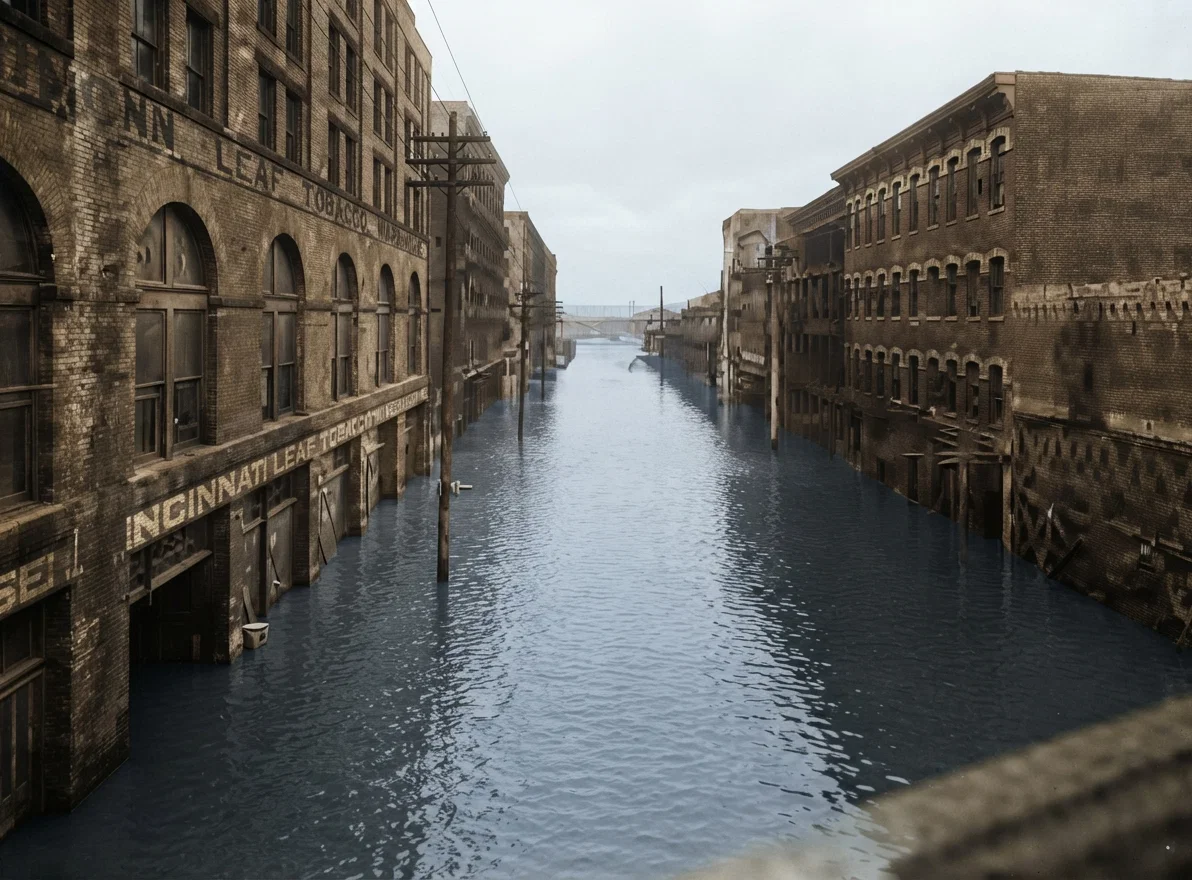
Wholesale tobacco warehouse district, on Front Street, Cincinnati, Ohio, during her recent million dollar flood
One of the serious troubles is that “the whole country is almost without standards and ideals, and our traditions are fast going from us.” But the real point in her remarks is well taken, and it is this: “We have lost the greatest of our ideals — in fact, the one thing that makes ideals possible — we have lost our religious consciousness.” And Mrs. Fish speaks truly; the religious consciousness, and we might say, the religious conscience, is wanting, and “if the foundations be destroyed,” what may we expect of the hollow superstructure?