Our India Letter

3%

Pacific Press Publishing Association · Mountain View, California · Apr 8, 1913

FromSigns of the Times, Vol. 40, No. 14.

Read the full edition

Our India Letter

[This letter is direct from the field, written by one qualified to observe, himself an editor. It will be seen that the great problems of India are world problems.—Ed. S. of T.]
THE four months of the cool season in India are usually those in which the most happens to draw the attention, as then the great plains of the country are bearable, and the legislatures, the conferences, the congresses, and the myriad other activities of the land are in full swing. It is also the time when the missionary endeavor is the keenest and the missionaries are itinerating and doing the hardest part of the year's work. And the present season has been an exceptionally busy and interesting one, crowded with happenings tense with meaning both to the country and to the outside world.

Islam and the Balkan War

We had scarcely entered upon the winter before the strife in the Balkans blazed forth, and Mohammedan feeling in India witnessed an answering chord to Moslem fanaticism in Turkey, while only the decree of neutrality by the British government, with a warning note to its peoples, withheld from active assistance, monetarily and by enlistment, some of the Indian Moslems. Even then large sums have been given to the hospital service, and relief and ambulance corps have been sent to Constantinople. In the revolution that recently brought about the rupture of peace negotiations, these same Indians were said to be among those who incited the populace to revolt. Indians are subscribing largely to the bonds of the new government; and five times a day, in the entire empire, the Moslem population pray to Allah for the success of the Turkish arms.
England's part in the peace negotiations, and her taking part in the note of the powers to Turkey, were hotly resented by Indian Mohammedans, who used threats of a withdrawal of their time-honored custom of siding with the British raj if further aggressive action were taken. English papers warned them of the danger of such speech. The "Times of India," in its issue of February 5, 1913, has this to say to the Moslem community:
"It is time that the wise heads among the Moslem community interfered to give the community a lead, for the extravagant language which is now being employed, and its effect on the uninformed, are so mischievous that if a corrective is not applied the consequences must be most prejudicial to the Indian Moslems themselves."
His highness the aga khan, one of the leading Mohammedans of India, felt called upon, because of the feeling which was developing, to undertake just such a task as the "Times of India" had indicated, saying in the course of his public letter to Moslems that they should refrain from urging Turkey on to further sacrifices and suffering, as only those on the ground knew the conditions under which those sacrifices must be made, and were able to judge of the necessities of the situation. Speaking of Turkey as an Asiatic power, he says in the same letter:
Lord and Lady Charles Hardinge and Family
"Turkey as an Asiatic power can live and thrive only if she has the good will, friendship, and support of England. England has everything to gain and nothing to lose by a strong Turkey in Asia. As it is, the route to India has practically fallen, all along the Mediterranean, into the hands of foreign powers; and should Asiatic Turkey, Syria, Mesopotamia, and Anatolia become German, French, and Russian, it would indeed be a serious position for England. . . . There is a great opening for Musulmans in India alike in serving England and Islam. . . . It means the Musulmans must say nothing and act in no way that can weaken English confidence in Islam and in the loyalty of Musulmans in India. England has no territorial ambitions in Asia Minor, in Syria, or Arabia, or Mesopotamia. By our present sacrifices we can establish an influence with the Turkish government which will give weight to our sentiments and representations at Constantinople. In this way we can act as the cement which will unite these two empires into an irresistible whole, preserving at once to Turkey the opportunity of working out her destiny in Asia and safeguarding the road to India."
But his highness's words have been hotly resented by some Moslems in India, probably a large majority, and a Calcutta public meeting passed a resolution condemning his letter and advice and advocating a stronger policy on the part of Turkey.
In the course of a visit to a local government official recently, the writer was informed that it had become necessary to suppress one Urdu paper of this city, Lucknow, because in its editorials it had advocated the Moslem population rising and massacring the entire European community. It is easy to see, from such incidents, the extent to which Moslem feeling in India has risen in view of the Turkish defeats and reported massacres of Turks in European Turkey. Were it not for the strong hand of the government under which we live, the spirit of Islam would be as manifest here as in other parts of the world. But when religious fanaticism and race animosity are once strongly roused, it is hard to tell to what lengths they might go.
The task of England in the governing of India is not an easy one, and these recurring religious problems are among the thorns in the flesh. One has scarcely disappeared before others crop out in greater intensity.

The Delhi Outrage

It is a trait of character particularly Indian, and yet not confined to this people, which masks their faces while in the back of the mind all sorts of ideas and thoughts are taking possession and driving on to good or evil. Fortunately for India, its outward manifestation is mostly good, and only occasionally do animosity and vengeance crop out. Nevertheless there can not but be at times an unrest in the hearts of the rulers of the country as they see the outcroppings of a spirit of anarchy and disloyalty which is unaccountable and untraceable.
In the latter part of December the viceroy entered Delhi in state, opening the new imperial capitol for official business, the Imperial Legislative Council to meet for the first time with its additional provincial members on the 25th of January succeeding. But in the course of the procession from the railway to the durbar grounds, where the opening ceremony of welcome was to be carried out, a dastardly attempt upon the life of Lord Hardinge was made by parties unknown, from the premises of the Punjab bank. The bomb which was thrown was of Indian manufacture; and the deed undoubtedly was the work of an organized band of anarchists or political assassins who not only work secretly, but successfully avoid detection, for to the present writing no trace of the perpetrators has been found.
Fortunately, the viceroy, who has from the time of his arrival shown his friendship for the Indian people and wisdom in his rule, escaped death, altho seriously injured by fragments of the bomb and of the howdah in which he and Lady Hardinge were sitting. Ten others were injured. Lady Hardinge escaped with only a shock and slight deafness.
There is a growing feeling, among the well-informed and responsible people of India, that anarchy has become one of the questions which must be met in the future of the land, and that these events of frequent occurrence are not matters of personal grievance only. It is felt that years will be required to outlaw it, if indeed this is ever possible. In the West, anarchy is felt to be the work of the mentally deranged and the uneducated; but here in India it is apparently the educated but dissatisfied, the ambitious of political upheaval, most often of good social position, who are involved. Those who occupied the building on the day of the bomb throwing were people of good standing in the community, and it is thought that they know far more about the affair than they are willing to tell. In fact the government has intimated as much to the people of Delhi.
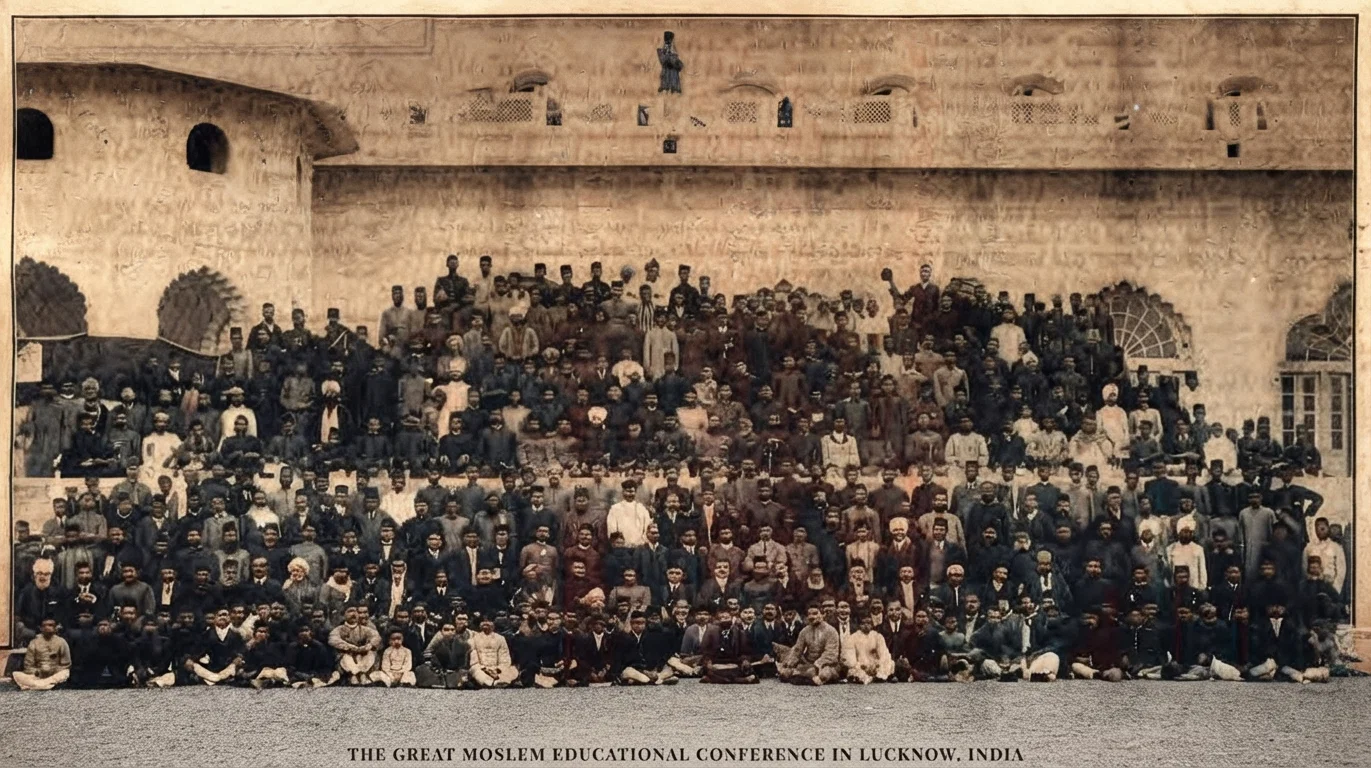
THE GREAT MOSLEM EDUCATIONAL CONFERENCE IN LUCKNOW, INDIA
In his speech of the newly assembled Imperial Legislative Council on the 25th of January, the viceroy, who was sufficiently recovered to read his speech from the throne before retiring to undergo a second operation, seemed to feel the seriousness of the situation which the government faces on account of anarchy, for he says:
"I have one word more to say to the people of India, which I say with a profound sense of the gravity of the import of my words. I need hardly recall to the memory of anybody that the recent incident is not an isolated episode in the history of India, but that during the past few years both Indians and Europeans, loyal servants of the government and of India, have been less fortunate than I have been, and undeserving of the cruel fate meted out to them, have been stricken down by the hand of the assassin. Those deplorable events cast a slur on the fair name of India and the Indian people, to whom I know they are thoroly repellent; and I say to the people of India, not merely as a viceroy intensely jealous of the honor of the country that he has been called upon to govern, but as one of the many millions in India of the fellow subjects of the king-emperor, and one who loves India and the Indian people amongst whom he is living—I say that this slur must be removed and the fair fame of India must be restored to a high and unassailable place.
"The atmosphere which breeds the political murderer is more easily created than dispelled. It can only be entirely and forever dispelled by the display and enforcement of public opinion in a determination not to tolerate the perpetration of such crimes, and to treat as enemies of society not only those who commit crimes but also those who offer any incentive to crime. Among such incentives to crime should be included intemperance of political language and methods likely to influence ill-balanced minds and lead them by insidious stages to hideous crimes."

Seditious Literature Bill

Nearly two years ago the government passed a seditious literature bill aiming at the suppression of papers and books which encouraged these crimes, but it has had practically no effect so far as repressing them is concerned. Secretly the work goes on; and where there was once a clue to the perpetrators, there is nothing but the blank features and soft smile of one who may in some way be connected with the crime. Yet as the viceroy has said, the vast majority of the Indian people heartily abhor these methods.

The Mohammedan Educational Conference

The Moslem Educational Conference met in Lucknow in January to plan together the extension of the growing educational work of that sect. For some years there has been on foot a project to make the Moslem college at Aligarh, United Provinces, a university. Government sanction was given to the scheme if the funds could be found; and altho the collections for this purpose were temporarily abandoned in the effort to meet the more important work of assisting Turkey in her extremity, his highness the aga khan, one of the leaders in the educational work of Mohammedans, is confident of their ultimate success.
The outstanding feature of interest to Western peoples in this conference will be the fact that a Christian lady missionary addressed the conference on "Education for Women," and was well received by the delegates. Later a reception was held at Isabella Thoburn College (Methodist), and Bishop J. W. Robinson, of that denomination, welcoming the Moslem delegates, spoke on this wise:
"Another unique feature connected with this gathering is this: Host and guest are engaged in work connected with different religious faiths. We are glad the days of bitter antagonism are past, and that it is our privilege to live in days of toleration. But this gathering to-day—may we not hope?—indicates the beginning of an era when, no longer satisfied with mere toleration, we assume an attitude of active cooperation in the many things on which we agree. While recognizing the fact that we do disagree on some vital points, we have reached the place where we desire to place the emphasis on the things in which we agree and in which we can cooperate for the benefit of the race."
While the greater portion of the bishop's speech is good, there is one feature which stands out as indicative of the strong tendency of modern times toward eliminating what are called the points of divergence and emphasizing the points of contact. Men feel that the various denominations may be united as one, and that the differences are immaterial. So when, on the mission field, there must be met the teachings of other faiths, there is a like tendency to omit the differences, fraternize, and emphasize the points of contact. The letting down of the conscience to forgetfulness of the differences in faith which make the truths we love, opens the flood-gates to greater error, and seas mountain high sweep us to destruction. Mohammedanism is radically different, utterly opposed to Christianity. There are points of contact, it is true—places where the Koran acknowledges the truths of Bible faith and religion; but there are so many fountains of iniquity, so many loopholes of the enemy, in the whole system, that for Christians to go so far as to forget them in an effort at cooperation is, it seems to us, a grave mistake.
At the late Moslem Missionary Conference, held in this same city, Dr. Speer, in his message to the conference, said:
"In his attitude toward other religions, the evangelist must not obscure the points of difference. If there were no points of difference, there would be no need of evangelists; and it is the radical importance of these points of difference that justifies all that the missionary enterprise has cost and is still to cost. . . . I have been more and more led to the conviction that it will rather harm than help our cause to minimize the differences between Christianity and any other religion." ("Lucknow, 1911," pp. 219, 220.)
This, it seems to us, is the true attitude. With love for the individual Moslem, toward whom the spirit of our Master must at all times be manifest, but with uncompromising hostility toward the gigantic errors of the faith they hold, the true missionary must lead them away from the dim rays of light that now enlighten their lives, into the fulness of the truth. Acknowledging the good, it must never be forgotten that there is something higher, purer, nobler, for them in the Christian faith.
S. A. WELLMAN