We naturally look to Rome for both the head and the heart of the Roman Catholic religion. Logically we would expect to find both in the city of the pope and the propaganda; for to this head center all Catholics look and point as the court of last resort. On the rule that the tree is known by its fruit, we look to Rome for that which Rome itself would exhibit as the best results of the system. Then, as showing the fruit raised in the home garden, we give the following article, contributed to the Missionary Review by Miss M. E. Vickery, of the Methodist Young Ladies' College of Rome:—
"I have to do with children and young people, but I find that all that they have ever known of religious life has been a mumbling over of beads and bowing low before shrines and images. What tho these statues of marble and painted plaster be called the Virgin Mary, the Child Jesus, or by the name of some saint! The people are ignorant of Bible history, know nothing of the life and doctrine of Christ, and would pray with as much ardor to any idol put before them. In fact, the great miracle-working Madonna of Rome, worshiped in the Church of St. Augustina, is only a pagan statue of the wicked Agrippina with her infant Nero in her arms. Covered with jewels and votive offerings, her foot encased in gold, because the constant kissing has worn away the stone, this haughty and evil-minded Roman matron bears no possible resemblance to the pure Virgin Mary; yet crowds are always at her foot worshiping her. The celebrated bronze statue of St. Peter, which is adored in the great Church of St. Peter, and whose foot is entirely kissed away by the lips of devotees, is but an antique statue of Jupiter, an idol of paganism; all that was necessary to make the pagan god a Christian saint, was to turn the thunderbolt in his uplifted right hand to two keys, and put a gilded halo around his head. Yet, on any church holiday, you will see thousands passing solemnly before this image (arrayed in gorgeous robes, with the pope's miter on its head), and, after bowing before it, rise on their toes and repeatedly kiss its foot.
"How can there be any spiritual life in a religion that consists only in hearing mass in a language not understood by the common people, in repeating prayers learned by rote, as children, and attending confessional, where the priest's questions are only a prying into private life? The Bible has ever been a forbidden book, and a good Roman Catholic dare not even think for himself on religious questions; he must accept what the priest says as the final and only truth. He dare not approach God directly, but only through saints, and he thinks of God as an angry judge, that only, Mary can command to be clement and merciful to weak men.
"How often, after talking with some of the women, have I despaired of ever making them understand spiritual things! They think the saints, the Blessed Virgin, and even the infant Christ (they are taught that the Virgin ascended to heaven with the infant Jesus in her arms), like the pagan gods, can be deceived by outward devotion or their favor bought by some sacrifice.
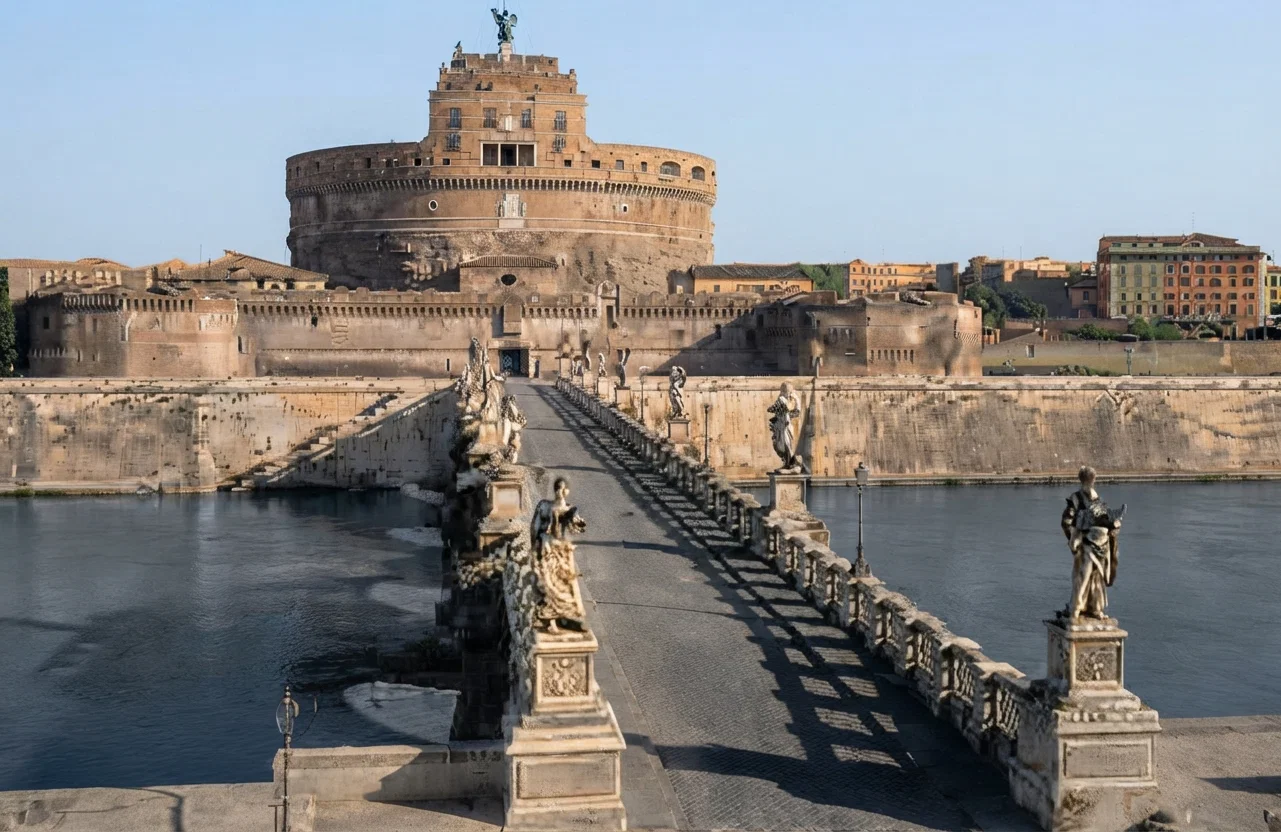
THE MAUSOLEUM OF THE ROMAN EMPEROR HADRIAN,
"In one of the three hundred and eighty-five Roman churches is an image of St. Anthony, the great saint of Padua. On one side of the statue is an iron box for offerings in money, and on the other side is a letter-box. Last Easter eve I saw the monks empty the money-box, and it required three of them to drag away the heavy sack of coin. There are always many young women to be seen before this image; for St. Anthony is the patron of marriages, and many a timid confession of love is dropped into the letter-box, and it often happens that a marriage is arranged as a result. The superstitious maiden believes that her letter goes directly to the saint in his heavenly mansion, and she has no suspicion that it is read by the parish priest.
"Yesterday I watched the Sacro Bambino (holy baby) being carried in a pompous procession to its carriage, and then hastily driven—to the bedside of some ignorant Roman woman?—No, to the bedside of a prince of the church, one of its boasted intellectual lights, Cardinal Jacobini, the cardinal vicar of Rome, only second to the pope in spiritual authority. Does it seem possible that such things could occur in Rome in this the last year of the nineteenth century?
"It is claimed that the bambino, the wooden doll, was carved and painted by the angels in the exact image of the infant Jesus, and that its mere presence in a sick-room will heal the most desperate cases. A large sum of money, however, must be given to the monks before it is allowed to leave its iron safe to visit a dying person, and guards go with it, for fear that it might be robbed of the earthly treasures, the diamonds, rubies, necklaces, rings, and bracelets with which it is completely covered. When taken into the sick-room, if its face glows, it is a sign that the patient will get well; if it turns pale, it means that God does not will the person to live. It turned pale for the cardinal, so to-day we hear of his death. When the highest spiritual authority puts all his faith in a gaudily-painted doll, what can we expect from the ignorant people, who get all their light from him?
"A dense cloud of paganism and immorality cuts off the vision of the Sun of Righteousness from the Italian people. One must begin with tearing down and destroying superstitious and base ideals of divinity, before he can hope to reach the hearts of these people, and lead them into the true light.
"The so-called 'holy year' has brought crowds of these ignorant, superstitious pilgrims to Rome. One has only to look into their faces, full of worry, fear, and superstition, to see what the Roman Church does for the masses—not a gleam of hope or intelligence in their eyes. They crowd into the churches to see pagan ceremonies. They kneel before the priest, and are touched with a rod, thus having their petty sins forgiven. They crowd into St. Peter to see the pope and his gorgeous court, devoutly kneeling as the procession passes. They crawl up the holy stairs on their knees (the same stairs that Martin Luther was ascending when the Spirit told him, 'The just shall live by faith'), but nothing brings a ray of joy or smile of peace to their troubled faces. Patiently they go through the allotted duties of this jubilee year, repeat the prayers over and over, and confess 'every day—all for the vague hope of shortening by several thousand years the long, long time they must pass in purgatory."