OF all the witnesses who clamor against the injustice of our present age, none speak with more eloquence than our poor despised brother, the Indian of the Argentine Republic. Many deny the Indian every human right, and demand his complete annihilation. Others, not daring to go to this extreme, refuse to concede to them the privileges which they themselves enjoy. We happen to be acquainted with many of these so-called "savages." In fact, the son of an Indian is even now the elder of one of our churches in the Chaco Santafecino, and is in very truth as intelligent and rational a being as is the average American.
What causes these Indian tribes to fight shy of the civilizing influence of our times? This is a question which may be reasonably expected, and one which can be easily answered.
The Argentine Government has good intentions, no doubt, in subjecting these wild indigenous tribes, and for this reason it expends hundreds of thousands of dollars every year seeking to subjugate these sons of the prairie. But, alas! the men to whom the commission is given to civilize these poor creatures, prove they are more brutish and uncivilized than the Indians they are hunting.
Not long ago a friend of mine joined in an "Indian expedition." That is to say, a squad of men gathered together with the one idea of exterminating the poor aborigines, who might be so unfortunate as to fall into their hands. This expedition, for five days, followed the track of those sojourners of the desert. At last they came upon their wigwams, and immediately attacked them with a ferocious and sanguinary spirit worthy of the very darkest period of the Dark Ages. The Indians were handicapped in their conflict against European arms, having only for defense long lances with steel points, and bolas, or balls of stone, iron, or brass tied in such a manner as to be an effective weapon in the hands of a skilful thrower.
The Indians, seeing how useless it was to continue the conflict, raised a white rag over their heads, signifying their wish to surrender. The white men made a sign for them to lay down their arms, which they formally did, and then approached their conquerors. But no sooner had they got within a few paces, than the sound of musketry resounded on the air, and the next moment nine dark-skinned figures lay writhing in the dust. The women were captured, abused in a most atrocious manner, then taken prisoners of war, to be disposed of for the highest price; while the children were separated from their mothers, nevermore to behold each other. Such acts as these cause the Indians to hate their white brethren.
Such is the modern way of civilizing the autochthonous races. The Indian in his native state is honest, truthful, virtuous, since robbery, lying, or immorality was utterly unknown among them until their contact with modern civilizers. They are Socialists in the extreme sense of the word, since they hold everything in common. Drunkenness has only recently been exhibited among them, and that since they have lived within the territories reserved for them by the government. The Indian is a faithful friend to those who succor him, but an awful enemy to those who seek to harm him. And, according to far-famed historians, he will endure privations, hardships, and surmount a thousand difficulties to satisfy a spirit of revenge.
Many of the Argentine tribes adore the moon. While the moon is on the increase, all is happiness in their encampments; but immediately it begins to decline, the whole appearance of things undergoes a sudden change, and melancholy and sadness replace their former joy. They are very clever in making small images and figures, which they personify to represent the divers objects of their adoration.
The principal occupation of the Indian is to hunt the tiger in the great forests of the Gran Chaco. He then sells the skin for a mere trifle to the traveling merchants of the deserts, who, for little or nothing, thus obtain articles of great value from the natives.
Weapons, etc., of an Argentine Indian.
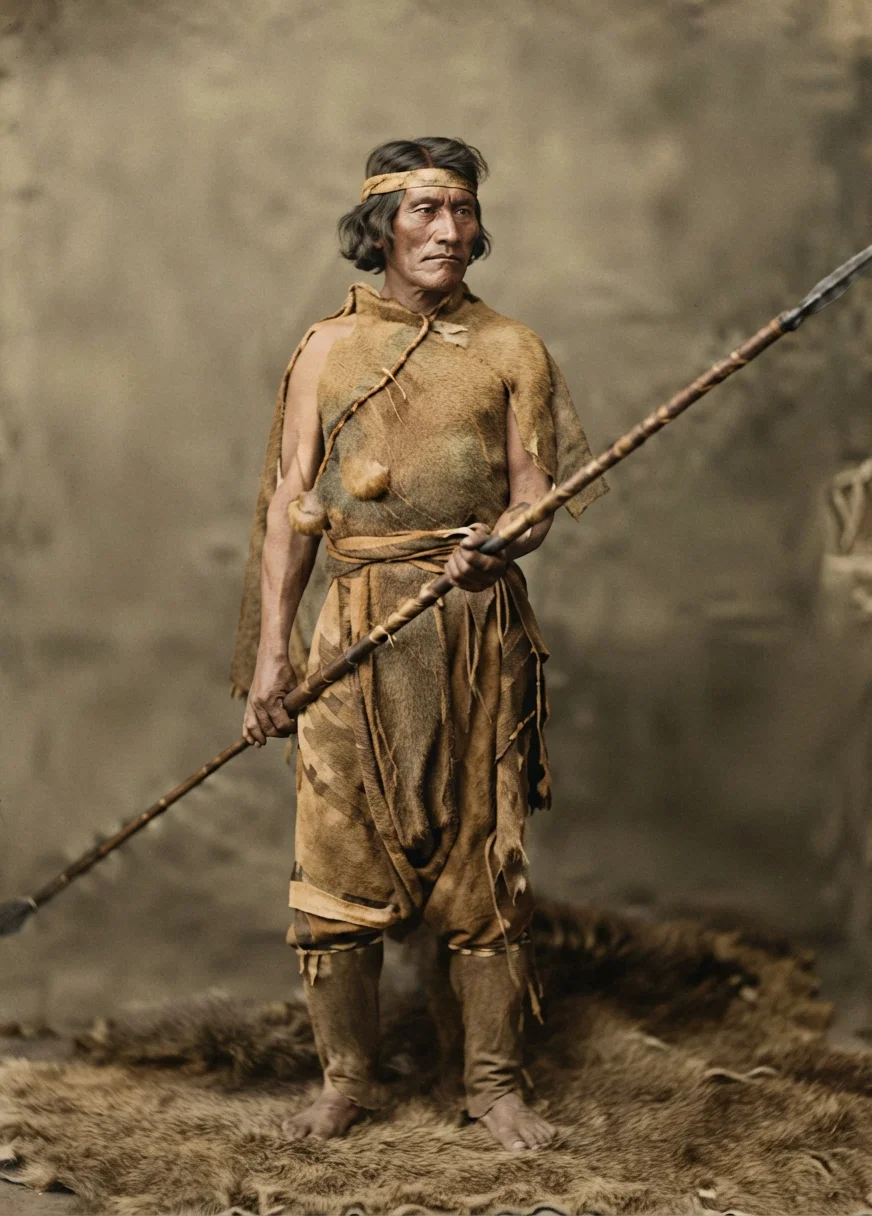
We present here the photograph of a famous Indian cacique, who resisted the government for some years, but who at last fell a victim, fighting for his natural rights and the liberty of his people. Another illustration shows objects gathered during different "Indian expeditions," and which are held in high estimation by the Indians.
Each tribe has a different language or dialect, altho at the present time the majority of the young Indians have learned to speak the Spanish language more or less fluently, since the criminals of the republic, to escape the hands of justice, seek refuge among the Indians, who gladly shelter and protect them.
Shall we, who call ourselves God's people, leave these poor, despised creatures to their fate? Shall we pass them by as being beneath our notice, and unworthy of the Gospel? or shall we rather, impelled by the profound love of God, place ourselves at the disposition of the Almighty, and say, with the ancient prophet, "Here am I, Lord, send me"?
The Argentine Chief.
Many aching hearts are yearning for the truth among these poor Indians. Many who are now bowed down by superstition's load, are longing to be free. The Gospel of Jesus Christ is the only medium through which permanent freedom may be obtained. Let us, therefore, without delay, imitate Jesus, by proclaiming "liberty to the captives." Then in that great day of reckoning, we shall behold many of this spurned race among the precious jewels which the Lord will gather to Himself in yon eternal mansions. JUAN MCCARTHY.