PRESENT TRUTH

5%

Pacific Press Publishing Company · Oakland, California · Aug 1, 1900

FromSigns of the Times, Vol. 26, No. 31.

Read the full edition

"PRESENT TRUTH."

THE term is Biblical. The apostle Peter desired that the people of God should "be established in the present truth." 2 Peter 1:12. The Greek expression literally means the truth that is present with you.
AND, really, this is all the truth that we have to do with. God has given us the present, the one eternal now. "Behold, now is the acceptable time; behold, now is the day of salvation." "To-day if ye will hear His voice, harden not your hearts." We can not bring back the time once spent. We can not bring the time of to-morrow into to-day. If the soul is cleansed at all, it must be in the now. If the victory is ever gained, it must be in the now. The crucifixion must be a present crucifixion, the death to sin, a present death. The newness of life must be a present possession. No glories of the future shall be ours unless we have their earnest here and now.
GOD gives us lessons of the past, not as mere history of events, not to entertain us, not merely to instruct us intellectually, but as lessons for the present time. They are given to instruct us now, to warn us now, to strengthen and encourage us now by the present truth which is in all His past history. His Spirit has said that "whatsoever things were written aforetime were written for our learning, that we through patience and comfort of the Scriptures might have hope." Rom. 15:4. Of God's dealings with His people we are told: "Now all these things happened unto them for ensamples [margin, "types"]; and they are written for our admonition, upon whom the ends of the world are come." 1 Cor. 10:11.
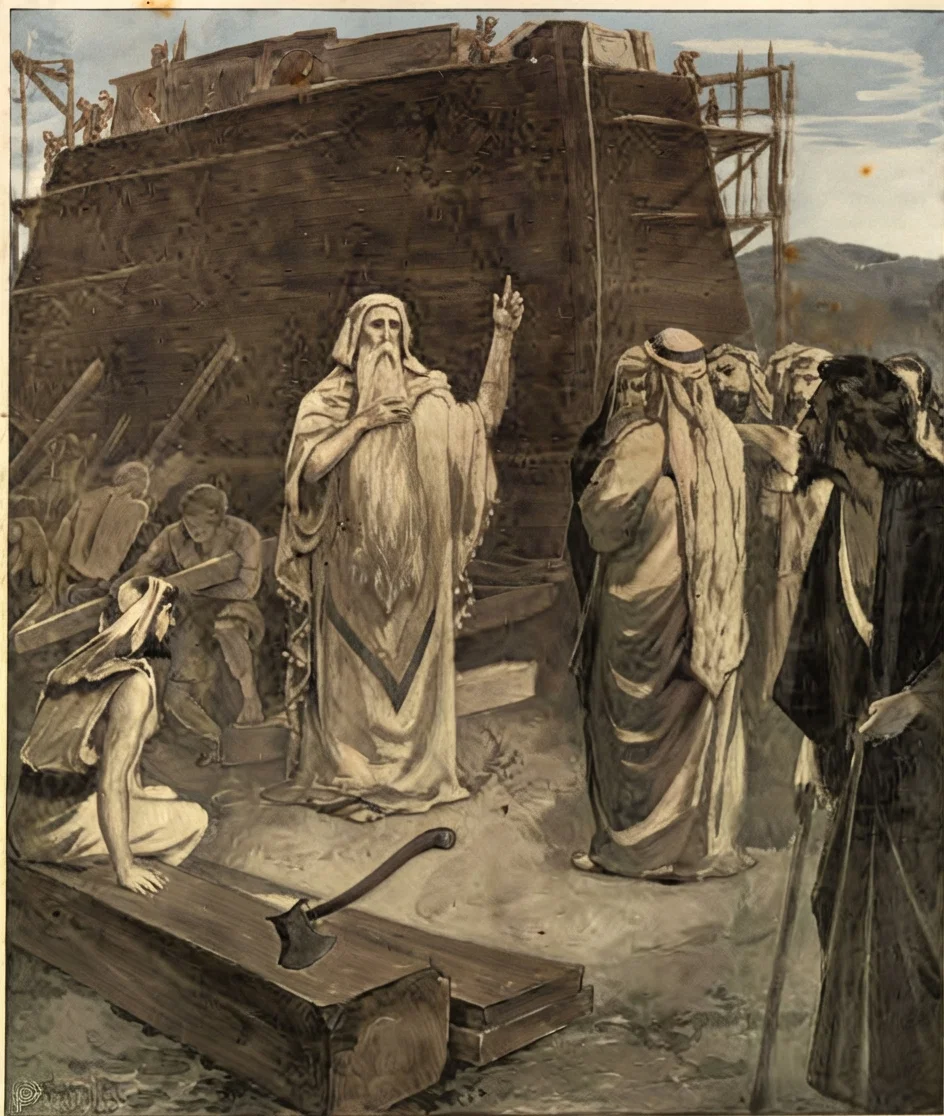
"Noah, a Preacher of Righteousness."
GOD, in His wisdom and goodness, tells us of the sure end awaiting the sin-lover and finally impenitent. He does this that we may know the end of sin and all identified with it, that we may now be admonished and persuaded to separate from it forever. He portrays before us the sure reward of the righteous, the glorious inheritance, and the transcendent beauties of the sinless state, that faith may now grasp it and hope be revived and encouraged. All that the Lord has said concerning past, future, and present are to us the now.
SUCH is the lesson which our illustration suggests. It is an imaginary antediluvian scene. Noah standing by the unfinished ark and preaching to the people. For over a millennium and a half after Adam's fall the world had gone on in ever-increasing wickedness. The long-lived race sought out devices to sin, and hardened their heart, until few indeed resisted the oncoming and increasing flood of iniquity. God faithfully warned them by those patriarchs true to Him. Enoch prophesied of the sure destruction to come. For three hundred years he lived his blameless life before them, witnessing to God's power to save from sin. But notwithstanding all this light, men hardened their heart against God till every imagination of the heart became corrupted, and there was no remedy save the destruction of sin and those identified with it. The flood-tide of sin must be washed out with a flood-tide of waters. He that spoke division between water and land in the beginning of earth's history (Gen. 1:9, 10), would now unspeak it, and convince the world that all power was in Him, that He was the Ruler of heaven and earth. Righteousness would maintain God's order, arrangement, kosmos; but sin on the part of earth's kingdom—brought disintegration and destruction, and "the world [kosmos, arrangement] that then was, being overflowed with water, perished." 2 Peter 3:6. What the arrangement was before the flood we do not wholly know; but we do know that much of what are continents now were then submerged, and much of what was land then is now in the bed of the great sea.
BUT God's goodness would not let the flood come upon men unwarned. "Jehovah said: My Spirit shall never pronounce judgment on men unwarned. They are but flesh. Their days shall therefore yet be one hundred and twenty years." Gen. 6:3. (Boothroyd). He found one righteous man to whom He could intrust His message of present truth for that generation, that people. "Noah was a just man and upright in his generations, and Noah walked with God;" and "Noah found grace in the eyes of the Lord." Gen. 6:9, 8 (margin). What made Noah righteous is the only thing through which any can be made righteous; he "believed in the Lord; and He counted it to him for righteousness" (Gen. 5:6), and he "became heir of the righteousness which is by faith" (Heb. 11:7). He not only was made righteous, but he was "a preacher of righteousness." 2 Peter 2:5. He preached the truth that was with him and in him; that the only salvation from impending judgment was "the righteousness of God by faith." He proclaimed this message not in his own wisdom or might; but the Angel of the covenant, the Christ of God, was with him by His Spirit. 1 Peter 3:18-20. By his faith he was justified and saved; and by that faith "he condemned the world" (Heb. 11:7); for the fact that he believed and was saved was a proof that every other soul could have believed and been saved, "for God is no respecter of persons."
His faith was a faith that worked. He did not work to get faith; he worked because he had faith. "By faith Noah, being warned of God of things not seen as yet, moved with fear, prepared an ark." Heb. 11:7. His building was, in his life, a fruit of his faith. To others it was a proof that he believed what he preached.
His was a righteousness of principle, the fruit of a faith based on God's Word. There were wise and mighty and renowned men in those days, whose mothers were daughters of the church; men who did not believe in a coming flood; men who scoffed at Noah and ridiculed his ideas of science; who could have said, and doubtless did say: "The earth is as it has always been; it will stand forever as it has always stood. How foolish it is to build an ark, a boat, a ship, on dry ground." And they laughed him to scorn. But the old patriarch knew God. He knew that He who spoke a world into existence could speak it out of existence; that God had said it and would perform it; and he builded on, prayed on, preached on. Doubtless he employed carpenters and workmen, who laughed at the builder behind his back. Some of them, like Methuselah, died in the faith before the flood came. Others were like the staging used in building the ark; they perished in the flood in the sight of the haven of safety, the door of which opened only to faith. Doubtless some of those who died, professed the faith of Abel and Enoch. These patriarchs did not believe in a flood; why should they? And so they rejected the present truth for them.

Its Lessons.

THE flood has its lessons for us. Let us in faith study some of them.
1. The long-suffering mercy of God which warns and waits, warns and waits, for the soul's repentance. How eagerly He watches! How gladly He welcomes home to His heart of love the wanderer!
2. God's mighty power to restrain such wickedness as would ruin the very universe, is shown. God withdraws His sustaining hand, which has preserved men that they might repent, and permits them to perish in the sin they have chosen. Yet in all the cataclysms of the elements He is able to preserve those who trust in Him.
3. God sends warning of coming perils at all times. No judgment will find men unwarned. The Son of God, by His Spirit "lighteth every man that cometh into the world." John 1:9. "Surely the Lord God will do nothing, but He revealeth His secret unto His servants the prophets." "We have also a more sure word of prophecy; whereunto ye do well that ye take heed, as unto a light that shineth in a dark place, until the day dawn, and the day-star arise in your hearts." 2 Peter 1:19. Was a deluge to come?—God warns the world through Noah. Had Sodom and Gomorrah reached the limit of divine forbearance?—God warns them through Abraham and Lot. Had Egypt reached the culmination of her wickedness, and must the oppressed go free?—The Lord sends Moses and Aaron. Was wicked Nineveh doomed?—Jonah is sent. Was the love of God to be manifested in Christ the Lord?—John the Baptist went before.
In "a little while" Jesus Christ is about to come again. In the face of such Gospel light as the world has never seen, the sons of men, not a few of which are professed children of the light, have yielded to sins innumerable. Among the worst sins is that of blinding men's eyes to the Word of God. "Higher criticism" and on down has clothed it, in the eyes of the people, in the garb of fallible humanity. Hoary pagan tradition and "science falsely so called" are exalted on thrones above it; and it no longer speaks with authority to the people. In it is the law of God, but "the man of sin" in the church has torn from God's Ten Words His holy day, and substituted another in its place. The Word still speaks as always, but men heed it not. They count God as themselves. Numerous lines of prophecy and special signs precursor the great day of wrath and deliverance, but the prophecy is counted as a book that is sealed or as a fancy of the mind. The wisdom of the world either relegates it to the past or counts it as naught, and the great world goes on in blindness, because it trusts not to God, but to the "multitude of its mighty men." Yet as surely as the flood came, so surely will the end come upon this age in a great final cataclysm of war and famine and fire, the destruction of sin and sinners, and the eternal salvation of the people of God.
4. To give His last warning message to the world God will choose the humble, the believing, the righteous, even as He did in the time of the Deluge. He would be glad to take the learned and the great of earth; but He can not use them. Either they would take all the glory to themselves, or men would give to them all the glory and become followers of men instead of Christ. So the Lord chooses the weak, the feeble, the humble, the meek,—those who will give Him the glory, and through them He declares to the world His message of present truth, epitomized in Rev. 14:6-14. To reject God's message of present truth in Noah's day meant the loss of salvation; to reject His message now, in the light of all the ages, means not less. Men went on in Noah's day, all absorbed in the pursuits of life, heedless of the message, and died. Jesus says: "For as in the days that were before the flood they were eating and drinking, marrying and giving in marriage, until the day that Noe entered into the ark, and knew not until the flood came, and took them all away; so shall also the coming of the Son of man be." Matt. 24:38, 39. Men scoffed at the old farmer as he builded his ark; there will come also "in the last days scoffers, walking after their own lusts, and saying, Where is the promise of His coming? for since the fathers fell asleep, all things continue as they were from the beginning of the creation." 2 Peter 3:3, 4. They mocked and died in Noah's days; so shall it be in the last days. In the light of the above prophecy, the very mockers are themselves a promise of His coming.
5. The ark was the refuge for Noah; but neither he nor his family would have found place there, if Noah had not first found refuge in Christ. When there comes upon the land the last great fourfold judgments that sweep the earth with the besom of destruction the righteousness and relationship of no man, not even a Noah, Daniel or Job, will save a single soul; "they shall but deliver their own souls by their righteousness." Eze. 14:12-21. There is but one covering then, the righteousness of God by faith of Jesus Christ. There is but one refuge, the great Jehovah. "I will say of the Lord, He is my refuge and my fortress; my God; in Him will I trust. . . . Because thou hast made the Lord, which is my refuge, even the Most High, thy habitation; there shall no evil befall thee, neither shall any plague come nigh thy dwelling." Ps. 91:2-10.
How NECESSARY it is, in the light of these lessons, to know God's message for this time, and to "be established in the present truth"!