WHILE it may not be possible to forecast with absolute certainty the outcome of the troubled conditions in China and the far East, as to divisions of territory and ultimate control, yet the history of governmental movements during the past fifty to seventy-five years, and notably the steady and resistless on-march of Russia, furnish a significant index to future changes. So quietly has the larger part of Russia's preparatory work progressed that the rest of the world has hardly realized what was taking place until some specially striking stage of her advances has from time to time called forth widespread comment.
Not so many years ago—within the memory of even the younger generation—Siberia was practically an unknown country, a wild and inhospitable region, covered with snow and ice in much of its extent the greater part of the year. But as the mists have cleared away, there has burst on the vision a picture of vast prairies and far-extending valleys, with growing grain and fruits, and flocks and herds, while stretching away four thousand miles, from Tcheliabinsk and Ekaterinburg in the Ural Mountains on the West to Vladivostok on the Pacific, is the shining track of the great Trans-Siberian Railway, with its many branches.
The extension of the railroad meant rapid strides toward China, the coveted bone of contention in the East. Then came the Chino-Japanese War, and Russian occupation of Port Arthur, and constantly-spreading Russian influence in Manchuria, until now this province is practically annexed. In her scheme of expansion and absorption Russia has planned with far-sighted wisdom. Her watchword has been conquest by peaceful means where possible,—victory by diplomacy, and she is gradually revealing herself to the world as a past master in this art. Money and force of arms will accomplish almost anything in this world. Both of these agencies Russia possesses, and besides is at the door and in the ground with them. And so, while other nations have either endeavored in vain to obtain concessions for railway building and promotion of other enterprises, or have gained a point only after long delay, Russia has quietly proceeded with marvelous energy, and, apparently, no hindrances, until at the present time she has nearly completed in Manchuria over twelve hundred miles of railway, as against about five hundred miles in all the rest of China, built by other outside enterprises.
Into these Eastern openings Russia has been and is pouring troops by rail and by water, until, it is estimated, there are in garrisons at Port Arthur, Talienwan, New Chwang, Moukden, and other near-by cities, and at Vladivostok, Khabarovsk, Nikolskoe, and other places, further north and east, and along the lines of the Manchurian branches of the Trans-Siberian system, more than two hundred thousand soldiers. Besides this force there can probably be relied upon to fall in with Russia the one hundred and seventy odd thousand Manchu soldiers, distributed throughout the various provinces, when it is considered that China's best regiments are officered by Russians. Add to these resources practical control already of Mongolia, the breeding-ground of all Chinese horses, and it requires no astute prophet to foretell some of the probable final outcomes of the far Eastern question.
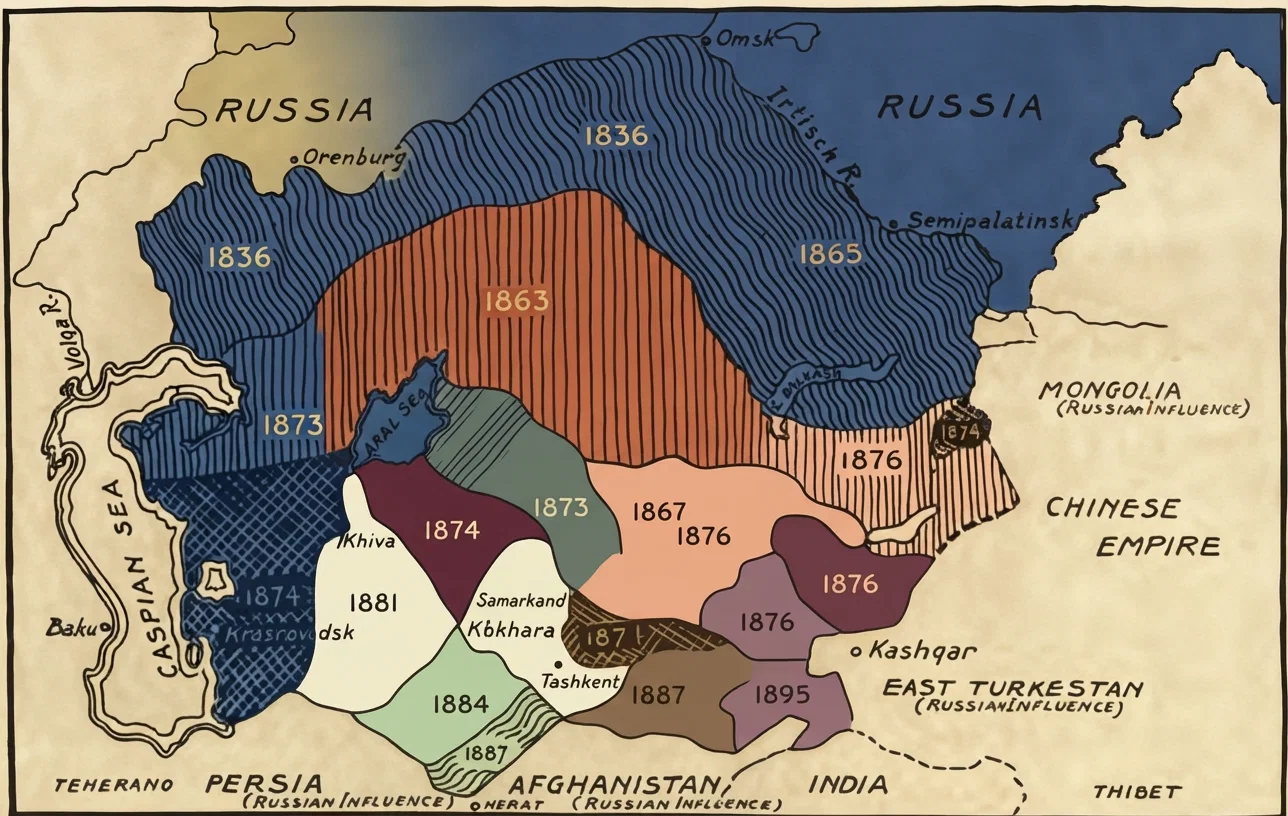
But this is only part of the Asiatic problem. It was Lord Charles Beresford who predicted that the Russian annexation of Manchuria would be followed by a successful invasion of India by the arms of the czar. The fear of this is England's nightmare, and the facts of the situation warrant the prediction. A glance at the accompanying map will show the stages of Russia's advances in Central Asia during the present century. Into lands for thousands of years barred to foreigners Russia has forced a path, and brought under her sway and to partial civilization at least, ten millions of lawless dwellers of the steppes of West Central Asia. Her southern boundary is the northern line of Persia and Afghanistan. Eastern Turkestan is under her influence, and between these two she touches India in the Pamirs.
From Krasnovodsk, on the eastern shore of the Caspian Sea, begins the Central Asian Railroad, already stretching fourteen hundred miles into the heart of Asia, with Peking ahead of it, and touching, among other cities, Askabad, Merv, Charjui, and Samarcand, once the seat of the world's civilization. At Merv a branch turns south to Kushk, forty miles from Herat, the capital of Western Afghanistan, and here, through her diplomatic tampering with the Ameer, Russia expects to establish a base from which a rapid descent can be made on India when the proper moment arrives.
Russian Advance in Asia.
Distributed at a dozen different points along the line of this great military road—for this is what it really is now—and at points easy of access from it, the czar has a force of over eighty thousand Cossacks, half of whom are at Kushk.
But this is only a small portion of the number he can call to his aid in this region in an emergency. The leading warriors and chiefs of the vast hordes subjugated in the interior are made mounted officers in the czar's service, and, with their followers, add thousands of ardent supporters to the man in St. Petersburg. So that along her Asiatic frontier Russia has stretched an army of fully five hundred thousand soldiers. For their transportation and for the carrying of provisions where the railroad fails, she has easily ten million horses and camels on the Kirghiz and Turkestan steppes. And the provisions are found in the valleys of this same interior region, made fertile and productive by canals and extensive irrigating works, constructed at an immense outlay of capital by the Russian Government. In fact, this has been planned as a vast commissary department, and its supply is inexhaustible.
This is not all. It is well known that Russian influence is dominating in Persia, and work is now progressing on the Trans-Caucasian Railroad from Tabriz in northwestern Persia to Bander Abbas on the Indian Ocean, which port is claimed by the czar as one consideration of a large loan to the Shah. When this line is completed, a steady line of troops can be poured into Persia from Batum on the Black Sea, even as forces in large numbers are now being hurried to the front via Baku, thence by large steamers across the Caspian to Krasnovodsk, thence to the frontier, ready for advance into Afghanistan, with India the goal.
A crisis is approaching. The "Boxer" trouble in China is only an incident, and when this is quieted there will still be the settlement of the greater question. England is at present handicapped by her South African affair, and under ordinary conditions could not possibly withstand Russia in China, so far as a land conflict is concerned, and it would be made such by reason of Russia's land advantages. In India, England could place in front of an invading force about one hundred thousand British soldiers, and four hundred thousand native troops, if the latter could be induced to fight for her.
In the southeast is France, crowding India and England's sphere of influence in China in the North. At present France and Russia are together in working against England, and Germany seems to stand in a friendly relation to her big neighbor. America's policy is not fully defined; but in the meantime her trade is multiplying enormously, for with Russia's advances go American railroad material and agricultural implements, which are supplied more cheaply and quickly than like material from Europe. England sees the situation and realizes that her chances are desperately shaky, as evidenced by recent utterances of her leading statesmen. And then Japan must be reckoned with, and she looks with unfriendly eyes upon Russia's operations in Korea.
Russia's long line of outposts from Bander Abbas to Port Arthur, has been likened to a seven-thousand mile drag-net. The question is, When the net contracts and the ends close in, what will be the fate of China and India, and, later on, what the fate of France in China, and of other possible allies, who may then stand in the way of the czar's complete domination of Asia? The Slavonic race dominant in Asia is the czar's dream. From a human standpoint it bids fair to come true. But, unless accomplished very quickly, there are other factors of mighty import—factors based in prophecy and hastening to fulfilment—that will prevent by precipitating a conflict sore indeed, and one that will be ended only by the speedy coming of Christ in the clouds of heaven.