Untitled article

7%

Pacific Press Publishing Company · Oakland, California · Jul 4, 1900

FromSigns of the Times, Vol. 26, No. 27.

Read the full edition

LIMA. No. 1.

[Pastor G. H. Baber, editor "Las Signes del Tiempos."]
LIMA is a place for the day-dreamer of America. What native American of twenty years has not dreamed of Lima? For all, Lima is an illusion; and for very few, a reality."—N. Avellanda.
This capital city of the Peruvian republic is situated in latitude 12° south, at an elevation of about 400 feet above the sea level, in the most central and extensive valley of the Peruvian coast. It is six miles from the sea, abutting the outlying hills of the Cordilleras.
The River Rimac, with its soft, clear water, traverses the city from east to west, leaving about four-fifths on the south side.
Lima was founded by Francisco Pizarro in 1535, and named by him the "City of the Kings," but the natives soon and wisely gave it the name of Lima, a word said to signify the presence of an oracle.
The population of the city is certainly very fluctuating, or the census takers fail in their duty. The figures given range from 100,000 to double that number. Without giving statistics, the impression of a transient is that a large majority are not descendants of the white races. The copper color, with its varying shades toward the white, seems to predominate. Nearly all have fine features and polite manners; but they show a debility in physical structure. They are evidently a "dying nation."
The most popular entertainment for all classes seems to be the weekly bull-fight. Every Sunday afternoon, the women having gone to mass in the forenoon, the mixed multitude, rich and poor, white and black, old and young, turn out to witness this barbarous, dark-age diversion, and show by their relish of such brutal scenes that they are not so far removed from that bloody age as they should be, considering the length of time that has elapsed.
Usually six or seven bulls are sacrificed on the altar of public amusement on each occasion. The bull is usually harassed by men on horseback until it is tired, when the would-be gladiator sallies forth with great pomp, salutes the judges and the rest of the spectators, and then proceeds to show his skill by sticking a sword into the tired animal. Sometimes he is skilful and drives the weapon to the vital part; and sometimes he is bungling and only wounds the poor creature, which runs around the ring seeking a friend or a way of escape from such heartless enemies. He often carries away the sword of his antagonist, the handle being on one side and the point on the other, the blade having been thrust entirely through the body, while the blood gushes from his mouth and nostrils. He is usually killed in one way or another before the fight ends.
Sometimes, however, justice prevails, and the bull gets the best of it. Within the present month a burly, athletic fellow was so badly treated by his four-legged opponent that he had to confess to the judge that he was hors de combat. Then the crowd broke forth with, "Bravo Toro!" and hissed the unfortunate torero, telling him he ought to go to prison. He was the fourth man wounded on that day. The incapacity of some of the fighters and the removal of several bulls from the ring enraged the spectators to such an extent that a regular tumult ensued. They broke benches, chairs, and doors, and hurled them into the ring. They wounded several persons quite seriously, and tried to burn the edifice.
The editor of El Comercio, the best daily in Lima, concludes his account of the occurrence as follows: "The riot of yesterday in the bull ring is the best argument against a savage diversion, that ought to disappear from the customs of a polished people. The so-called attachment for bull-baiting has decreased and is decreasing more and more each day."
The flesh of the dead bulls is put on the market and is eagerly sought for food, under the impression that it possesses virtues not found in ordinary meat. Is it any wonder that such people consider themselves greatly disgraced by having the pure Gospel of Jesus preached in their city?
Altho in the tropics, and half surrounded by mountains, this city enjoys a climate unsurpassed for softness and tranquillity. Balmy spring all the year round seems to be a good definition for the word "climate" in Lima. The sun vail and the sea breeze are scarcely ever absent at the same time. An arrangement by no means left to chance, but a beneficent provision of Him who commands the clouds from above and causes the east wind to blow; who commands the sun and it riseth not; who covers the sun with a cloud, and appoints the moon for seasons; who telleth the number of the stars and calleth them all by name; who covereth the heavens with clouds; who prepareth rain for the earth; who maketh grass to grow upon the mountains; who giveth snow like wool and scattereth hoarfrost like ashes; "He casteth forth His ice like morsels; who can stand before His cold? He sendeth out His word, and melteth them; He causeth His wind to blow, and the waters flow;" who maketh a tabernacle for a shadow in the daytime from the heat, and for a place of refuge, and for a covert from storm and from rain.
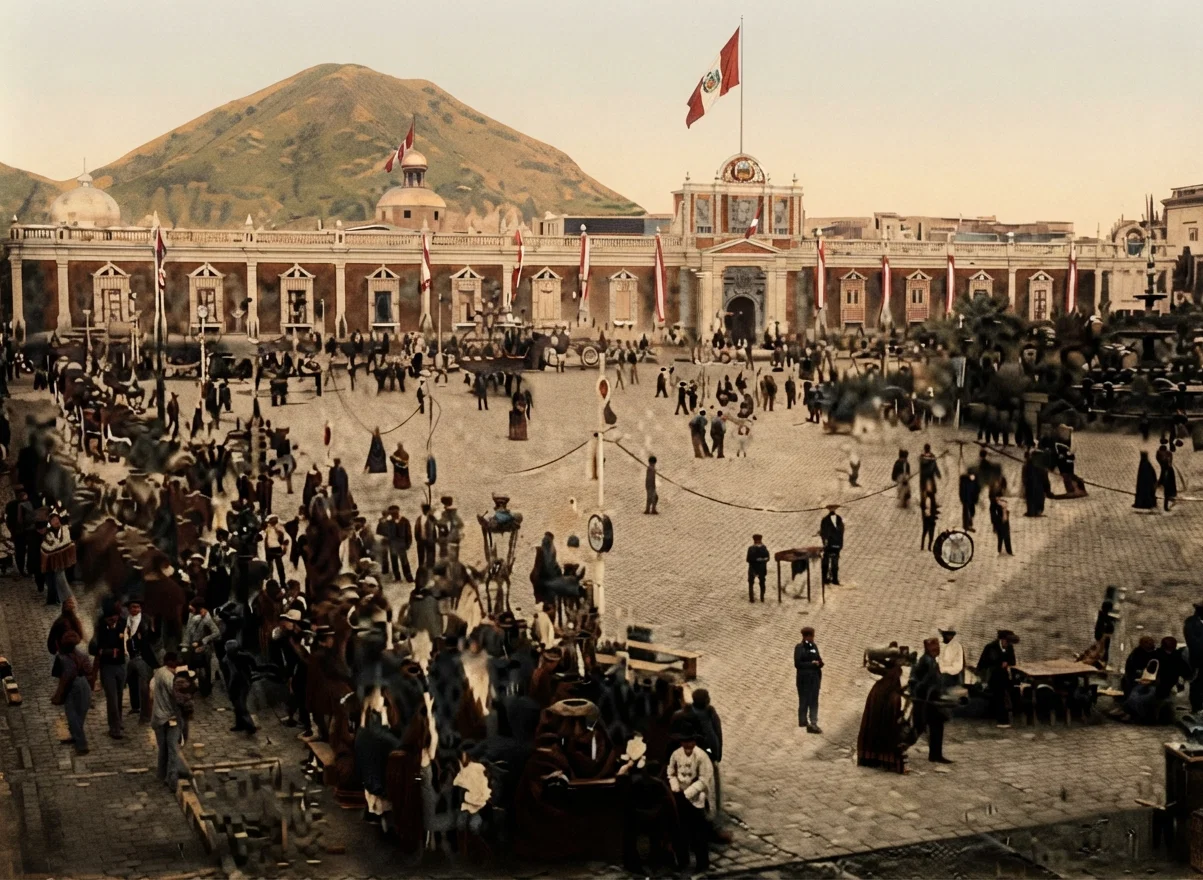
Plaza of Lima, Peru.
Then praise Him, sun and moon and all ye stars of light; "praise the Lord from the earth, ye dragons, and all deeps; fire, and hail; snow, and vapors; stormy wind fulfilling His word; mountains, and all hills; fruitful trees, and all cedars; beasts, and all cattle; creeping things, and birds of wing; kings of the earth, and all people; princes, and all judges of the earth; both young men, and maidens; old men, and children; let them praise the name of the Lord." "Let everything that hath breath praise the Lord. Praise ye the Lord."