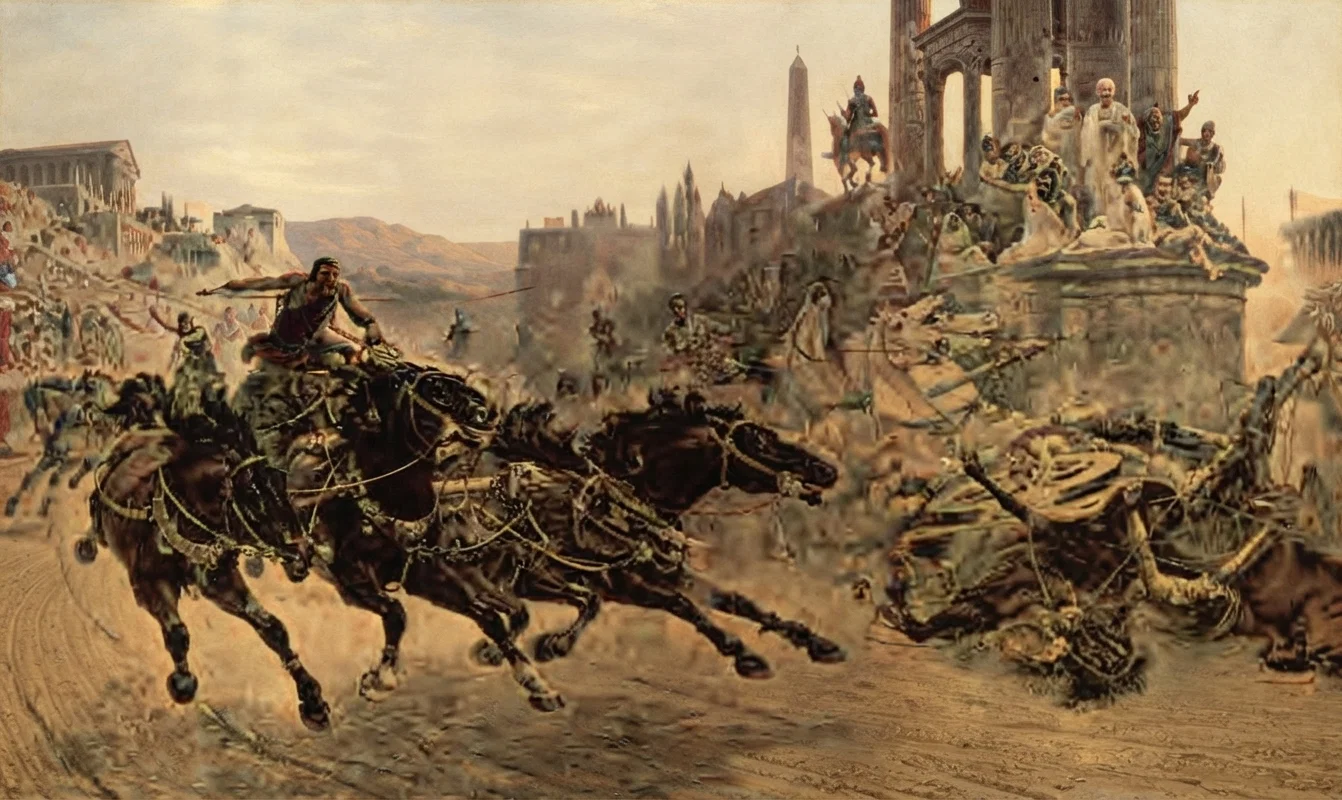
THE most popular, the most thrilling, the grandest in gorgeous setting and associations of all ancient games, sports, or contests, was the chariot race, depicted in our illustration. Kings and princes could condescend to witness other contests of skill, strength, or endurance; they took part personally in this, and prized next to their crown, the fading wreath of victory. Chariot-racing was pre-eminently a royal sport.
Rival kings and princes strove for the mastery. Armed chariots were among the most effectual weapons for the great pitched battles on level ground and open country; kings and princes and generals and those who aspired to lead must learn how to guide the spirited horses, and keep cool heads where all else was excitement. By the chariot race the youthful warrior strove to acquire fame; by its use in battle the king hoped to win victory and greater empire. The chariot may well stand, therefore, as one of the types of earthly contest, fame, power, and glory.
THE world's contests are invariably selfish. Where unselfishness creeps in, it is the result of divine impulses or education. But normally—if a degenerate thing can be said to act normally—the striving in the world is for selfish gain, selfish rule; that self may in some way be pleased. So selfish is it that it many times expects success only because of some other person's downfall or utter ruin. The striver does not wish to destroy honor or property or life; but his own interests demand that himself shall succeed, and all in the way of success must go down.
AN ANCIENT CHARIOT RACE.
GREAT thrones are erected on once happy but now ruined smaller states, living only in history. Thousands of businesses are built up on the ruin of many thousands more. The great trusts mean utter ruin to myriads of small traders. Noble souls protest against it; but the hardened, brutal answer is frequently, "It's the way of trade; the big fish eat the little ones." So God has said selfish man would do. "The wicked devoureth the man that is more righteous than he." He makes "men as the fishes of the sea, as the creeping things, that have no ruler over them." He enlarges "his desire as hell, and is as death, and can not be satisfied, but gathereth unto him all nations, and heapeth unto him all people." Hab. 1:13 to 2:5. Like the chariot driver, men race on. What matter that their rival's horses lie dead, and he crushed and bleeding among the ruins of his once gorgeous chariot? Success is so much more certain. This is the nature of the contest of strife.
"BUT men become famous." Yes, they do. They wear for a little while the laurel wreath of the victor. They listen awhile to the insincere plaudits of an excited populace. They are fêted and wined and dined by the rich and noble of earth. But only for a little while. The laurel wreath withers. The sweetness of the applause becomes bitter when it is given to some soon-coming new hero. The laudation of the festive board becomes insipid, the wine sour, the food nauseating. The "pleasures of sin" are but for "a season."
"BUT men and nations become powerful." Yes, they do. They sway for a time the multitudes, mold the policy of State or Church, ruin and crush nations, and build kingdoms; and the great world bows before them. But it is only for a little while. Powers of mind and body fail. Young, fresh, and vigorous men enter the lists, and conquer. The applause is transferred to the new hero; the power to sway slips from the weak, nerveless grasp. The end has come, and the erstwhile ruler broods, a disappointed Bismarck, or meets the death of a Cicero or a Thomas Cromwell. So ends the mightiest power of earthly rule.2
AND all the glory is but earthly, temporal, fading. A kingdom may last for centuries, but it will sometime crumble and decay. A dynasty may exist for several generations, but it finally becomes extinct and passes to another. And, however great the earthly glory of the greatest, the truth of God is written upon everything human: "All flesh is as grass, and all the glory of man as the flower of grass." It perishes, and is gone. It is not to the spirited horses and exultant driver that we are to look, but at the ruined horses, the broken chariot, and the royal driver underneath. In his selfish contest for superiority he has met the end of his fame, his power, his glory, soon. His rivals may not meet it his way; but the undesirable end will as surely come to them as to him.
WILL not mortals learn the lesson? It is as true in the small things of life as in the great. Fame which is achieved by others' downfall is but infamy. Power that is gotten by enslaving, fettering, brutalizing others will sometime recoil with crushing weight upon the head of him who used it.
"O! it is excellent
To have a giant's strength; but it is tyrannous
To use it like a giant."
And upon the tyrants of these last days, the Word declares, will return in double measure the crimes of their oppression. After the passage quoted in the fourth paragraph of this article, from the prophet of old, he continues: "Shall they not rise up suddenly that shall bite thee, and awake that shall vex thee, and thou [the oppressor, which counted men "as the fishes of the sea"] shalt be for booties unto them? Because thou hast spoiled many nations, all the remnant of the people shall spoil thee." Selfishness is sin; and all the pleasures, the gains, the glories of sin are but "for a season." We may read them all in the wreck of the chariot race.
WHAT is the lesson? It is written in God's Word; it is written in human experience; it will be revealed for all eternity in glorified humanity, even as it was manifest in a glorified Christ. Here is the blessed truth which it is the privilege of every soul to make his own: "Some trust in chariots, and some in horses; but we will remember the name of the Lord our God." Ps. 20:7. And the opposite is written: "Woe to them that go down to Egypt for help; and stay on horses, and trust in chariots, because they are many; and in horsemen, because they are very strong; but they look not unto the Holy One of Israel, neither seek the Lord!" The name of the Lord our God is His glorious character of unselfishness, of goodness. He wishes with infinite longing to name it upon us. He waits for our consent. He would make us, by His infinite power, like Himself. He would give us the disposition to strive for others' good,—to lift up the fallen, to bind up the broken-hearted, to proclaim liberty to the captives and oppressed, to open the prison-house to them that are bound, to preach good tidings to the meek, to manifest the blessed, uplifting Christ-character here, and share His eternal glory hereafter.