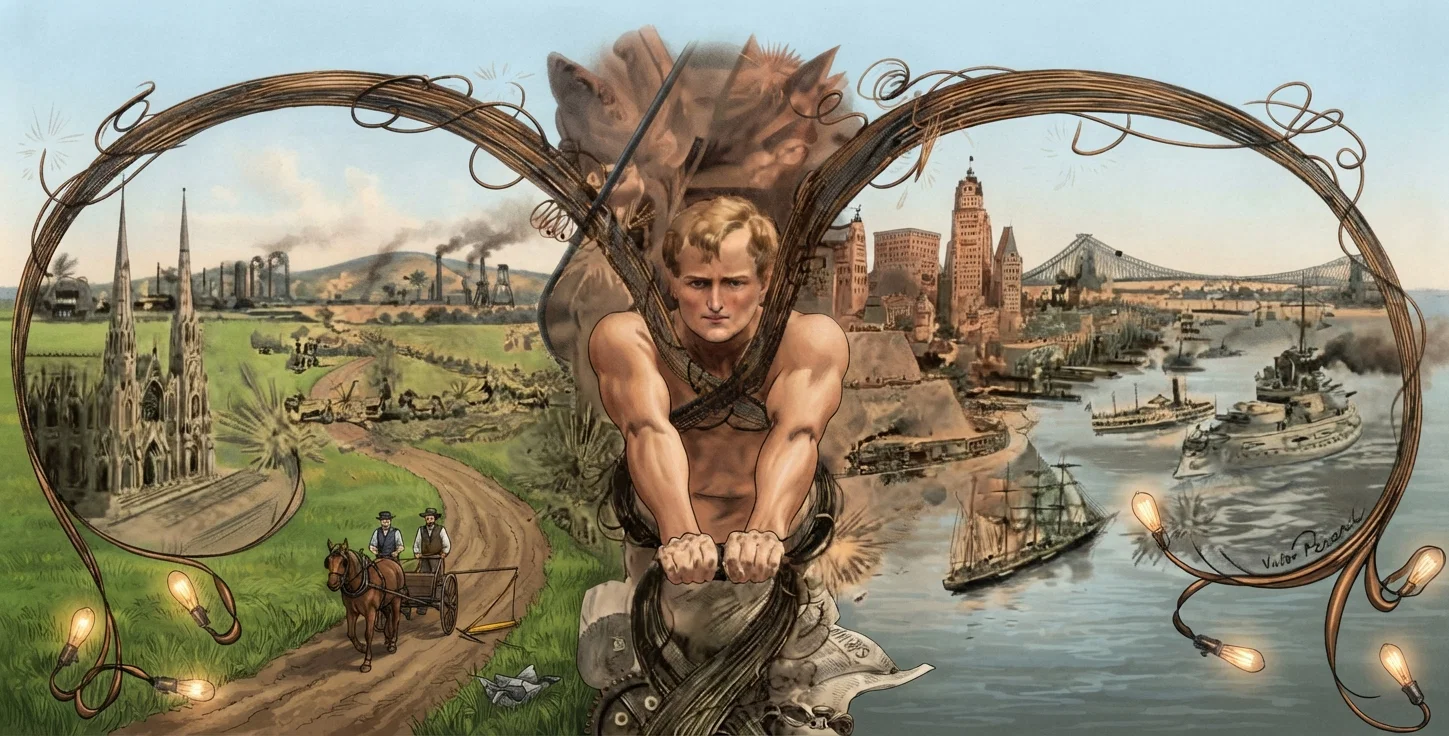
THE nineteenth century is the marvel of all the ages. In its material progress it has gathered up everything of value belonging to the past, and has advanced to build the railroad, the steamship, the telegraph, to perfect the printing-press, to do a multitude of things with electricity, to make marvelous discoveries and developments in chemistry, in the science of medicine, and particularly in surgery and sanitary science. This inventive age has produced instruments that have made it possible to enter the broadest realm of new truth in the field of both the telescope and the microscope; invention has also given us machines that do nearly all the work that has to be done at the present time, from knitting our stockings to reaping and threshing our fields of grain. Numerous books are written to tell of the marvels of this time, and certainly it takes large volumes to give even the briefest mention of what has been achieved. Truly the material progress of this age is a marvel that outstrips all the other marvels that have before held the minds of men.
But the material progress—the advancement in the arts and sciences and the inventive genius of this time—is by no means greater than the results that have been accomplished in the individual liberty that has been acquired by the masses. The advent of this century marked a rising tide in the great battle for freedom. In England, France, Germany, and elsewhere in Europe, the vigorous sentiment for reform was driving to the background the old régime of tyranny and despotic rule. The seeds of the Reformation were taking strong root, and the outlook for the future seemed glorious because of the promise for an order of things that would give the poor man a chance, and break the shackles from all who were bound by the slavery of superstition.
Progress in Civil Government.
The right to rule had been monopolized by kings and nobles, and it was considered a crime worthy of the extremes of punishment for any one to question their "divine right." Certain ones inherited the ability and the right to rule, so their political creed taught, and no others could possibly do it. It was affirmed with all the dignity peculiar to that particular form of superstition, that the common people should not meddle with the affairs of either State or Church, because they could not understand them. Their work was to do the serving, while the nobles temporal and the nobles ecclesiastical did the ruling.
One of the strongest characteristics of the beginning of this century was the hold that the fundamental principles of truth were gaining in the minds of men. This spirit of truth, the foundation of all true liberty and reform, was trampling the old ideas of darkness and error underfoot, and the hearts of men everywhere were swelling with songs of emancipation from that thralldom in which the world's midnight had enchained both their minds and their bodies. The struggle was intense. A terrible contest was waging, and thousands of lives were sacrificed at the altar of truth and progress, and in the defense of justice.
The ages do not afford a greater marvel than the asylum that was preparing at the beginning of this wonderful century for those who would escape from the cruelties of Church and State despotism. A new nation was being born, in which the lamb-like principles of righteousness were to have a chance to develop, and show the result to all the world. Noble-hearted men in England, feeling the iron heel of despotism, had fled to Holland, and then to America. Many others, not only from England but from all parts of the Old World, fled to these shores direct. Influential men in England were not backward in saying that the "mother country" had no right to hold the colonies in subjection, and France was prompt in lending her aid in a substantial way. The new nation was born, and the new principles (old principles in reality, but seemingly new, because they had been so long covered up) were to be given a chance.
In this new nation the fullest freedom was allowed in the State, and the matter of religion was left entirely to the conscience of the individual. The great asylum that America afforded for the ardent lover and supporter of liberty of conscience and of action caused the battle to grow less pronounced in the Old World; for when men could no longer endure the exactions of a superstitious priesthood, nor the tyranny of a despotic State, they had only to come to this new land to find that for which their hearts were panting.
With such principles as were laid in the foundation of this government, contrasting so sharply with the old order of tyranny and superstition, the perfectly natural result was a nation that stands not merely as a marvel among all the marvels of this time, but one the majesty of whose splendor stands as a mountain peak, lifting its lofty head above all the wonders of all the ages. The freedom of thought that was allowed here insured the freedom of discussion also, and in this interchange of ideas the science of government was given a new meaning, and all the material progress of this time was largely developed. The majority of the inventions that mark the age were made in this country, and concerning the part that other portions of the world have taken in the work, who can tell how much of it would have been done had it not been for the stimulus that was given by the freedom of this new nation?
It was the Reformation that originated Protestantism, and Protestantism stands for the religion of the Bible, unmixed with human creeds or speculations. Protestantism in its purity stands for freedom of thought and of action, and is the revival of the Christianity of apostolic times. Protestantism shows a marked contrast to the Papacy, and in this century Protestant principles have made their greatest growth, and have4been allowed their most untrammeled freedom. The seeds had been sown in other years, but this has been the time of fruitage. Every form of error was swept before the light of this new day of reform. Old heresies and superstitions that had held sway in the days of darkness, were placed before the lamp of truth, and shown to be unworthy of men formed in the image of the Creator of the heavens and the earth.
The Midday of Civil Liberty.
But this new world was not without its dark spots of character. Slavery had fastened its chains about a whole race of men, and bound them as chattels under the very shadow of this great tree of freedom. The new nation, however, was equal to the task of striking off these manacles at one strong blow. The immorality and injustice of slavery had been strongly presented by Garrison, and Lovejoy, and Phillips, and hundreds of others, and a vigorous effort was made to rid the nation of this evil by the persuasion of morals; but, these measures failing, slavery was washed away in a deluge of blood. Thus between 1861 and 1865 the principles of the Constitution of this new country were affirmed anew, and the sentiment at that time was so strong in favor of universal and untrammeled freedom that it seemed to all human sight that the thongs of slavery, either of body or mind, could not be bound again to the sensitive flesh of a fellow-man. The new nation was a statue of liberty, not built of marble or of bronze, but a colossal brotherhood of brave-hearted, liberty-loving men, and this mighty statue was set by the God of heaven Himself for the enlightenment of the world. The midday of the world's greatest enlightenment, and the time of its most glorious liberty and freedom, is reached. And how fitting that in such a time, and as an emblematic crown of victory, there should be proclaimed the year of jubilee for an oppressed people, that a whole race, riding on the tidal wave of freedom, should be anchored in the haven of liberty and hope!
Will the light of this new and glorious day shine on and on? or will it be darkened by shadows of returning night? The evidence is conclusive that the night is returning. The high-water mark of progress has been reached, and the tides of reform and freedom are receding. It is hard to see this unless we carefully study the facts; and this some will not take the time to do. Many will still cling to the shadow of liberty and freedom, long after the substance has departed. They will close their eyes to the present, while they try to make themselves believe that the glories of other days are still shining upon us.
A new form of slavery has arisen, and a new kind of nobility has come to take charge of the bodies and souls of men. Under the old régime, nobility was handed down from father to son by right of birth; but in these days a nobility of wealth has been built up. Under the old order of things, those nobles claimed the right to hold great communities and empires of men under control, and they led them forth as soldiers, or commanded them to till their lands, as they saw fit. But in these days colossal combines of wealth have given men the power to hold their fellows in a slavery that is none the less servile or exacting, while the mental development of the age makes it more exasperating. A nobility is forming in the heart of a democracy, and the new nation is forging the chains for another kind of slavery. While America was advancing under the flag of freedom, and was doing such wonderful things for God and humanity, all the nations of the world were learners in her school. Will they not be equally apt to take her teachings as she changes her standard and marches under another leadership? How quickly it will be caught up and heralded that democracy is a failure, and that the Protestantism that is the basis of all true democracy is a failure also! And then how quickly, too, will the Papacy come forward to say that since Protestantism is failing to fulfil its promises, the Church of Rome, with all its arbitrary rulings, should be allowed to take its old position, and guide the various nations through the troublous times upon which the world has entered!
Revivification of Ancient Cults.
A time of reform is a time when superstition, and ignorance, and all that it represents, is driven to seek shelter in the abodes of a still denser darkness. But when the spirit of reform is losing its hold on the minds of men, then the superstitions that mankind had cast off begin to reassert themselves. And who has not marked with wonder and astonishment the advances that old oriental religions are making in enlightened Europe and America? The very liberality that freedom engenders is turned in the direction of glossing over the ignorance and idolatry of the heathen of India and Persia, and the countries of the East in general; and occult sciences and hidden and mysterious arts, such as we used to affirm belonged to the Dark Ages, are gaining adherents, and men who are said to be intellectually gifted are following these superstitions madly.
The teachings of Buddha and the morals of Zoroaster have had centuries of operation and their value has been tested. But what has been the result?—Those who are under the influence of any of those old oriental religions are wallowing along in the quagmire of the grossest superstitions and the lowest depths of mental darkness. And now that men and women who have the advantages of the enlightenment of this time are advocating that this heathen darkness holds forth a great light, what is the only conclusion that can be reached? There are some who do not especially take to the superstitions peculiar to the orientals, but they transform these religions of the East into the more modern forms of Christian Science, Hypnotism, and Spiritualism. To the thoughtful mind these facts must indicate the strong current in the direction of mysticism, and the thirst for the mysterious and subtle fancies of the occult arts. And such a condition as this, more than anything else, was a distinguishing feature of the Dark Ages.
The individual who is guided by the light of inspiration, and who closely analyzes these times in the light of history, can not fail to see that the high noon of the wonderful enlightenment of this wonderful century has been passed, and we are going again into the shadows. The corruptions and the frauds, the vices and the crimes, of these times are consuming, as in a great conflagration, the materials of morality out of which reforms are made. Rings and bosses control politics, and tools that can be molded at will are too often lifted into the offices of state. These things drive away the great statesmen skilled to build and guide nations; and the ships of state of all the countries of the world, amid much of the hollow sounds of oratory and delirious rejoicings, are drifting upon the rocks of everlasting ruin.
But the darkness of this picture that so frowningly beclouds the world to-day is being driven before the splendors of the light of the Lord's clear prophecies. While the nations of earth are crumbling to decay, the evidence is overwhelmingly abundant that the Prince of Peace, the Lord Jesus Christ, is about to establish His everlasting kingdom. All who are seeking a citizenship in that kingdom will stand with the Master in these times, and still hold up the torch of righteousness and liberty, so that every bewildered mariner upon the troubled waters of these closing moments of time may see clearly how to guide his bark into the haven of secure and everlasting rest.