By Leon A. Smith
*Editor of the "Sentinel of Liberty."
In order to understand the significance of present tendencies in Church and State, it is necessary to note not only the positions occupied by Church and State to-day, but the positions they ought to occupy. To this end let us consider the nature of these two paramount institutions, and the ends they are respectively designed to serve.
The purpose of the State is to protect the individual in the enjoyment of his natural rights. Men are "endowed by their Creator with certain unalienable rights, among which are life, liberty, and the pursuit of happiness." The State compels each individual to respect the rights of all other individuals, and thus preserves to each individual liberty of action within the sphere of rights. Man must have liberty if he is to develop character.
The Church, on the other hand, deals with the obligations of religion. The Church takes cognizance not only of what man has a right to do, but the infinitely broader question of what is right for man to do. It is wrong for any man to disregard the rights of others, but the obligation to respect rights is only one of a myriad of duties which are laid upon man by religion, covering not only his relation to his fellow-men, but to his Creator. While the State guarantees to man the liberty to do wrong, the Church presents to him the obligation always to do right.
Considered as the exponent of Christianity, the Church occupies a sphere altogether distinct from that of the State. Not only the ends sought by each, but the agencies employed, are wholly dissimilar. Christianity operates by love; the State employs coercion. Christianity persuades and entreats, appealing to the heart and conscience; the State simply commands, appealing only to force. Christianity governs the thoughts and motives; the State deals only with outward conduct. Christianity liberates the sinner; the State shuts up the criminal. Christianity demands that punishment for transgression be deferred; the State demands that the transgressor be punished speedily. The power and wisdom of the State are human; Christianity is the power and wisdom of God.
Having these essential points of contrast, it is evident that only by keeping within wholly separate spheres can, Church and State avoid working at cross purposes. Love can not work with coercion; command nullifies entreaty; justice shuts out mercy; compulsion dispenses with conscience. When these agencies of the State are employed by the Church, the Church works not for Christianity, but directly against it. Abundant and melancholy evidence, alas! is furnished by Church history upon this point.
The Church, in her proper sphere, is the salt of the earth, the light of the world. Her wisdom is supplied by omniscience, her power is power from on high, her voice is the voice of God. Before her weapons of warfare the strongholds of evil and of error are thrown down, and the very thoughts of the heart are led captive. Like the warrior on the white horse, she goes forth "conquering and to conquer;" a vision "fair as the moon, clear as the sun, and terrible as an army with banners." But when she drops the sword of the Spirit to grasp the sword of temporal power; when she lets go the hand of Christ to take that of Caesar, at once all is changed. She has forsaken Him unto whom all power is given in heaven and in earth, and she is shorn of her strength and beauty. The source of her life even is cut off. Severed from her divine Head, spiritual death must swiftly follow. The semblance of worship may remain, but the glory and the spirit have fled; the form of godliness may be exhibited, but the power thereof8is denied. And to elect an earthly head in the place of her revered Lord, only completes the ghastly counterfeit. Henceforth she wears religion not as an armor, but as a cloak; and in the name of Christ, she follows the lead of Satan. Instead of shepherding the sheep, she fleeces and scatters them; instead of the strongholds of evil, she tears down the temples of God. Her appeal is not to the consciences of men, but to their cupidity; not to the love of God, but to the love of power and worldly advantage. Shorn of strength from above, she grasps at the power from beneath, wielded by earthly governments. She descends into the arena of politics. Her fold is opened to take in every hypocritical self-server seeking worldly emolument in the name of piety. She becomes, finally, "the hold of every foul spirit, and a cage of every unclean and hateful bird."
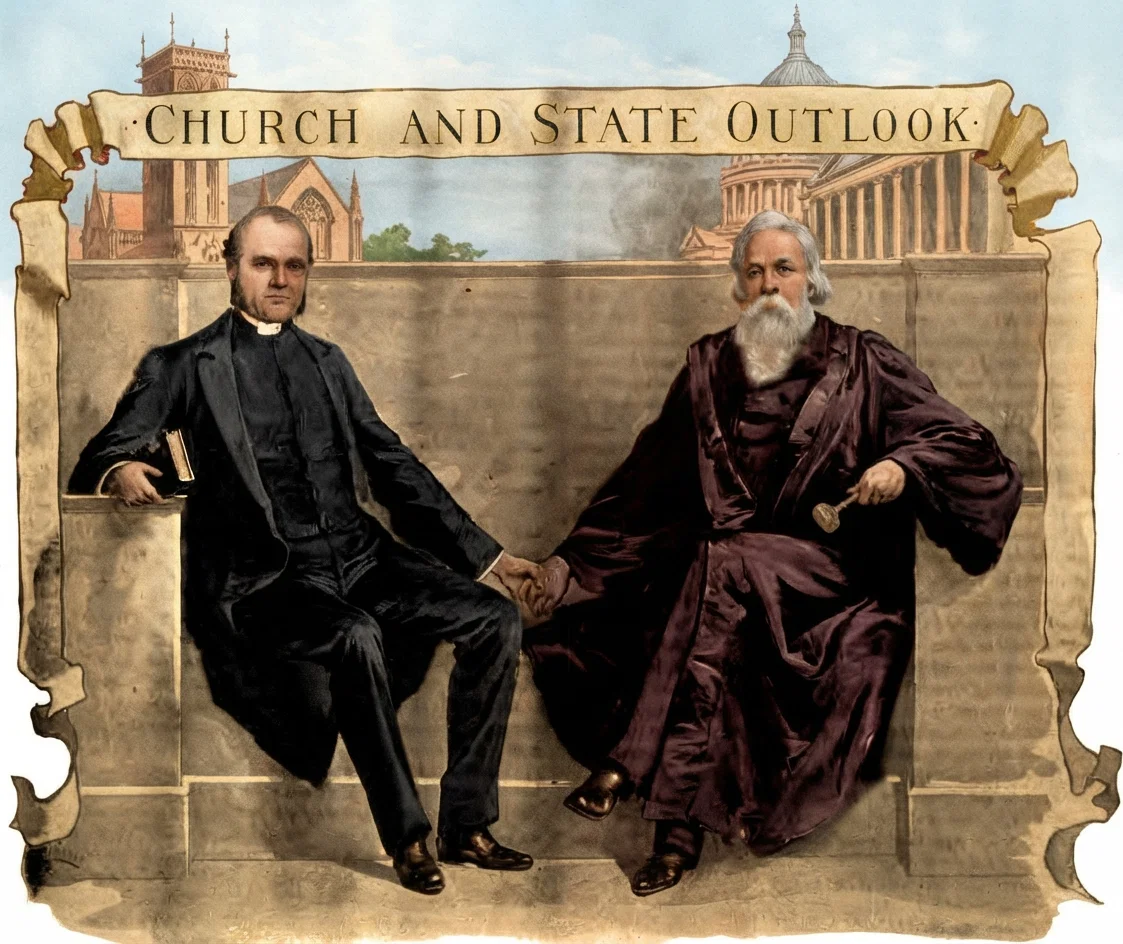
What illustrations of these truths do we discover in the world's present outlook? The question is a most pertinent one; and the answer, to the candid investigator, is startling. The fact appears, and too plainly to be mistaken, that the Church-and-State outlook to-day constitutes one of the great signs of the times. There is visible everywhere a tendency of these two to join hands—a movement to re-establish between them the old medieval relation. History, if these indications speak the truth, is about to repeat one of its darkest chapters. We stand within the shadow of an approaching eclipse of the bright sun of civil and religious freedom. And that event, in the very nature of things, must mark the close of the present epoch of time, which has been characterized by separation of Church and State and the world-wide proclamation of liberty as the inalienable right of each person among all people.
This epoch began with the Reformation. Then was proclaimed to mankind the old but long-hidden truth of salvation by faith, which meant the right of every man to think for himself, and for himself to accept or reject the doctrines of Christianity. The voice of the Reformation, sounding throughout Europe, called men to throw off a despotism that enslaved the mind, and millions responded to the call. But the process of emancipation did not stop there. It was seen that the right to think meant nothing without the right to act, and that in religion man must not only be free from the dictates of pope and priest, but from the decrees of civil rulers as well. This meant that the spheres of religion and the civil government were separate, and that not only the system of religious government bequeathed from the Dark Ages, but the prevailing systems of civil government, also, must be reconstructed. It was not, as had been believed, the duty of mankind to rest their religious belief upon the word of popes and prelates; neither was it, as had been taught, the right of the civil ruler to prescribe religious duties by law, and punish the dissenter by the infliction of legal penalties. The right to prescribe and enforce religious duties could inhere in no power not also possessed of infallibility, and the papal claim of infallibility was a logical necessity of the papal scheme of religion. Such a claim was characteristic of the papal system, and it came to be recognized that the exercise of civil authority in the field of religion involved a claim by the civil ruler to infallibility, which led back to the Church of Rome.
For this new governmental system, dispensing alike with pope and king, the Creator had prepared a home in a new quarter of the earth, where it might spring up and become the foundation principle of national life, unimpeded by the principles and institutions of despotism that had become so firmly rooted in the Old World. And from this new land, where the new nation that was to be, had come to the birth, the just and right system of civil government was proclaimed to the world in the Declaration of Independence.
What, then, is the cause of the drawing together again of Church and State to-day? What is the center about which this baneful movement is taking shape? For answer we have but to note the legislation that is enacted and enforced to-day to promote the observance of Sunday, and to remember that every exercise of the civil authority in the sphere of religion is a step toward the Church of Rome. The essential feature of the Papacy is the union of Church and State, and the essential sign of papal authority is her claim to have changed the Sabbath from the seventh to the first day of the week. This fact is fully set forth in standard Catholic works. Two things so essential to the same system are closely related to each other.
The separation from Rome caused by the great wave of religious reform which swept over Europe and brought forth the institutions of modern liberty, stopped short of the practise of Sunday observance. This essential element of union with Rome was still preserved by the Reformers. One strong cord which bound them to the old religious system remained uncut. The badge of the Church-and-State system was still worn, though unconsciously, by those who repudiated the system itself. The leaven of the old order of things was taken into the new, there to lie dormant for a time, but finally to begin its fatal work of leavening the whole lump. This leaven of the old despotism was chiefly embodied in the Sunday laws.
Within recent times an agitation for the enforcement of Sunday has arisen and has spread to all parts of the civilized world. In this country, Congress and the State Legislatures have been repeatedly, and at times successfully, importuned for Sunday legislation; and the movement gathers force from new organizations that are continually springing up. In Canada a decision is pending in the higher courts which is to settle the validity of Sunday legislation in the provinces; and the "Lord's Day Alliance" is bent on securing Sunday legislation from the Dominion Parliament. In Europe there is a growing tendency to legislation curtailing the hours of Sunday work. The influence of the Sunday-rest Congress held recently in Brussels has been powerful in this direction. In Protestant Germany the tendency toward prohibition of Sunday labor is especially marked. In Protestant Switzerland observers of the seventh-day Sabbath have been rigorously prosecuted and their publishing house closed by law. If we take up papers published in England, in South Africa, in Australia, or in India, we may read the same accounts of agitation and appeals for Sunday legislation. A simultaneous movement of this character is in progress throughout the Protestant world.
On the one point of Sunday observance we find Protestants and Catholics in agreement to-day. And this point of harmony is being magnified, this bond of union is being sedulously strengthened. Protestant organizations in this country have been speaking very strongly in behalf of Sunday, and courting an alliance with Rome for Sunday enforcement; and recently Roman Catholic leaders have been taking up the same cry. Rome is ready to join fully in the movement when the opportune hour arrives. But hitherto it has been her wisdom to let Protestants alone in the work—they were doing so well in her behalf. Had Rome shown an eagerness to help the movement along, the Protestant forces behind it might have taken the alarm, and retired from its support.
The conclusion to be drawn from the facts and principles before us is a momentous one. The sure result of this Protestant movement in behalf of the Sunday sabbath, if it continues to grow, must be reunion with Rome. No other result is logically possible. To enforce Sunday observance Protestants must adopt papal principles and go over to the papal camp. The reunion takes place on Rome's own ground. Sunday as a sabbath is a papal institution, resting upon tradition and the decrees of church councils. The early Catholic Church declared it to be the Christian sabbath, and this was the origin of its claim to such distinction. If Protestants take the word of Rome upon this point, they can not logically refuse to accept her word upon another point. If they accept the authority of tradition for Sunday observance, they can not reject the same authority speaking for the system she represents. Rome declares that the Church is the rightful ruler of the world, and that the head of the Church, the pope, is the rightful sovereign of kings and emperors. If her word is good for the claims of Sunday, it is equally good for the union of Church and State. The claim of the authority to settle questions of religion is a papal claim. The claim of Sunday to the allegiance of mankind is one concerning which the religious bodies are not agreed; and "it is impossible for the magistrate to adjudge the right of preference among the various sects that profess the Christian faith, without erecting a claim to infallibility, which would lead us back to the Church of Rome."
And this reunion upon the ground of Sunday observance, when it is accomplished, must, as before stated, mark the end of the age. It must do this because it completely reverses and repudiates all that has characterized this age as the age of civil and religious freedom. The dark shadows of despotism will then once more cover the earth; depraved human nature, in conjunction with the enemy of righteousness, both the same in all ages, will cause history to repeat itself in evil; a lost world, circling upon its track, will plunge again into the obscurity of the Dark Ages, from which it had once hopefully emerged.
And what then? What and when is to be the outcome? A momentous question this for every person, and to it the sure word of prophecy makes answer, the nature of which is set before the reader elsewhere. The God of liberty is not dead, and His purposes are not to be defeated. He is prepared for the emergency, and when He shall have performed that which He has prophetically spoken of this time, all the world will know that the cause of human liberty has been finally and eternally vindicated.