THE PROTESTANT OUTLOOK

3%

Pacific Press Publishing Company · OAKLAND, CAL., KANSAS CITY, NEW YORK · Nov 28, 1900

FromSigns of the Times, Vol. 26, No. 48.

Read the full edition
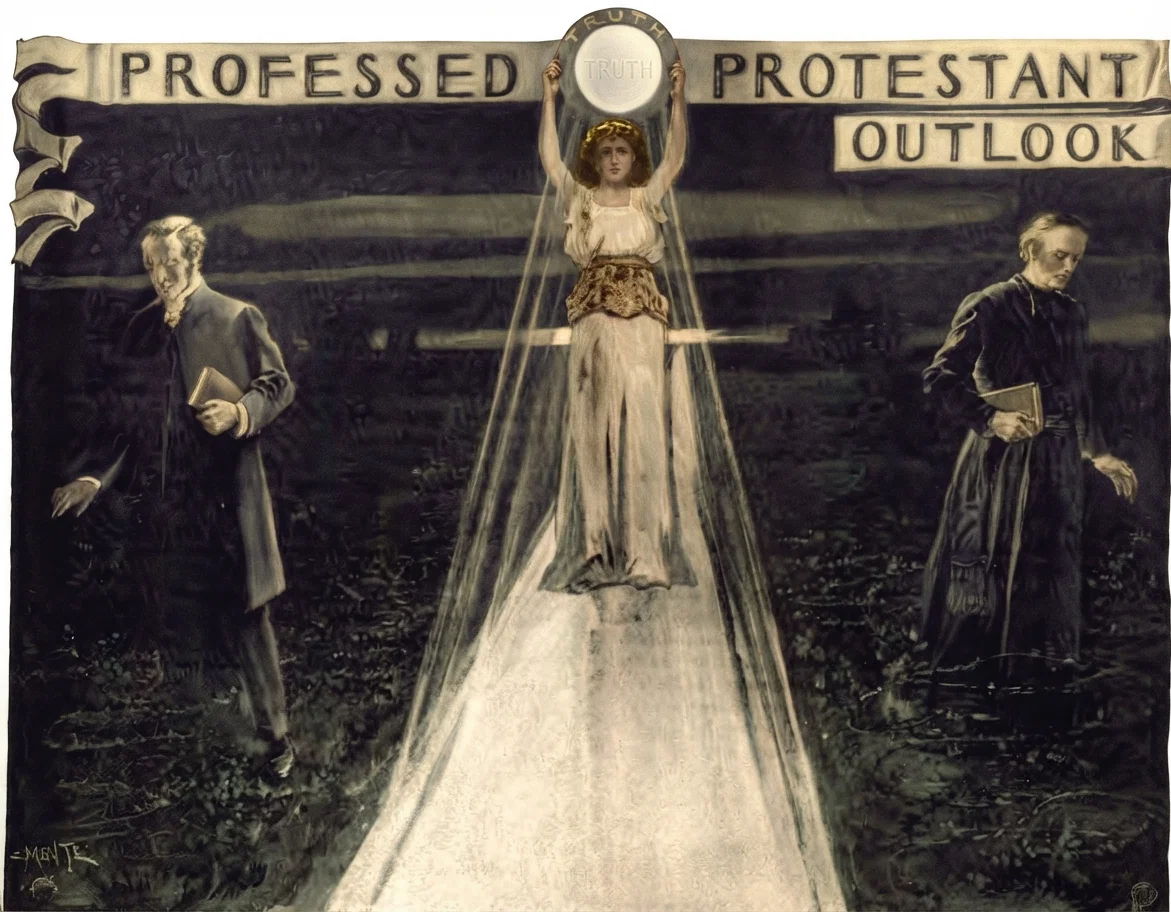
THE PROTESTANT OUTLOOK

PROTESTANTISM derives its name from the Protest of the Reformers at the Diet of Spire, 1529. It derives its life from simple faith in the Word of the Living God. The great historian of the Reformation, in which Protestantism had its birth, well says:—
The Reformation was accomplished in the name of a spiritual principle. It had proclaimed for its teacher the Word of God; for salvation, faith; for king, Jesus Christ; for arms, the Holy Ghost; and had, by these very means, rejected all worldly elements. Rome had been established by the law of a carnal commandment; the Reformation, by the power of an endless life.
The Reformation was but the revival of true Christianity, not in mere form, but in power; neither as an ism or a creed, but as a life. For, as D'Aubigne again says:—
If there is any doctrine that distinguishes Christianity from every other religion, it is its spirituality. A heavenly life brought down to man—such is its work. . . . One of the tasks of the sixteenth century was to restore the spiritual element to its rights. The Gospel of the Reformers had nothing to do with the world and with politics.
The life of Christ, received by faith through His Word, must protest against the abuses which had crept into the church,—principles which were essential to the Papacy. And this it did in the celebrated Protest at Spire. What the essentials of this Protest are we will let the Protest itself speak.
Said the Protestants:—
Because it concerns the glory of God and the salvation of our souls, and that in such matters we ought to have regard, above all, to the commandment of God, who is King of kings and Lord of lords, each of us rendering Him account for himself, without caring the least in the world about majority or minority. . . .
That there is no sure doctrine but such as is conformable to the Word of God; and that the Lord forbids the teaching of any other doctrine; that each text of the Holy Scriptures ought to be explained by other and clearer texts; that this Holy Book is, in all things necessary for the Christian, easy of understanding, and calculated to scatter the darkness: we are resolved, with the grace of God, to maintain the pure and exclusive preaching of His only Word, such as it is contained in the Biblical books of the Old and New Testament, without adding anything thereto that may be contrary to it. This Word is the only truth; it is the sure rule of all doctrine and of all life, and can never fail or deceive us. He who builds on this foundation shall stand against all the powers of hell, whilst all the human vanities that are set up against it shall fall before the face of God.
Says D'Aubigne again:—
The principles contained in this celebrated Protest of the 19th of April, 1529, constitute the very essence of Protestantism. Now this Protest opposes two abuses of man in matters of faith; the first is the intrusion of the civil magistrate, and the second is the arbitrary authority of the church. Instead of these two abuses, Protestantism sets up above the magistrate the power of conscience, and above the visible church the authority of the Word of God. It declines, in the first place, the civil power in divine things, and says, with the prophets and apostles, We must obey God rather than man. In presence of the crown of Charles the Fifth, it uplifts the crown of Jesus Christ. But it goes further, it lays down the principle that all human teaching should be subordinate to the oracles of God. . . . In this celebrated act in Spire no doctor appears, and the Word of God reigns alone. Never has man exalted himself like the pope; never have men kept in the background like the Reformers.
This is Protestantism; the Word of God only as the rule of faith, the power of the Spirit only for the propagation and preservation of the Gospel; Christ supreme above all earthly rulers; absolute separation of Church and State; absolute non-interference of the civil magistrate in matters religious; conscience above creed; individual freedom of choice above the church. All these are involved in simple faith in the Word; for faith must be of individual exercise, and all the others are taught by the Word.
It was not until the Protestant church sought to confine to the cold, dead forms of human creed the living Word of God; to seek the aid of civil power to support and enforce the creed; to make faith a body of doctrine instead of a matter of personal relationship between the individual soul and its God, that that church lost its power. Theglorified and living Christ could not dwell in the creed-built tabernacles of Peter, or James, or John, or Calvin, or Luther.
If the Reformation, having attained a certain point, became untrue to its nature, began to parley and temporize with the world, and cease thus to follow up the spiritual principle that it had so loudly proclaimed, it was faithless to God and itself. Henceforward its decline was at hand. It is impossible for a society to prosper if it be unfaithful to the principles it lays down. Having abandoned what constituted its life, it can find naught but death.
And the historian goes on to say that God taught this great lesson right in the beginning of the Reformation. One branch looked to God alone, rejected the arm of flesh, and prospered; the other sought alliance with the world, and found sorrow and desolation.
But it was only a little while when those who rejected the power of the civil arm crystallized their faith into a creed, and allied themselves with the civil power. From thence sprang the "Protestant" State churches of Europe.
And all this necessitated dissent and dissenters. Christ could not be confined to human creed. No man or men could apprehend or express the whole of the living truth. The Spirit of God could not be limited by civil statute.
And yet the dissenters could not learn this lesson; and creed of dissent has followed creed to the present day. Each Protestant creed has, however, uniformly held to the one principle,—the all-sufficiency of the Word of God,—and has uniformly excommunicated and denounced as heretics those who had the courage to follow the principle outside of the creed.
Still, at the beginning of the century just closing, the great Protestant body—diverse though it was in creed—held strongly to the great principle of the Word of God as the all-sufficient rule of faith. Baptists, Friends, and Presbyterians were united in protesting against any union of Church and State, or any interference of the civil power or its officers in matters of religion, or any preference by the State of one creed or religion over another, affirming that such union or interference or preference would erect "a claim to infallibility which would lead us back to the Church of Rome."
Yet upon this principle—so vital to Protestantism and the world—this great body of Protestantism was to be tested.
"In the fulness of the time" Christ is to come again, even as He came "in the fulness of the time" at the first. A reform message in the spirit and power of Elijah is to precede His second coming, to prepare the way before Him, even as such a message preceded His first advent. That message will of necessity restore the primitive faith, the primitive power, the primitive purity of Gospel teaching. It will declare as the Gospel, even as the prophet and apostle declared it, that "all flesh is as grass, and all the glory of man as the flower of grass. The grass withereth, and the flower thereof falleth away; but the Word of the Lord endureth forever. And this is the Word which by the Gospel is preached unto you." 1 Peter 1:24, 25; Isa. 40:3-10.
And this message of preparation which thus exalts God and His Word, and holds out no hope in the human, is the everlasting Gospel of God. This is the message preceding the King's coming, represented by an angel proclaiming with a loud voice that all the world may hear: "Fear God, and give glory to Him; for the hour of His judgment is come; and worship Him that made heaven, and earth, and the sea, and the fountains of waters." Rev. 14:6, 7.
The power of this Gospel Word is creative power, the power of Him who made all things, who "spake and it was," who "commanded and it stood fast." The power of this Gospel is this same mighty, creative "power of God unto salvation to every one that believeth." Rom. 1:16.
That Word, that Gospel, presents as man's only Saviour, Jesus Christ, in contrast to salvation by human aid; as man's only hope, naked faith in the creative power of God, in contrast to so-called scientific evolution; as man's only life, that which comes through the righteousness of God by Jesus Christ, in contrast to the erroneous doctrine of man's inherent immortality; as man's only rule of conduct, God's holy law, as given and kept by our Lord, in contrast to that law perverted by human tradition; as the only husband of the church, Jesus Christ, in contrast to the alliance of the church with civil power; as the culmination of the hope of all the ages, the second coming of our Lord, in contrast to the utterly groundless, scriptureless hope of a converted world; in brief, including the above and others, the pure water of life of God's truth, in contrast to the wine of Babylon's fornication.
It was God calling from lifeless creed to the living Word; from helpless humanity to a divine Lord; from lying tradition to the eternal law of truth; from a perverted gospel to the Gospel of Jesus Christ.

What Did Protestantism Do?

Would to God we could write the answer differently! If we could only say that she has been true to her essential, fundamental principles, principles which gave her life, the maintenance of which are necessary to her existence, we would not need to pen this. Her present condition of power and unity would answer the question. Her conquests over the strongholds of error would demonstrate her right to exist.
But as God's providence developed and revealed, oftentimes through humble instruments, His glorious Gospel in contrast to the error of creed, the churches refused to walk therein. By the majority, life through Christ and His righteousness only, was rejected for the old pagan belief in the immortality of the soul, and from this false basis, Satan, through Spiritism, has swept away millions. Creative power as recorded in Genesis has been rejected, and evolution has taken its place, offering no hope to the poor sinner; for surely if God's Word does not mean what it says as regards creation of the earth, it does not as regards cleansing from sin and regeneration of heart. Still holding the traditionary Sunday, which has no mandatory support save in pagan and papal precept, she is turning from the law of God, and the Sabbath of the Lord in that law, that she may keep her own tradition. Having no support for Sunday in the Word of God, she is appealing to the State to help her enforce the traditions of men. Still quaffing the wine of Babylon's fornication, drunken with human prestige and prosperity, God's Word has, with many, become an object of criticism, containing many errors, insufficient of itself as a rule of practise. In holding this view of the Word, in repudiating the divine law, obedience to which made Jesus Christ the character that He is, in turning from the increasing brightness of the truth-lighted pathway, Protestantism is left a prey to every delusion of the enemy; and, on the one hand, thousands are becoming entangled in the snares of "Christian Science," "Modern Spiritualism," Evolution, Unitarianism, and other modern and ancient cults, while thousands of others are becoming meshed in the Roman net, deeming the great "mother" more consistent, stronger, and more aggressive than the Protestant body, honeycombed as it is with every species of error. All is Babylon—confusion—now to the poor souls longing for truth.

God Still Calls.

Still God loves all these. He solemnly warns the professed church that Babylon is fallen, and that she will soon meet her doom. Rev. 14:8; 18:1-8. He solemnly protests against the worship of all earthly powers, against the reception of all marks of human homage, against all human exaltation, error, pride, and power. Rev. 14:9-11.
And souls will heed His Word. Souls will believe and be saved, of whom it will be said: "Here is the patience of the saints; here are they that keep the commandments of God, and the faith of Jesus." Verse 12. They will return to the life of Protestantism,—faith in the living Word,—and will live. Some of the children of this remnant church may be persecuted; some may die for their faith. Nevertheless, she will gloriously go forth in the light of the dawning morning, "fair as the moon, clear as the sun, and terrible as an army with banners;" for with her is the "Chiefest among ten thousand, and the One altogether lovely."
MILTON C. WILCOX.